
LITTLE ROCK, Ark. — Arkansas has been named the nation’s top state for religious liberty in the 2026 Religious Liberty in the States (RLS) index after a series of laws signed by Gov. Sarah Huckabee Sanders expanded statutory protections for religious exercise and conscience rights.
With a score of 89.2%, Arkansas displaced Florida to become the highest-ranked state and, along with Tennessee, earned the index’s first-ever “Excellent” rating. Produced annually by the Center for Religion, Culture & Democracy (CRCD), the index evaluates all fifty states using fifty legal protections grouped into twenty religious liberty safeguards spanning government, health care, economic life, religious institutions, and education.

Governor Sarah Huckabee Sanders [Official Portrait – State of Arkansas
“Religious liberty is America’s First Freedom, and Arkansas is leading the nation in protecting it,” Sanders said in a statement announcing the ranking. “Our rights come from God, not government, and every American should be free to live according to their faith and conscience. We’ll continue defending that freedom and ensuring the Natural State remains the best place in the country to live, work and worship.”
Arkansas climbed from sixth place after lawmakers enacted several measures expanding legal protections. Chief among them was Act 677, signed in 2025, which prohibits state and local governments from penalizing individuals, businesses, and religious organizations for acting according to their religious beliefs concerning marriage and biological sex. The state also strengthened protections through the Conscience Protection Act, signed in 2023, expanding Arkansas’ Religious Freedom Restoration Act by prohibiting discrimination against religious organizations based on their religious identity or status.
Sanders also publicly defended the state’s Christmas office closure proclamation after criticism from the Freedom From Religion Foundation.
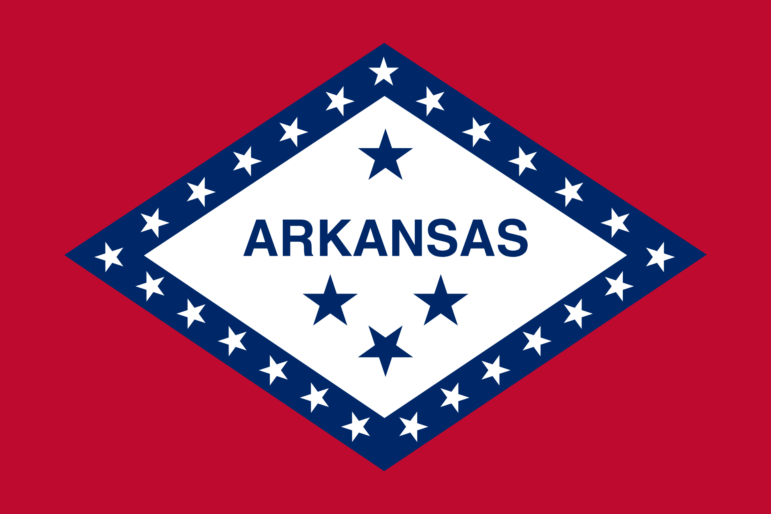
State Flag of Arkansas [public domain]
“This year’s changes show that the Religious Liberty in the States index is dynamic by design,” said Dr. Paul D. Mueller, associate director of the project. “Arkansas moved from sixth to first, and Tennessee moved from tenth to second, because both states adopted meaningful protections for religious liberty.”
The Religious Liberty in the States index is produced by the Center for Religion, Culture & Democracy (CRCD), an initiative of the First Liberty Institute, a conservative Christian legal organization that litigates religious liberty cases nationwide. According to the CRCD, its mission is to promote scholarship and public policy affirming religion as a public good and strengthening what it calls America’s “foundational freedoms.” The project is explicitly intended to serve as a resource for legislators and advocacy organizations by identifying statutory protections that states can adopt to strengthen religious liberty protections.
The report is transparent about its methodology and makes its complete database publicly available, making it a useful resource for comparing state religious liberty statutes. It evaluates fifty legal protections grouped into twenty safeguards and acknowledges that the weighting of those safeguards reflects methodological choices rather than objective measures.
It is important to recognize that the index measures statutory religious liberty protections, not necessarily the day-to-day experience of religious communities within a state.
That distinction is significant. Many of the safeguards, including Religious Freedom Restoration Acts, clergy privilege, protections for houses of worship, and school accommodations, are broadly accepted across the religious spectrum. Others, however, focus on more contested questions such as medical conscience protections, exemptions from participating in weddings, insurance mandates, and refusals involving abortion, contraception, or sterilization. States that adopt these exemptions receive higher scores, meaning the rankings reflect a particular understanding of religious liberty centered on statutory conscience protections.
Viewed through the lens of minority religions, including contemporary Pagan traditions, another limitation becomes apparent. Although the report states that it seeks to measure religious liberty for all faiths, most of its safeguards address legal questions more commonly encountered by Christian churches, ministries, faith-based schools, medical providers, and businesses. Consequently, it gives comparatively little attention to issues that frequently arise for minority religions.
The index does not evaluate issues such as prison and hospital access for minority clergy, military chaplaincy, protection of sacred lands, ritual fires or ceremonial tools, recognition of Pagan clergy, zoning protections for small congregations and covens, cemetery access, or protections against discrimination directed toward practitioners of non-traditional religions. These issues often represent the practical religious liberty challenges faced by Pagan, Heathen, Indigenous, and other minority faith communities.
Their omission does not make the report inaccurate; rather, it reflects that the index measures one dimension of religious liberty rather than the full range of religious liberty concerns experienced by America’s diverse religious communities.
The result is not necessarily an inaccurate ranking, but a narrowly focused one. The report offers a detailed assessment of one important dimension of religious liberty, state statutory conscience protections, but it should not be read as a comprehensive measure of how well every religious community can freely practice its faith. For minority religions, religious freedom often depends as much on legal recognition, accommodation, and equal treatment as it does on exemptions from generally applicable laws.
The Wild Hunt is not responsible for links to external content.
To join a conversation on this post:
Visit our The Wild Hunt subreddit! Point your favorite browser to https://www.reddit.com/r/The_Wild_Hunt_News/, then click “JOIN”. Make sure to click the bell, too, to be notified of new articles posted to our subreddit.