
TWH – The Wild Hunt generally doesn’t report on weather forecasts. After all, some members of our community maintain they have their own ways of influencing local weather.
Over the past week, however, our inbox has been filled with press releases from national weather agencies, agricultural organizations, humanitarian groups, and climate research services urging community organizations to help spread a common message: prepare for a developing El Niño that forecasters now believe could become one of the strongest on record.
This week, the U.S. National Oceanic and Atmospheric Administration’s Climate Prediction Center (CPC) made its strongest statement yet, opening its weekly advisory with the simple, almost understated declaration: “El Niño is present.” According to the agency, there is now a 97% probability that the event will reach strong or very strong intensity during the three-month period ending in December, with an 81% chance it will become a very strong event before gradually weakening during early spring 2027.
The CPC reports that sea surface temperatures across the central and eastern equatorial Pacific remain well above average and that atmospheric conditions now match those typically associated with El Niño, increasing forecasters’ confidence that the pattern will continue strengthening through the remainder of 2026.

The World – NASA/NOAA/GSFC/Suomi NPP/VIIRS/Norman Kuring, Public domain, via Wikimedia Commons
ENSO and El Niño?
El Niño is the warm phase of the El Niño-Southern Oscillation (ENSO), a naturally occurring cycle in the tropical Pacific Ocean that influences weather patterns around the globe. During El Niño, warmer-than-normal ocean temperatures develop across the central and eastern Pacific, altering atmospheric circulation and shifting the position of the jet stream.
Although El Niño originates thousands of miles from most of the world’s population, its effects ripple across continents, influencing rainfall, drought, tropical cyclone activity, and seasonal temperatures.
Scientists generally classify a “very strong” El Niño when Pacific sea surface temperatures exceed approximately 2°C above average. While the phrase “super El Niño” has become common in media reports, federal agencies generally use the formal designation “very strong.”
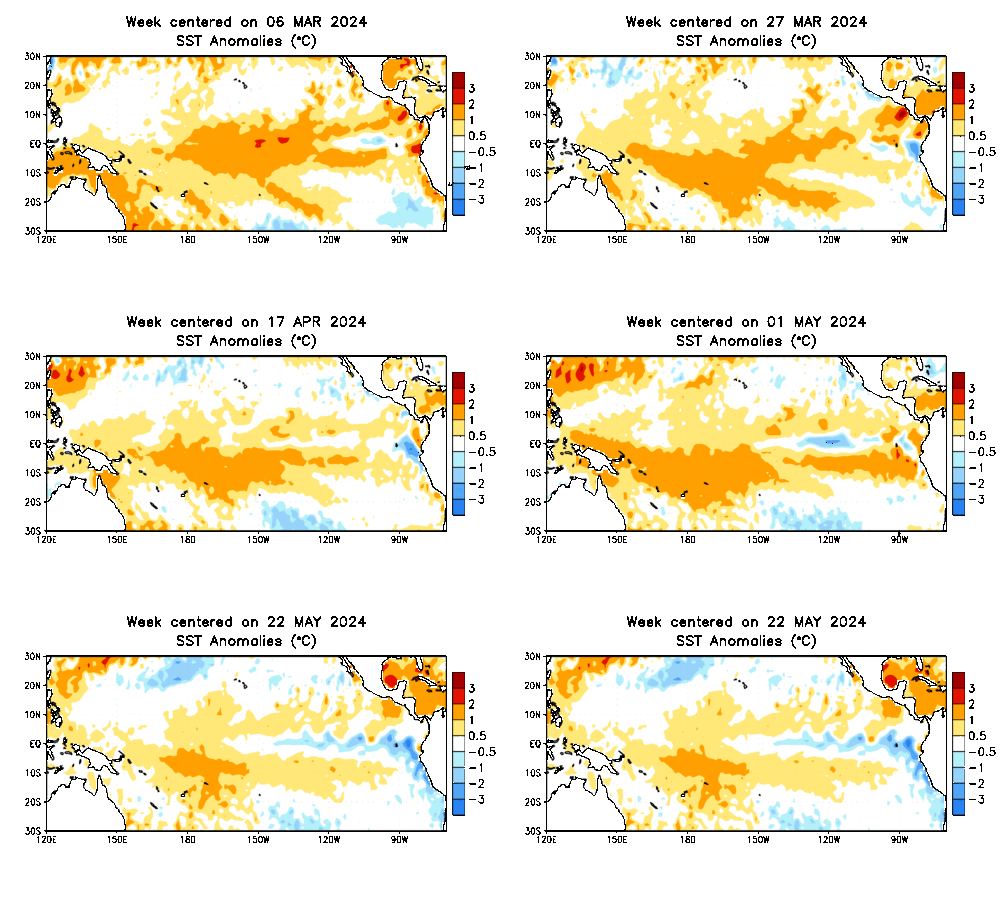
via U.S. National Oceanic and Atmospheric Administration’s Climate Prediction Center
What does it mean for North America?
The greatest impacts are usually felt during the Northern Hemisphere winter.
For the United States, the southern tier, including California, the Southwest, Texas, Gulf Coast states, and Florida, typically experiences wetter and stormier conditions than normal as the subtropical jet stream strengthens. Increased rainfall can reduce drought in some areas but also raises the risks of flooding, landslides, and severe winter storms.
Meanwhile, much of Canada and the northern United States often experience milder and drier winters, reducing snowpack while increasing the risk of drought and spring wildfires in some regions.
There is also some good news: El Niño tends to suppress Atlantic hurricane development because increased upper-level wind shear makes it more difficult for tropical cyclones to organize.
A global phenomenon
But we must be clear: El Niño’s effects are worldwide.
Australia frequently experiences some of El Niño’s harshest consequences as rainfall declines across much of the continent, increasing the likelihood of drought, extreme heat, and severe bushfire seasons.
Southern Africa often faces prolonged droughts that threaten agriculture and water supplies, while East Africa, including Kenya, Somalia, and Ethiopia, can experience unusually heavy rainfall that increases flooding, landslides, and outbreaks of waterborne disease.
The United Nations’ World Food Programme has warned that El Niño can simultaneously produce devastating drought in some regions while bringing destructive flooding to others, damaging crops, livestock, infrastructure, and transportation networks that support global food production.
Economic consequences
Beyond the weather itself, economists are increasingly focused on what some analysts have termed “climateflation.”
Several financial institutions have warned that reduced harvests, transportation disruptions, and higher agricultural production costs could place additional pressure on global food prices through 2027 and beyond. Crops considered especially vulnerable include rice, palm oil, sugar, coffee, cocoa, and wheat.
The combination of El Niño-related weather disruptions with ongoing geopolitical instability and higher energy costs has prompted analysts to caution that even relatively modest production shortfalls could produce disproportionate increases in commodity prices.
Planning
While global forecasts describe broad climate patterns, local impacts will vary considerably. Meteorologists emphasize that El Niño influences the odds of certain weather conditions rather than guaranteeing that any particular community will experience flooding, drought, or severe storms.
Emergency managers therefore encourage residents to pay close attention to local forecasts and preparedness guidance rather than relying solely on seasonal outlooks.
For Pagan communities, whose calendars include outdoor festivals, camps, rituals, and gatherings throughout the year, these forecasts provide another reminder that weather planning has become an increasingly important part of both event preparation and personal planning.
This El Niño will unfold at a time when forecasting technology is more sophisticated than at any point in history. Satellite observations, ocean monitoring networks, and increasingly accurate climate models provide weeks and months of advance warning that previous generations simply did not possess. Preparation, informed planning, and community resilience remain the most effective responses.
The risks are real, but so is our ability to prepare for them. The consistent advice from forecasters and emergency managers is straightforward: pay attention to local forecasts, heed emergency guidance, and make preparations before severe weather arrives.
As for the rest? As the late Jimmy Buffett advised, “a little gris gris keeps you safe from harm.”
The Wild Hunt is not responsible for links to external content.
To join a conversation on this post:
Visit our The Wild Hunt subreddit! Point your favorite browser to https://www.reddit.com/r/The_Wild_Hunt_News/, then click “JOIN”. Make sure to click the bell, too, to be notified of new articles posted to our subreddit.