
Blessed Turning of the Wheel!
 Tomorrow and over the weekend, across the Northern Hemisphere, many modern Pagans, polytheists, and Heathens will honor the sacred festival of Lughnasadh. The feast is also known as Lammas, Lughnasa, Lúnasa, or Harvest Home. Celebrated on or around August 1, this seasonal rite marks the first of three traditional harvest festivals, followed by Mabon and Samhain.
Rooted in Gaelic tradition, Lughnasadh commemorates the beginning of the grain harvest. Its name derives from the Irish god Lugh, a radiant figure of light and master of many arts, with craftsmanship, warfare, healing, and poetry among them. The festival also honors Tailtiu, Lugh’s foster mother, who is said to have cleared the land for agriculture before dying of exhaustion. The sacrifice reminds us of the toil behind every loaf of bread.
In the Norse tradition, this season is celebrated in honor of Freyr, the god of fertility, abundance, and peace. Freyr ensures the land’s prosperity and is closely associated with fruitful fields and golden harvests. Like Lughnasadh, the season is a time for feasting, games, songs, gratitude, and the offering of first fruits.
While these celebrations are ancient, their heart still beats strong. As Literata beautifully put it:
“Having enough food is a good thing to celebrate, and it’s downright fun. Having enough to get through the next season and be able to make both beer and bread is even better, and definitely deserves a party. But in this day and age few of us harvest any kind of food with our own hands… I think one result is that we tend to focus on the mystical meanings of bread and life while ignoring the seemingly mundane but fundamentally necessary part of the harvest: work.”
Indeed, Lughnasadh invites us not only to reflect on abundance but to recognize the labor, sacrifice, and community effort that sustains us.
This cross-quarter fire festival holds a liminal space between the Summer Solstice and the Autumn Equinox, a threshold time to express thanks for what has ripened in our lives and prepare for what’s yet to come.
Loaves of fresh bread are often offered in ritual as symbols of gratitude and transformation—grain that was once alive, cut down, and reborn through fire into nourishment.
As we reported earlier this year, archaeological and genetic research has shed fresh light on just how ancient our bread-baking traditions truly are. A study published in the Proceedings of the National Academy of Sciences suggests that modern bread wheat (Triticum aestivum) likely emerged about 8,000 years ago in what is now the South Caucasus through the natural hybridization of domesticated wheat with a wild grass. Excavations uncovered bread wheat remains dating to approximately 5800–6000 BCE, providing the first direct archaeological evidence supporting earlier genetic findings. Honoring our ancestors with bread at Lughnasadh, it seems, reaches back into humanity’s earliest agricultural history.
Meanwhile, in the Southern Hemisphere, the Wheel of the Year turns toward Imbolc, as winter begins to release its grip and the first whispers of spring awaken in the land.
Wherever you are on the Wheel, may your harvests be rich, physical, magical, and spiritual. May your heart be as light as the grain that sways in the summer wind.
Blessed Lughnasadh!



Saturn Retrograde is upon us!
 Saturn retrograde is an annual astrological period when Saturn appears to move backward across the sky. In reality, the planet does not reverse its orbit. This fascinating phenomenon is an optical illusion created as Earth, traveling much faster around the Sun, overtakes Saturn in its orbit. From our perspective, Saturn appears to slow down, stop, and briefly move backward against the background stars, even though it continues moving forward along its orbit around the Sun.
Over the next few months, Saturn will gradually become brighter and easier to observe as it approaches opposition, when Earth passes directly between the Sun and Saturn. At that point, the ringed giant will be near its closest approach to Earth and visible for most of the night.
In astrology, Saturn is associated with discipline, responsibility, structure, boundaries, and long-term goals. Rather than signaling external upheaval like Mercury retrograde is popularly believed to do, Saturn retrograde is often viewed as a quieter, more introspective period. Astrologers interpret it as a time to reassess commitments, review unfinished projects, strengthen foundations, and reflect on how well one’s actions align with long-term aspirations.
The 2026 Saturn retrograde began on July 26, 2026, and will run through December 10, just in time for Saturnalia. During this cycle, Saturn begins its retrograde in Aries, emphasizing themes of accountability, personal responsibility, and leadership. According to astrologers, the period encourages people to slow down, examine habits and priorities, establish healthier boundaries, and address lingering obligations before moving forward.
Some contemporary astrologers view Saturn retrograde as a period for reassessing relationships, personal boundaries, and long-standing commitments. Rather than emphasizing external events, many interpret the cycle as an invitation to examine unhealthy patterns, take responsibility for personal growth, and build more sustainable foundations for the future.
Rather than viewing Saturn retrograde as a negative influence, many see it as an opportunity for growth through patience, self-discipline, and thoughtful course correction.
Whether one views Saturn retrograde through the lens of astronomy, astrology, or both, the event offers a reminder that our perspective can shape what we perceive. Sometimes, what appears to be moving backward is simply the result of where we are or choose to be.
The Power of Money and the Witch
 Historically, women accused of witchcraft were often targeted for reasons that extended beyond alleged magic, including their economic and social independence. In a new essay adapted from her book Good Witch, author Lucianne Tonti argues in The Guardian that financial autonomy has long been a common thread linking women accused of witchcraft.
Tonti shares the story of Katherine Harrison, a wealthy seventeenth-century widow in colonial Connecticut who inherited property, successfully managed her farm, brewed beer, kept bees, and practiced astrology after her husband’s death. Rather than remarrying or surrendering control of her estate, Harrison maintained her independence, drawing the suspicion of her neighbors. Although the evidence against her was weak, she was ultimately convicted of witchcraft and banished.
Tonti places Harrison’s experience within a broader historical pattern documented by historian Carol F. Karlsen. Women who inherited land, accumulated wealth, or entered occupations traditionally dominated by men were disproportionately vulnerable to witchcraft accusations. Across Europe and colonial North America, women working as healers, brewers, midwives, and food producers often found their skills recast as evidence of witchcraft as social and economic systems increasingly marginalized women’s authority.
The essay argues that while witch trials have ended, the symbolic power of the word “witch” remains. Women who challenge established power structures, seek financial independence, or refuse prescribed gender roles may no longer face the stake, but they can still encounter suspicion, hostility, and attempts to undermine their credibility. Rather than a relic of history, Tonti suggests the figure of the witch continues to reflect enduring anxieties about female autonomy and power.
Events and Announcements
Do you have news to share with our community?
Announcements? Festivals? Elevations? Events?
We’ll share it with the community in the
TWH Events Calendar featured on the Front Page.
(Yes, it’s free, we just need your information.)
Let us know at pcn@wildhunt.org
More Events at our new Events Calendar
👉 Don’t forget: supporting The Wild Hunt helps sustain independent Pagan journalism.
As always, our deepest gratitude to everyone who has brought us this far.
Tarot of the Week by Star Bustamonte
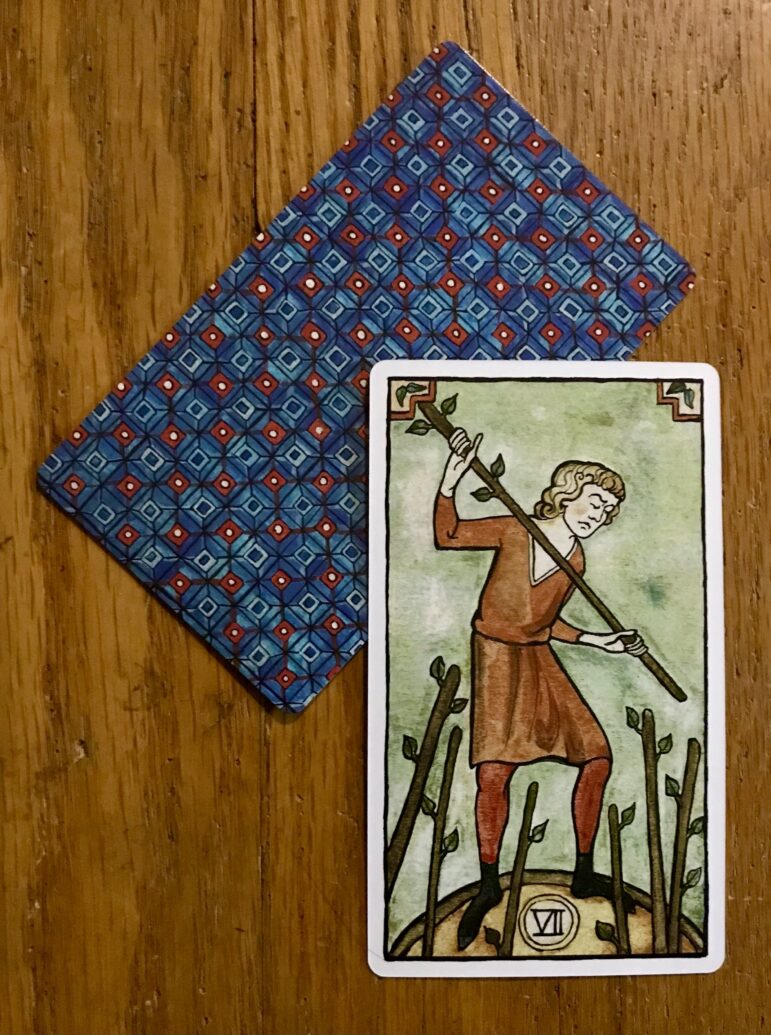 Deck: Verdance Tarot by Stephanie Pui-Mun Law, published by Llewellyn Publications.
Card: Six (6) of Swords – The Voyager
The week ahead may have all the earmarks of transition, and potentially herald an easier time after hard-won successes. Taking time to review and fully evaluate past actions and their impacts is liable to produce greater understanding, knowledge, and wisdom. Rest, retrospection, and healing that are all much needed are likely to be on the horizon.
Conversely, the need for a major change or shift is around the corner or already underway. Choosing to embrace a new direction or reality rather than fighting against it is likely to offer the best outcome and way forward. Releasing past issues to move forward may require resolving unfinished business, particularly old conflicts and wounds.
The Wild Hunt is not responsible for links to external content.
To join a conversation on this post:
Visit our The Wild Hunt subreddit! Point your favorite browser to https://www.reddit.com/r/The_Wild_Hunt_News/, then click “JOIN”. Make sure to click the bell, too, to be notified of new articles posted to our subreddit.