

Uncovering the Past
For many Pagans, the Wheel of the Year includes three great harvest festivals, and one of them is, in many ways, a bread holiday. The grain harvest has long symbolized survival, transformation, and reciprocity between humanity and the land. In traditions such as Wicca and Druidry, the first harvest festival, Lughnasadh or Lammas, from the Old English “hlaf-mas” or “loaf mass,” honors the turning of grain into bread, the labor of communities, and the sacred relationship between people and agriculture. Lughnasadh is still a few months away, but anytime there is a compelling story about bread, it tends to catch our attention.
Wheat, as a staple, cannot be underestimated for its impact on human society. Bread wheat, known scientifically as Triticum aestivum, today accounts for approximately 95% of global wheat production and consumption. Yet scientists have long noted that there was once a time when wheat resembled little more than grass before human communities recognized its extraordinary potential.
Who and when saw that potential has remained a mystery and topic of debate, though it is clear that domestication was gradual rather than a singular moment of recognition.
New research published last week in the Proceedings of the National Academy of Sciences (PNAS) is offering fresh insight into one of humanity’s oldest and most important relationships: the domestication of bread wheat. In “An independent center for the origin of bread wheat in the Neolithic period of Georgia in the South Caucasus,” researchers suggest that bread wheat likely emerged around 8,000 years ago in the South Caucasus region through a natural hybridization process between already domesticated wheat and a wild grass species known as goatgrass.
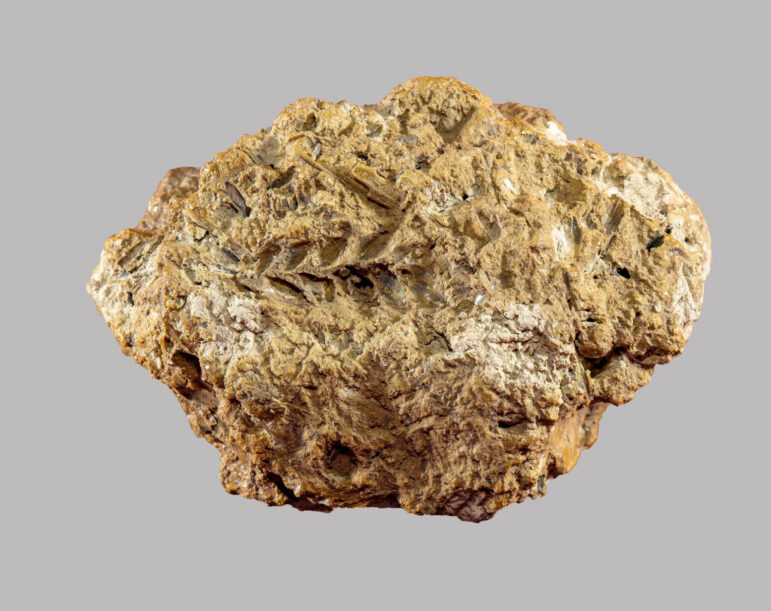
A mudbrick imprint via Georgia National Museum/ David Lordkipanidze
The study brings together archaeological evidence from the sites of Gadachrili Gora and Shulaveris Gora in present-day Georgia with earlier genetic studies that had already pointed to the South Caucasus and southwestern Caspian regions as likely origins for bread wheat. Previous DNA analyses of modern wheat and wild grasses had suggested that domesticated wheat crossed naturally with the wild grass Aegilops tauschii, eventually creating the hybrid that became modern bread wheat. However, until now, researchers lacked direct physical archaeological evidence supporting that theory.
The newly published research provides that missing link. Researchers recovered direct archaeological evidence of both bread wheat and goatgrass grains from securely dated Neolithic contexts associated with the Shulaveri–Shomutepe culture in Georgia, dating to roughly 8,000 years ago.
The research team was led by David Lordkipanidze, director of Georgia’s National Museum. Lordkipanidze said the discovery demonstrates that the people living in what is now Georgia were among the earliest sophisticated farming communities. He also connected the wheat findings to previous discoveries of ancient winemaking in the same region.
“Here we have 8,000 years of traces of bread wheat, as well as we found here some years ago 8,000 years of traces of wine making,” Lordkipanidze said. “So, we can say for sure that here in Georgia, we discovered traces of bread wheat and winemaking, which dates back 8,000 years.”
That pairing of bread and wine has attracted particular attention among researchers because both became foundational elements of agricultural civilization across Europe and the Near East. Lordkipanidze later noted, “This is the first place where you have this pairing of both bread wheat and wine.”
Researcher Nana Rusishvili, a paleoethnobotanist at Georgia’s National Museum, has studied archaeobotanical remains from Gadachrili Gora for decades. She explained that the samples revealed evidence of early domesticated wheat crossing with Aegilops tauschii, the wild grass species long suspected in wheat’s evolutionary history.
“This gives us the possibility to prove that on the Georgian territory, the bread wheat has been originated and as a result, Georgia is one of the centers of bread wheat domestication,” Rusishvili said.
The physical evidence itself required careful analysis. Charred grains of bread wheat resemble other wheat varieties, including durum wheat, making identification difficult. Researchers instead focused on the rachis, the stem structure that holds grains to the wheat ear, because its form differs among wheat species. After identifying bread wheat rachis remains, the team radiocarbon dated the material to between 5800 and 6000 BCE.

Image via Manny’s incessant bread-baking [MJTM
The communities connected to the sites belonged to the Shulaveri–Shomutepe culture, an early Neolithic culture in the South Caucasus. Archaeologists have uncovered circular mudbrick homes, stone tools, pottery, and decorative imagery, including grapes, serpents, and human figures.
Researchers describe this era as a period of agricultural experimentation. Farming practices that later became standard, such as crop rotation, fertilization, and drainage management, had not yet been fully developed. Communities often relocated temporarily when soil productivity declined, later returning after the land had recovered.
The region itself occupies a significant place in archaeological history. The South Caucasus forms part of the broader Fertile Crescent, often called the “Cradle of Civilization,” where some of the world’s earliest agriculture and urban societies emerged.
Now, about the butter.
The Wild Hunt is not responsible for links to external content.
To join a conversation on this post:
Visit our The Wild Hunt subreddit! Point your favorite browser to https://www.reddit.com/r/The_Wild_Hunt_News/, then click “JOIN”. Make sure to click the bell, too, to be notified of new articles posted to our subreddit.