
WASHINGTON — In 2025, President Donald Trump announced the creation of a White House Faith Office and a task force charged with eliminating what he described as “anti-Christian bias” within the federal government. The initiative was formalized through Executive Order 14202, “Eradicating Anti-Christian Bias,” which outlined grievances with the Biden administration and formally established the Task Force to Eradicate Anti-Christian Bias within the Department of Justice.
Trump asserted that agencies, including the Department of Justice, the FBI, and the IRS, had unfairly targeted Christians. “This task force will work to immediately halt all forms of anti-Christian targeting and discrimination within the federal government,” he said, adding that it would also ensure the prosecution of anti-Christian violence and vandalism.
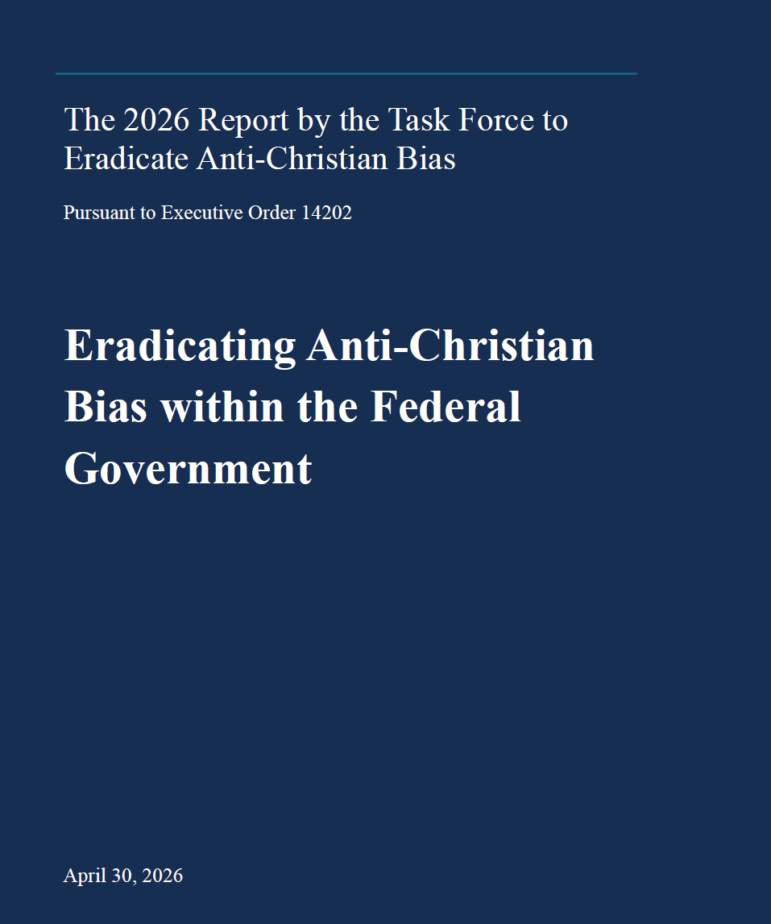
Task Force Report Cover
After a year of meetings, the task force released its 2026 report on April 30, a 197-page document accompanied by more than 200 pages of exhibits. The report states that the Task Force’s work will continue through 2027.
The report presents a sweeping interpretation of American history and governance, concluding that “our Nation’s origin and system of government bear the imprint of a Christian worldview and ethic,” and that Christian beliefs helped shape both the Constitution and the broader structure of American law.
From that foundation, the report argues that the Biden administration’s policies “regularly clashed with a Christian worldview and burdened traditional religious practices,” particularly in areas such as abortion, gender identity, and sexual orientation. It ultimately concludes that Christians were penalized for living in accordance with their beliefs.
Alongside these findings, the report advances a series of recommendations aimed at expanding what it describes as religious liberty protections. While framed as universally applicable, these proposals are rooted primarily in Christian experiences. Notably, the report does not appear to mention Paganism and does not substantively engage minority religious communities, even as it presents its conclusions as relevant to religious liberty more broadly.
This tension between universal framing and Christian-centered analysis runs throughout the document. The report defines harm, conflict, and accommodation almost exclusively through Christian contexts, raising important questions about how its recommendations may be interpreted and applied to minority faith communities, including Pagans.
Eight key policy directions emerge from the report, each carrying potential implications.
The report strongly supports expanding “conscience protections,” particularly in healthcare, employment, and public services. These protections would allow individuals and institutions to refuse participation in activities that conflict with their religious beliefs. For Pagan practitioners, this may strengthen the ability to request accommodations for ritual observance or ethical commitments tied to their traditions. At the same time, these protections could be used by others to deny services to Pagans, creating an uneven application of religious liberty.
It also criticizes the exclusion of religious organizations from federal grants and public programs and calls for expanded access to funding. In theory, this could open new opportunities for Pagan organizations to participate in public partnerships or receive financial support for community initiatives. In practice, however, funding structures often favor larger, well-established religious institutions, leaving smaller or decentralized traditions formally eligible but effectively sidelined.
Another major recommendation involves the expansion of federal “Faith Offices” and agency-level liaisons to engage religious communities. These structures could provide Pagan leaders with a formal channel for advocacy and representation within government. Yet such offices have historically operated within mainstream religious frameworks, which may result in Pagan traditions being overlooked or misunderstood.
Seal of the US Department of Justice
The report also calls for reframing enforcement priorities across federal agencies, particularly within the Department of Justice. It argues that Christian individuals and organizations were disproportionately scrutinized and seeks to rebalance enforcement. This shift could lead to greater caution in how the government approaches religious practitioners more broadly. However, if enforcement becomes more responsive to Christian claims specifically, minority religions may find themselves receiving less attention or protection when facing discrimination.
In addition, the report emphasizes stronger protections for religious expression in public spaces, including speech, attire, and symbolic displays. For Pagan practitioners, this could support greater visibility, such as the wearing of pentacles or the public practice of ritual. Yet increased visibility without consistent institutional support may also expose minority practitioners to misunderstanding or backlash.
Education policy is another focal point. The report critiques public school policies that it argues conflict with religious beliefs and promotes expanded parental rights, including opt-out provisions. Pagan families could benefit from increased flexibility in navigating religious differences within educational settings. Yet, these debates often center on dominant religious perspectives, potentially further marginalizing already limited representation of Pagan and other minority traditions in curricula.
The report also raises concerns about “debanking,” or the exclusion of religious individuals and organizations from financial services. Strengthened protections in this area could help safeguard Pagan organizations from account closures or financial discrimination. Still, informal barriers, such as reputational risk assessments, may continue to disproportionately affect minority religions.
Finally, the report criticizes zoning laws and land-use regulations that restrict religious activity and supports expanding protections for religious land use. This could benefit Pagan communities seeking to establish ritual spaces, temples, or land-based practices. However, local authorities often rely on narrow definitions of religion, which may continue to disadvantage non-institutional traditions.
Despite the breadth of its claims, the report remains less clear on how these recommendations will translate into concrete policy. Much of the document is devoted to grievances, supported by extensive exhibits, but it offers limited detail on implementation. Some actions already taken are largely symbolic, such as adjusting official messaging to include explicit references to Christian observances, for example, shifting from “Happy Holidays” to “Merry Christmas.” These changes are framed as affirming Christian inclusion, though critics note that Christmas is already a federally recognized national holiday.
Criticism of the report has been swift and pointed. Legal scholars and religious freedom advocates argue that it selectively interprets evidence to support a predetermined conclusion, reframing policy disagreements as religious persecution while overlooking broader patterns of discrimination affecting other groups.
Nick Fish, president of American Atheists, said, “True religious freedom — the kind our nation’s founders enshrined in the Constitution — protects and treats equally people of all faiths and of none. It’s very clear this administration is only concerned about Americans of a certain faith.”
Data cited by the organization reinforces those concerns. Nearly a third of respondents to the Secular Survey reported negative experiences in education due to their nonreligious identity, and more than 20% reported discrimination in the workplace, particularly in environments where religious conformity is expected.
American Atheists also warned that the administration’s framing of “anti-Christian bias” risks advancing a broader ideological agenda. The organization argues that the concept is being used to promote the narrative that the United States is inherently a Christian nation, to reframe civil rights protections for LGBTQ+ individuals as discriminatory, and to cast dissent from a particular religious worldview as improper or even unlawful.
Fish added, “The Trump Administration’s deliberate distortion of our American laws and values will have devastating consequences on pluralism, freedom, and democracy, all foundational pillars of our nation that distinguish us from the theocracies and autocracies abroad.”
Americans United for Separation of Church and State issued a similarly forceful response. President and CEO Rachel Laser said, “The Executive Summary alone confirms what we have been saying all along: The administration’s claims that it has uncovered extensive evidence of anti-Christian bias within the federal government are unfounded. Instead, the report just repeats the misleading examples the Trump administration has been using since Day 1.”
Laser continued, “The task force is doing exactly what we expected: imposing its narrow view of Christianity on the country and attacking freedom and equality, especially for women and LGBTQ+ Americans. All people, including Christians, should be able to live as themselves and believe as they choose so long as they don’t harm others. But rather than protecting religious beliefs, this administration has made clear it will misuse religious freedom to justify bigotry, discrimination, and the subversion of our civil rights laws. This is part of the Christian Nationalist crusade to remake our country. Not on our watch.”
Ultimately, the report raises a central question: whether expanding religious liberty through a framework rooted in a single faith tradition can truly serve a pluralistic society. While its recommendations may create new avenues for protection in theory, their application and the assumptions underlying them will likely determine whether they broaden inclusion or reinforce existing inequities.
The Wild Hunt is not responsible for links to external content.
To join a conversation on this post:
Visit our The Wild Hunt subreddit! Point your favorite browser to https://www.reddit.com/r/The_Wild_Hunt_News/, then click “JOIN”. Make sure to click the bell, too, to be notified of new articles posted to our subreddit.