
Author’s note: First of all, my apologies for this editorial intrusion. As I worked through this piece, I kept repeating that I could not believe I was writing it. And yet, here we are. I have done my best to maintain a journalist’s tone, but I will pre-apologize for the moments where incredulity breaks through.
It does that sometimes when the story insists. And, yes, the story insists.
WASHINGTON — Six months out from the midterm elections, the political landscape is shifting in ways that are difficult to ignore.
Recent polling paints a stark picture for President Donald Trump. According to a Washington Post–ABC News–Ipsos survey conducted in late April, his disapproval rating has climbed to 62%, the highest recorded in that poll’s history. His approval rating sits at 37%, with other surveys, such as Reuters/Ipsos, placing it even lower, at 34%. Aggregated polling averages tell a similar story, with roughly two-thirds of Americans expressing disapproval.
The CNN “Poll of Polls,” which aggregates several recent national surveys, reiterates the same trend: about 64% of Americans disapprove of President Donald Trump’s performance, while roughly 35% approve.
The erosion appears tied to a convergence of issues: the ongoing conflict with Iran, persistent concerns about inflation, and broader dissatisfaction with the cost of living. On the latter, the numbers are particularly stark. Roughly three-quarters of respondents report disapproval of the president’s handling of everyday economic pressures. Even among supporters, confidence appears to be fraying. Whether this represents a temporary dip or something more durable remains to be seen, but the trajectory is clear enough to draw attention and speculation.
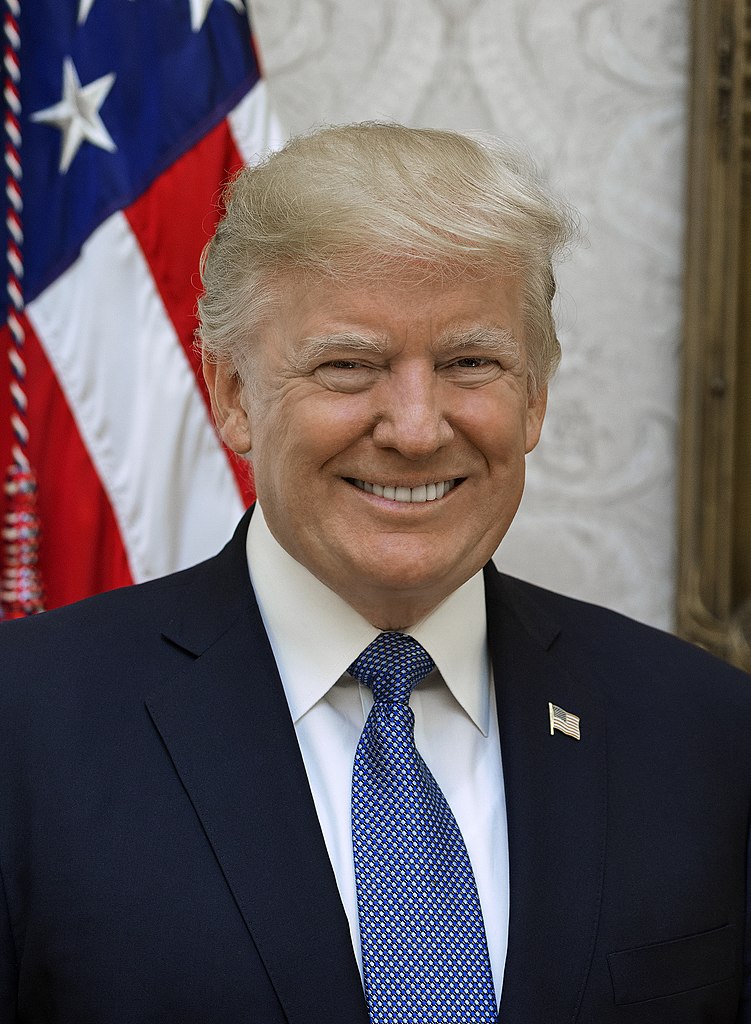
Official portrait of President Donald J. Trump, Friday, October 6, 2017. (Official White House photo by Shealah Craighead)
And speculation, dear reader, is never in short supply, especially if there’s something sorcerous in the works.
Into this moment steps Tucker Carlson, who, in a recent interview with The New York Times’s Lulu Garcia-Navarro, offered a reflection that, if nothing else, adds a surreal layer. Carlson, who has previously been a vocal supporter of Trump, now frames his observations with a degree of uncertainty, less about what he thinks and more about what he claims to have witnessed.
He describes a president who, despite holding the highest office, seemed constrained, aware of the consequences of his decisions yet proceeding as though he had no real alternative. Carlson interprets Trump’s reassurances like “everything’s going to be OK,” not as confidence, but as a kind of rationalization from someone who feels boxed in.
There’s so much more. Carlson ventures further.
Reflecting on Trump’s personal influence, he says it carries “a kind of quality that he has that’s spellbinding… I think it probably literally is a spell.”
The effect, he argues, is to leave those around the president more compliant, more confused, and less likely to push back. It is, he suggests, something he has experienced firsthand. He adds that he is “not a theologian,” but that Trump’s effect seems to have a “supernatural component.” Moreover, “it’s real.”
Yes, that is a paragraph I just typed. Trump is being accused of spellcraft. By Tucker Carlson, no less.
Carlson’s comments do not exist in isolation. They land in a broader environment where political rhetoric has increasingly blurred the line between metaphor and literal belief, particularly when it comes to language about religion, morality, and “evil.”
Consider Iowa, where Republican gubernatorial candidate Adam Steen has leaned fully into that framing. In a recent campaign advertisement, Steen positions himself as a defender of “good” against “evil,” promising to “keep the Satanists out of the Capitol” and to protect children from what he describes as ideological threats. The imagery is not subtle. It recasts political disagreement as spiritual warfare.
Steen’s rhetoric also extends beyond Satanic imagery to broader cultural anxieties, including warnings about Sharia law, claims that echo long-standing Islamophobic tropes and remain untethered from any credible policy reality in the state. Yet the effectiveness of such language does not depend on accuracy. It depends on resonance.
A cauldron seated on stones in a field [Pixabay]
Meanwhile, in Minnesota, My Pillow CEO and conservative political activist Mike Lindell has entered the gubernatorial race with a similar approach. In an interview on Steve Bannon’s “War Room” podcast, Lindell identified his top priority not as economic policy or infrastructure, but as banning Sharia law and removing what he described as “satanic” displays from the state capitol.
The latter claim refers to a permitted display by members of The Satanic Temple during the 2024 holiday season, an event that, while controversial in some circles, was legally authorized under existing First Amendment protections. The display was temporary, lasting approximately two weeks. But in the telling of political actors, it has taken on a life far beyond its actual footprint.
And this is where the threads begin to converge.
What we are seeing, increasingly, is not simply a collection of isolated statements or campaign tactics. It is the reemergence, possibly a reimagined version, of a familiar narrative: the Satanic Panic. Unlike its 1980s predecessor, which fixated on heavy metal music and role-playing games, today’s version operates in a digital and political ecosystem. It moves quickly, scales easily, and finds amplification in both media and legislation.
Its core mechanism, however, remains the same. It frames social change as an existential threat. It casts political opponents not as misguided, but as malevolent. And it mobilizes voters not through policy proposals, but through fear, specifically, fear rooted in religious and moral language.
In this context, Carlson’s “spellbinding” comment, whether intended literally, metaphorically, or somewhere in between, feels less like an outlier and more like a symptom. It reflects a broader willingness to interpret political dynamics through a supernatural lens, or at least to borrow that language for effect.
That shift carries consequences.
When political discourse adopts the vocabulary of possession, corruption, and spiritual warfare, it becomes harder to engage in the ordinary work of governance and easier to mobilize voters through fear.
Compromise looks like capitulation. Opposition looks like heresy. And power, once framed as something granted by voters and constrained by institutions, begins to take on a different character entirely.
There will undoubtedly be more to this story as the election cycle unfolds. For now, it is enough to note the pattern, and perhaps to resist the urge to treat it as normal.
Carlson may speculate about sorcery, but what is actually being communicated is something far more familiar: vote in fear.
There will undoubtedly be more. Stay tuned. We’ll cover it.
The Wild Hunt is not responsible for links to external content.
To join a conversation on this post:
Visit our The Wild Hunt subreddit! Point your favorite browser to https://www.reddit.com/r/The_Wild_Hunt_News/, then click “JOIN”. Make sure to click the bell, too, to be notified of new articles posted to our subreddit.