

While continuing my mission to fill up my National Parks passport book, I visited Fort Vancouver National Historic Site this spring, in Vancouver, Washington, on the north side of the Columbia River from Portland, Oregon.
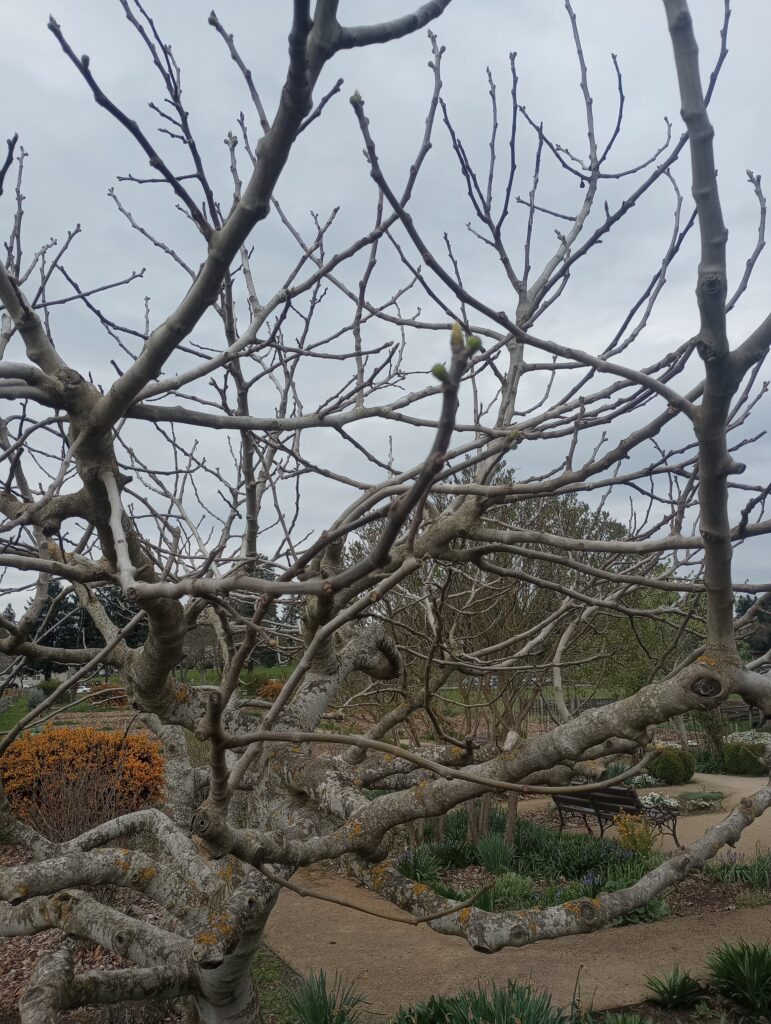
A barren tree outside of Eugene, Oregon [M. Fischer]
Outside the fort walls, I learned how the Hudson Bay Company once oversaw a five-to-eight acre garden of crops to support the fort’s population. Many of the crops were of European origin, grown with Old World agricultural methods. Interpretive signs mentioned crop failures and food shortages.
My food-obsessed partner, who will hopefully get their degree in culinary anthropology one day, questioned why so many of the settlers of North America seemed so uninterested in native food sources, focusing mostly on Old World sources of food that weren’t necessarily adapted for the climates and terrains of Turtle Island. “It’s like after the Colombian Exchange happened and a few key New World ingredients were adopted by Europeans, they just stopped being interested,” they said.
I was instantly inspired. I’ve wanted to consume more foods that are indigenous to the land I live on for a long time, but accessibility is limited if you’re not a full-time DIY-er. I once found a source of acorn flour for $50 a pound – understandable at the scale it was probably being produced, but cost prohibitive for most of us. But if anywhere was going to have a Native American restaurant, I figured it would be Portland, and I was right – there were two!
That is how I came to have a happy belly the next few days, full of a smoked bison sandwich and salmon chowder from 7 Waters Sovereign Foods, and elk fry bread with huckleberry sauce alongside Sonoran wheatberry salad and tapery bean dip at Javelina Indigenous Dining. Not only did this food feel healthier and more nourishing than a lot of what is on offer at many restaurants (fry bread aside), a powerful aspect of this experience was that eating it did not make me want to dissociate due to the moral injury of complicity in factory farming.
My journey with the consumption of animals has been fairly tortured. I became vegetarian at 12, but 15 years later I was just bored of tofu, tempeh, seitan, and beans as my only protein sources (two of those products being beans in another form). My awareness of other ethical issues involved in food production, such as plastic packaging, carbon footprints, habitat destruction from monocropping, and farm worker labor conditions had steadily increased. Limiting my consumption of food to that which checked all the ethical boxes had become an impossibility, even if I aspired to do the best I could to purchase local, or organic, or even regenerative-agriculture produced food. Eventually it stopped making sense to deny myself easy sources of dietary variety. I began to share meals with my omnivorous partner when I could no longer believe that vegetarianism was my key to staying morally pure.
But knowing intellectually that food-related ethical considerations extend beyond animal welfare hasn’t made me feel better about eating meat, either, especially if I have any suspicion the animals have unduly suffered. Knowledge of such suffering does not lend itself well to a mindful prayer of gratitude before a meal. It often made me want to cry, or it turned my stomach.
Yet while consuming the bison and salmon from 7 Waters Deli, I was able to eat mindfully without guilt. I tuned into the web of life with a greater sense of harmony in myself, imagining the rivers around me that have sustained life in a plentiful fashion for millennia. Similarly, the wild-hunted elk at Javelina may have supported a native hunter to continue relating to this land in a harmonious dance of give and take, rather than enriching the pockets of some anthropocentric cattle rancher who only sees the animals they profit from through the dominion-lens: as a commodity, rather than kin to be respected. I’ve encountered this second attitude plenty, including in the Animal Science class that pushed me toward consistently shelling out for Certified Humane labels, due to its exposure of the callous disregard with which animals are often treated in the ranching industry.
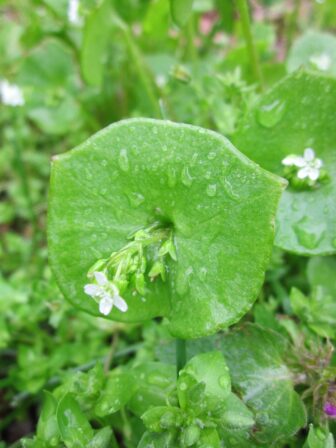
Miner’s lettuce [Pixabay, Wikimedia Images]
As I continued traveling Oregon this April, I connected more deeply with the traditional foodways of the Pacific Northwest, and other conscientious approaches to food. At the Eugene farmer’s market, I was able to purchase a familiar “face” from many a native plant walk: miner’s lettuce! I’ve long enjoyed munching on this native plant when I find it growing wild in enough abundance to go around, sometimes with Annie’s dressing on top, but had never seen it sold before. That same farmer’s market provided tallow-based body butter, Dakota black popcorn, and hazelnuts for which a portion of the profits were invested in habitat restoration. It was a balm to my soul to be around other humans who share my deep, often unmet, longing to nourish ourselves in ways that minimize harm, and ideally help, the web of life.
That same week, my partner got a tip at the Museum of Natural and Cultural History about another museum on the Warm Springs Reservation. On our way to the Painted Hills and John Day Fossil Beds the following week, we detoured to see the Museum at Warm Springs. The museum itself is well worth seeing, including its information about traditional sources of sustenance in this region, like camas roots.
But the highlight of our day on the reservation was a trip across the street to a little store – Salmon King Fisheries – that sold canned and dried salmon as well as beads and beadwork. The proprietor shared with us about the traditional nets she uses to catch salmon, that do not lead to distressed thrashing around of caught fish, and shared some piki bread she had been sent by a Hopi friend. Heartened by this peak into ways that traditional trade routes are kept alive in modern times, we stocked up on cans to send to friends and traditional wind-dried salmon – as displayed in the museum in replica, now edible! – to nourish us on the rest of our trip.
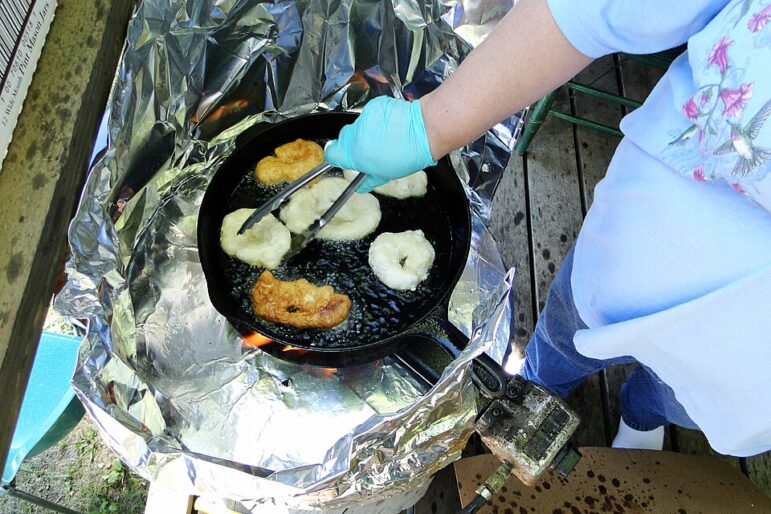
Frybread being cooked in a cast-iron skillet during a funeral potlatch in Tanana, Alaska [FairbanksMike, Wikimedia Commons, CC 2.0]
Inspired by connecting to this web of wholesome food sources, I looked up Indigenous restaurants in the San Francisco Bay Area, where I regularly spend a fair amount of time when home in California. I have now been lucky enough to enjoy pumpkin seed mole at Wahpehpah’s Kitchen in Oakland, and have more Native restaurants on my radar for when I visit Minneapolis later this year.
I have spent so much energy in my life and activism fighting against things I don’t want. There is a time and a place to hold boundaries against harmful things, but of late I am enriched by focusing more on what I do want to see more of in the world. Eating a few meals from some Indigenous restaurants and shopping at farmers’ markets is not a solution to all the world’s problems, but I think any move toward being in a more conscientious relationship with the land and beings around us is a step toward repairing the schism between much of human civilization and the rest of this planet.
I’m also not expecting perfection. If I’m passing through a food desert, I’ll take the monocropped nuts from a convenience store and thank them for getting me through my day. This is what I often did in my college years when I availed myself of food pantry bags full of off-brand mac-and-cheese and white bread. I already knew these products were part of a broken food system, but I thanked them for nourishing me in the short term and prayed that I would use the energy they gave me to get to another day and move forward, to help heal what is hurting in the world. I am grateful to see now that my prayers seem to have been answered.
The Wild Hunt is not responsible for links to external content.
To join a conversation on this post:
Visit our The Wild Hunt subreddit! Point your favorite browser to https://www.reddit.com/r/The_Wild_Hunt_News/, then click “JOIN”. Make sure to click the bell, too, to be notified of new articles posted to our subreddit.