The 2026 COVR Winners Announced!

The Coalition of Visionary Resources (COVR) has announced the winners of the 2026 COVR Visionary Awards, recognizing excellence across the Mind, Body, Spirit (MBS) marketplace. Presented annually by COVR, the awards honor outstanding books, card decks, media, products, practitioners, retailers, and creators whose work supports spiritual growth, personal transformation, and holistic living. Winners are selected through a combination of industry judging and public participation, making the awards one of the most visible recognitions in the MBS community.
This year’s awards included strong representation from Pagan, Witchcraft, Tarot, and esoteric publishing communities. Among the notable winners, Madame Pamita’s The Witch’s Guide to Animal Familiars captured multiple honors, including Contemporary Spirituality, Pets & Animal Books, Book Cover Design, and the coveted Book of the Year award. Christopher Penczak’s Goddess of the Cauldron received Gold in the Shamanism & Paganism category, while Jessica Lahoud’s Practical Guide to Magic in Nature won Gold for Witchcraft & Magick.
Several well-known Pagan authors and creators were among this year’s honorees. Christopher Penczak received Gold in the Shamanism & Paganism category for Goddess of the Cauldron, while Mat Auryn, Ivo Dominguez Jr., and Devin Hunter shared Gold in the Iconic Books category for the deluxe hardcover edition of Psychic Witch. Michelle Welch earned Gold for A Psychic’s Handbook: Methods and Advice for Communicating with Spirits and was also recognized as a Gold-winning Social Media Personality. Lorriane Anderson and Juliet Diaz’s Seasons of the Witch: Ostara Oracle won Gold for Oracle Card Decks and went on to receive Card Deck of the Year honors. Pagan author Gypsey Elaine Teague also received a Bronze award in the Alternative Science Books category for Norse Cosmology: A Compendium. Publishing houses familiar to many readers, including Llewellyn Worldwide, Rockpool Publishing, Hay House, U.S. Games Systems, and Inner Traditions, were recognized across numerous categories.
Special “Of the Year” awards recognized The Witch’s Guide to Animal Familiars as the Industry Choice Book, People’s Choice Book, and overall Book of the Year, while Seasons of the Witch: Ostara Oracle claimed both Industry and People’s Choice honors for card decks before being named Card Deck of the Year.
Congratulations to all of this year’s winners, finalists, publishers, artists, and creators who continue to enrich the contemporary Pagan and spiritual landscape. A complete list of winners is available on the COVR website.
A word from Oz

Oberon & Rhiannon Zell at the “No Kings!” rally in Asheville, NC [Photo: Courtesy
ASHEVILLE— In a forthcoming essay for Green Egg, Pagan Elder and Co-Founder of the Church of All Worlds, Oberon Zell reflects on diversity and inclusion as defining characteristics of the modern Pagan movement. Drawing on both historical and contemporary perspectives, Zell argues that Paganism’s inherently pluralistic nature has fostered a religious culture that values diversity, personal freedom, and respect for differing traditions.
The essay explores broad definitions of Paganism, describing it as an umbrella term encompassing many Earth-centered, polytheistic, animistic, and indigenous spiritual traditions. Zell notes that while Pagans follow a wide variety of paths and practices, many share common values including reverence for nature, gender equality, personal responsibility, and the celebration of human diversity.
Highlighting the wide spectrum of Pagan traditions, Zell points to groups organized around different cultural, spiritual, and identity-based experiences, including traditions centered on specific ethnic heritages, women’s spirituality, LGBTQ+ communities, and inclusive interfaith organizations. He argues that affinity groups have long played an important role within Paganism and that communities should be free to define their own membership while maintaining mutual respect across traditions.
The essay also traces the development of Pagan ecumenical organizations over the past half-century, including the Covenant of the Goddess and other councils formed to promote cooperation among diverse Pagan paths. According to Zell, these organizations have generally sought to oppose discrimination and foster welcoming spaces for practitioners of varied backgrounds.
Concluding with a call for unity, Zell cautions against internal divisions that can weaken the broader Pagan movement. While acknowledging disagreements among traditions, he urges Pagans to focus on shared values, mutual respect, and collaboration in the face of external challenges.

Guardian Article on Witchcraft Generates Comments and Controversy

Guardian logo
A feature article in The Guardian examines the growing popularity of Witchcraft retreats among American women seeking spiritual community, personal empowerment, and alternatives to traditional religious institutions.
Set in the Irish countryside, the article follows participants attending a retreat led by author and spiritual mentor Isabella Ferrari, known as “Penny the Witch,” where women gather for rituals, divination, meditation, and discussions centered on magic, folklore, and self-discovery. The retreat reflects a broader trend in which women are turning to contemporary forms of witchcraft as a response to feelings of isolation, disillusionment with organized religion, and dissatisfaction with patriarchal social structures.
Participants describe finding a sense of belonging, mutual support, and spiritual agency through practices that emphasize intuition, connection to nature, and communal ritual. Many attendees come from Christian backgrounds but say they no longer feel represented by traditional churches or religious institutions.
The article situates these retreats within the wider resurgence of modern Witchcraft, noting that Ireland’s landscapes, folklore, and associations with Celtic traditions make it an especially attractive destination. Activities include forest rituals, storytelling, divination, and ceremonies inspired by both contemporary Pagan spirituality and local folklore. Organizers describe the retreats as spaces for healing, reflection, and reconnecting with the natural world rather than as escapes into fantasy.
The social media response to the article was highly polarized, but several clear themes emerged. Many commenters expressed support for women-centered spiritual spaces, nature-based practices, and contemporary Witchcraft, while critics questioned the retreat’s cost, claims about communicating with the dead, or the commercialization of spirituality. Others responded from explicitly Christian perspectives, citing biblical condemnations of witchcraft.
Many commenters viewed the retreat as an example of women reclaiming spiritual authority and building community outside traditional religious structures. Several noted that the hostile reactions from male commenters seemed to reinforce the article’s discussion of patriarchy and women’s anger. Many defended Paganism and witchcraft as legitimate spiritual paths and welcomed the positive media attention.
Sara Amis offered perhaps the most widely shared Pagan critique. While acknowledging why such retreats appeal to women, she objected to charging approximately $3,000 for experiences that she and her friends practiced informally and freely for years. At the same time, she argued that the hostile comments demonstrated exactly why women continue to seek these spaces, writing that some people seem threatened by women expressing anger or trusting their own feelings.
Caroline Tully was more pointed in her criticism. Responding to concerns about expensive “Instagram witch” culture, she remarked that “The witch wound is lucrative” and later agreed with another commenter that the retreat appeared to be “all about wallowing.” Her comments suggest skepticism toward the commercialization of trauma narratives and healing language within contemporary spiritual movements.
Sorita d’Este entered a discussion about religion and belief. When one commenter repeated the common claim that people who stop believing in God will “believe in anything,” d’Este responded succinctly: “Actually, we do not stop believing in God – we just realise there are many gods.” Her comment reframed the discussion from atheism versus religion to a polytheistic perspective, emphasizing that many Pagans do not reject divinity but instead embrace multiple deities.
The discussion revealed a notable divide between mainstream perceptions of Witchcraft and responses from experienced Pagans. While some celebrated the visibility of women-centered spirituality, prominent Pagan voices largely focused on issues of commercialization, authenticity, and correcting misconceptions about Pagan beliefs.

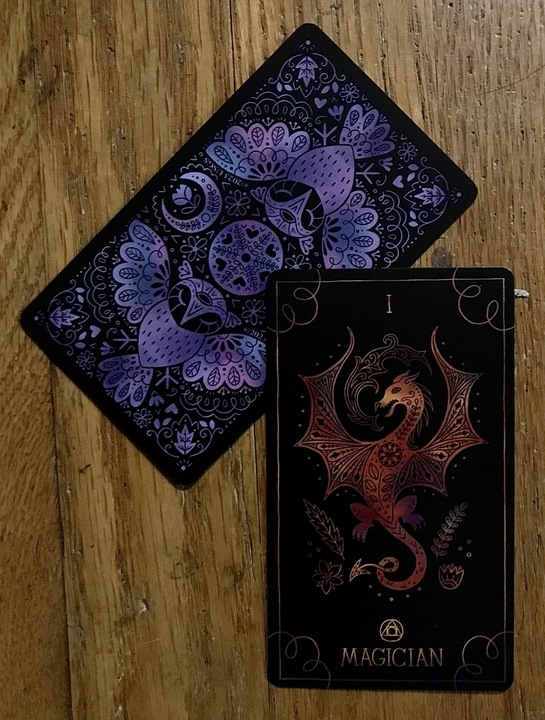 Deck: Folk Lore Tarot, by Rowan Ortins, published by U.S. Games Systems, Inc.