

Uncovering the Past
ROME — Archaeologists working at opposite ends of the Mediterranean have uncovered two remarkable artifacts that offer new insights into how ancient cultures expressed identity, status, and their relationship with the divine. One discovery comes from the Spanish coast, where a Roman-era marble head believed to depict Venus emerged during excavations near Alicante. The other comes from ancient Antioch in modern-day Türkiye, where a funerary monument reveals how a woman was memorialized through imagery associated with the city’s patron goddess, Tyche.
The discoveries, separated by more than a thousand miles and several centuries, nonetheless illustrate the enduring role that divine imagery played in everyday life across the ancient Mediterranean world.
In Antioch on the Orontes, one of the great cities of the Hellenistic East, researchers have completed a detailed study of a 2,100-year-old funerary stele discovered during rescue excavations in 2017. The marble monument, now housed in the Hatay Archaeology Museum, depicts two women framed within a temple-like architectural setting.
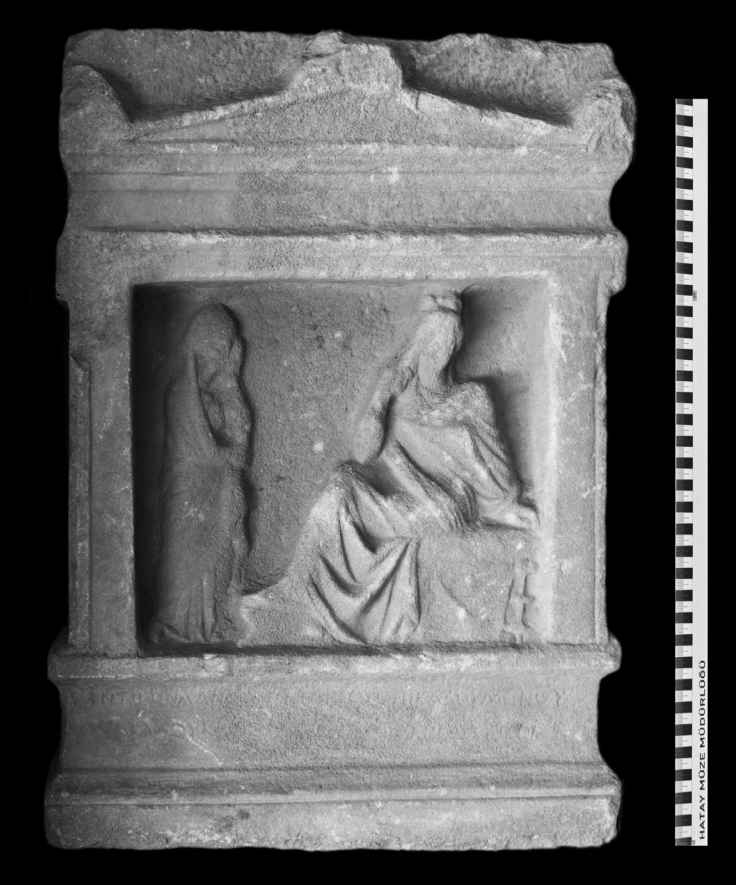
Funerary Steele via Çekilmez, İğrek & Çelikay (2026), OLBA
The most prominent figure is seated and identified by inscription as a woman named Antigona. What immediately caught researchers’ attention was her resemblance to the famous Tyche of Antioch, the protective goddess who served as the city’s symbolic guardian. The original statue of Tyche, created by the sculptor Eutychides of Sicyon in the early Hellenistic period, became one of the most recognizable civic images in the ancient world.
Tyche, the goddess of fortune, chance, providence, and luck, was among the most important symbols of Antioch. However, Antigona is not portrayed as a goddess herself. She lacks Tyche’s defining attributes, including the river god Orontes beneath her feet and the elaborate mural crown that symbolized the city’s walls. Instead, she adopts a modified version of the goddess’s seated pose, wearing a modest polos crown and seated on a simple stool.
According to researchers, the imagery appears to deliberately associate the deceased woman with Antioch’s most prestigious civic and religious symbol while maintaining her status as a mortal citizen.
A smaller standing female figure faces Antigona from the opposite side of the relief. Dressed in garments associated with the Pudicitia tradition, a visual language of modesty, dignity, and mourning, the second figure may represent either a relative or an attendant participating in the farewell.
The monument’s temple-like frame further enhances its symbolic significance. The women appear within a naiskos, a miniature architectural structure resembling a sacred shrine. Such settings were common in Hellenistic funerary art and often suggested ideas of immortality, remembrance, and continued existence beyond death.
Stylistic analysis places the stele between approximately 150 and 100 BCE, during the Late Hellenistic period. The monument provides a rare glimpse into how elite women in Antioch could be remembered through visual associations that connected personal identity, civic belonging, and religious symbolism.
While Antioch’s stele speaks to memory and commemoration, a newly uncovered sculpture in Spain reveals how divine imagery also occupied the domestic spaces of the Roman world.
At La Almadraba Beach in Alicante, archaeologists conducting excavations ahead of a coastal regeneration project uncovered a marble head believed to depict Venus, the Roman goddess of love, beauty, fertility, and prosperity. The sculpture was found within an archaeological zone where the remains of a Roman villa had previously been identified.
Measuring approximately 9 inches by 8 inches (22 centimeters high and nearly 20 centimeters wide), the marble bust is believed to date from the first or second century CE. Archaeologists believe the sculpture may once have adorned the home of a wealthy Roman family, either in nearby Lucentum or in one of the villas that dotted the surrounding coastline.
Nayma Beldjilali, Alicante’s Councillor for Culture, described the find as one of exceptional importance.
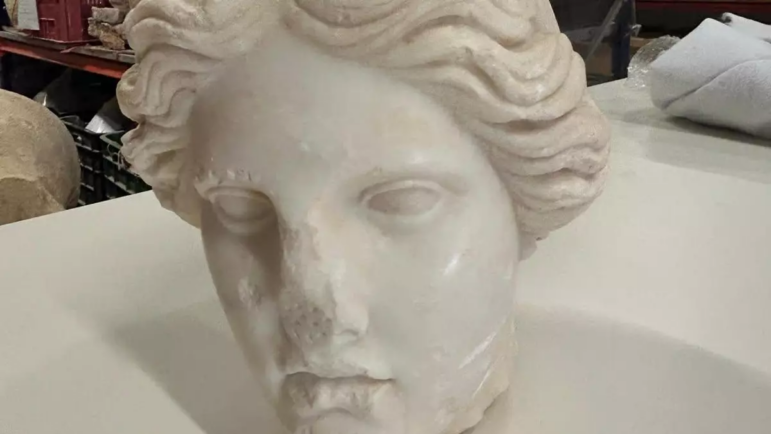
The bust of a Roman sculpture found during the construction work on Almadraba beach in Alicante. Alicante City Council
“It is a Roman head of great artistic quality and in an excellent state of conservation that, according to experts, probably represented Venus,” she said. “This could be one of the most important-ever discoveries of a Roman sculpture in Alicante province.”
José Manuel Pérez Burgos, the city’s Head of Integral Heritage, noted that the sculpture’s hairstyle reflects strong Hellenistic influences. The wavy hair, gathered back and parted at the center, closely follows artistic models associated with Aphrodite, the Greek counterpart of Venus.
Archaeologist José Ramón Ortega, who has worked on excavations across Spain for nearly four decades, described the discovery as unlike anything he had previously encountered. “In nearly 40 years as an archaeologist… we have never found anything like this.”
The discovery also reflects the cultural blending that characterized the Roman Empire. By the first and second centuries CE, Greek artistic traditions had become deeply integrated into Roman religious and domestic life. Representations of Venus often drew heavily upon earlier Greek portrayals of Aphrodite, creating a shared visual language that stretched across the Mediterranean.
Separated by centuries and geography, both discoveries reveal a common thread running through Mediterranean antiquity: the divine was not confined to temples alone. It was present in homes, cemeteries, public identity, and personal remembrance, woven into the ways people understood themselves and their place in the world.
The Wild Hunt is not responsible for links to external content.
To join a conversation on this post:
Visit our The Wild Hunt subreddit! Point your favorite browser to https://www.reddit.com/r/The_Wild_Hunt_News/, then click “JOIN”. Make sure to click the bell, too, to be notified of new articles posted to our subreddit.