
NEMI, Italy — The town of Nemi celebrated its 93rd annual Strawberry Festival (Sagra delle Fragole) on Sunday. According to local officials, attendance approached 62,000 visitors to the picturesque hilltop town nestled in the Arician Woods and overlooking Lake Nemi, the ancient “Mirror of Diana.”
For a day, the narrow streets of the town were filled with music, traditional costumes, flowers, and, of course, strawberries. Visitors crowded the historic center while local residents continued a tradition that has become one of the most recognizable festivals in the Alban Hills.
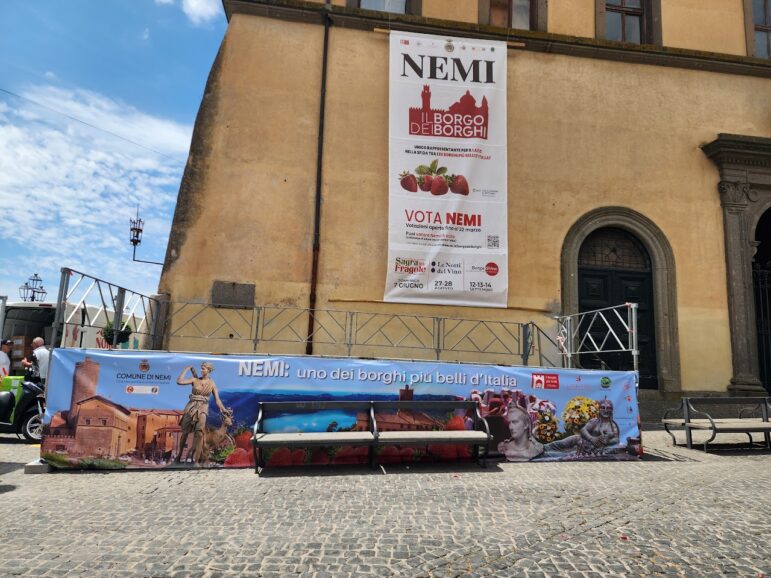
Nemi in preparation for the Sagra delle Fragole . Photo Credit: S. Ciotti
Although today’s festival is a secular celebration of Nemi’s famous strawberries, many of its themes would have been familiar to the ancient inhabitants of the region. Although first held in 1925, this year’s event marked the festival’s 93rd celebration, reflecting interruptions caused by war and public health emergencies.
The festival opened with a blessing from the local priest, the singing of the Italian national anthem, and a ribbon-cutting ceremony led by Nemi Mayor Alberto Bertucci, who welcomed visitors alongside local and regional dignitaries.
Viewed through a Pagan lens, the festival is easily recognizable as a first-harvest celebration. It celebrates fertility, abundance, and the successful gathering of the season’s harvest. In many ways, it reflects traditions that long predate Christianity and connect the community to the agricultural rhythms that have shaped life in the Alban Hills for centuries.
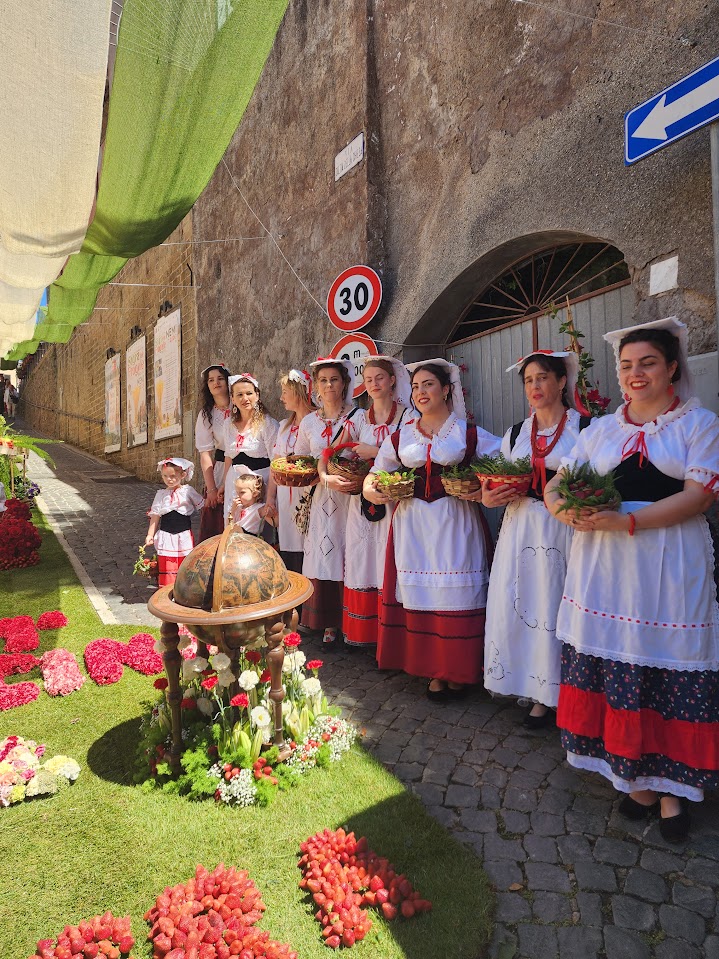
The Fragolare [Photo Credit: MJTM]
The modern Sagra has no formal religious connection to Diana Nemorensis, the ancient goddess whose sanctuary once dominated the shores of the lake below. Yet Diana remains impossible to ignore in Nemi. Her image appears throughout the town on municipal symbols, public art, tourism materials, and local businesses. Even after nearly two millennia, the goddess remains centrally woven into the identity of the community.
The annual event coincides with the peak strawberry season in the Alban Hills and honors the agricultural traditions that made Nemi famous throughout Italy. Central to the festivities are the fragolare, young women dressed in traditional costume who parade through the town and distribute strawberries to visitors. The custom recalls generations of local women who harvested the prized fragoline di Nemi, the small, intensely sweet wild strawberries that thrive in the area’s volcanic soil and unique microclimate.
Historically, the strawberry harvest represented an important source of income for local families. The festival became a way of celebrating both the fruits of the land and the people whose labor made the harvest possible.
One of the enduring symbols of the Sagra is the sharing of strawberries themselves. Massive quantities of fresh berries are distributed, sold, and displayed throughout the festival, transforming the harvest into a communal celebration of abundance. There is even a new local gin, Gincosta, celebrating Diana.
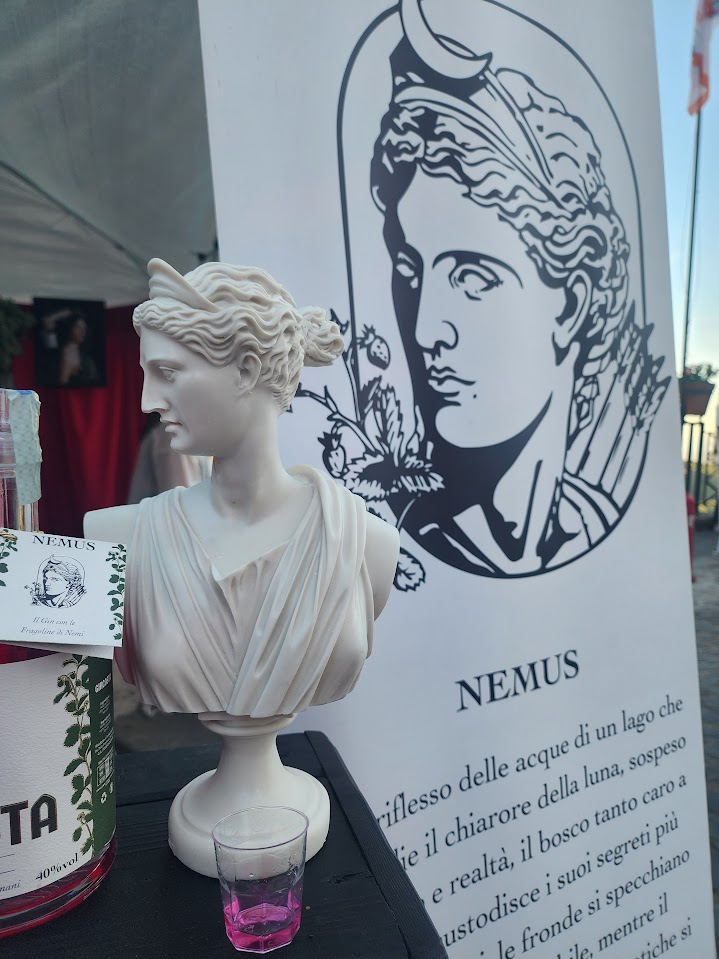
Gincosta Stand [photo Credit: S. Ciotti
Such celebrations are hardly unique to Nemi. Across Europe, many seasonal festivals survived the transition from Pagan antiquity to Christian society by adapting to new cultural realities while retaining their connection to the agricultural year. The modern Strawberry Festival is perhaps best understood as part of that broader tradition, a community gathering that celebrates the bounty of the earth even though the religious framework that once accompanied such observances has largely disappeared.
Beyond the festival and the town’s embrace of her image, Diana’s presence remains palpable.
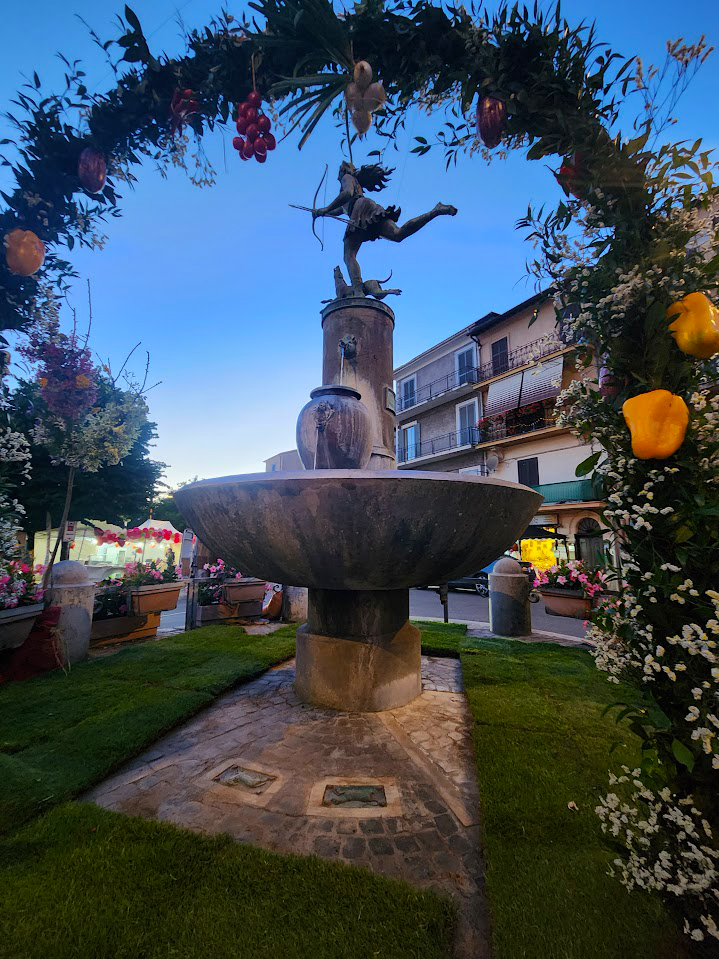
Nemi’s statue of Diana was adorned for the festival [MJTM]
Below the town, nestled between the wooded slopes and the lakeshore, lie the remains of the Sanctuary of Diana Nemorensis, one of the most important religious centers of the ancient Mediterranean world. For centuries, pilgrims traveled to Nemi to honor the goddess of the hunt, wilderness, childbirth, and the moon.
The sanctuary occupied a unique place in Roman religion. Long before Rome dominated the Italian peninsula, the sacred grove of Diana served as an important gathering place for Latin communities. Ancient writers described a sanctuary surrounded by dense woodland where religious ceremonies, festivals, and pilgrimages took place beside the waters of the lake.
The site later became famous through Sir James Frazer’s landmark study of comparative religion, The Golden Bough, which introduced generations of readers to the mysterious traditions associated with Diana’s priesthood at Nemi. While modern scholarship has challenged some of Frazer’s interpretations, his work helped transform the sanctuary into one of the most widely recognized sacred sites of the ancient Pagan world.
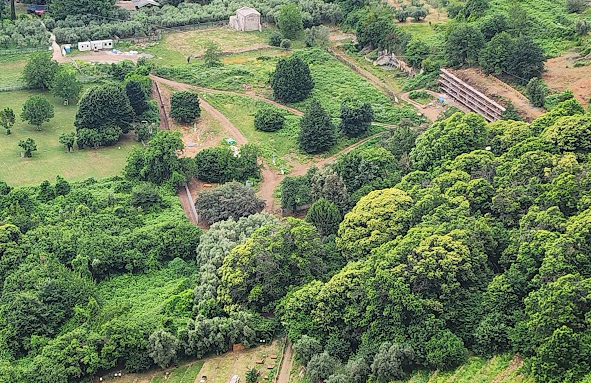
The restoration of the Sanctuary of Diana as seen from Nemi [Photo Credit: S. Ciotti
Recent archaeological investigations have revealed that the sanctuary was considerably larger than previously believed. Excavations continue to uncover evidence of a vast religious complex that once stretched across terraces overlooking the lake. These discoveries have reinforced the site’s importance not only for the study of Roman religion but also for understanding the broader religious landscape of pre-Christian Europe.
Today, the sanctuary is undergoing its most ambitious restoration in decades.
The project is funded through Italy’s National Recovery and Resilience Plan (PNRR) under the broader Caput Mundi cultural heritage initiative. Approximately €2 million has been allocated to preserve, restore, and reopen the sanctuary as a major archaeological destination.
The restoration includes stabilization of surviving structures, conservation of ancient masonry, improved visitor pathways, enhanced accessibility, and the creation of new interpretive facilities. Historically, access to the site has been difficult. Portions of the sanctuary remained overgrown, poorly marked, and only partially accessible to visitors. The current project aims to transform the area into a fully integrated archaeological and educational destination while preserving its historical character.
The works are also intended to connect the sanctuary more closely with other cultural attractions in the area, including the nearby Museum of the Roman Ships, creating a more comprehensive visitor experience centered on the history of Lake Nemi and the surrounding Alban Hills.
For now, however, the sanctuary remains closed.
Temporary fencing, security monitoring, and construction barriers surround the archaeological area.
Despite these restrictions, visitors continue to make their way to the woods surrounding the sanctuary.
During a recent visit, several individuals quietly approached the perimeter carrying flowers, coins, and other offerings intended for Diana. One expectant mother explained that she had come to ask the goddess for a safe pregnancy and birth. Later, a recently married couple visited the area to honor Diana and celebrate their vows in a place they regarded as sacred. Three young women arrived for what they described as a private meditation dedicated to Diana Nemorensis.
None wished to be identified, citing both privacy concerns and the legal restrictions surrounding the protected archaeological site.
Their presence, nevertheless, highlights an often-overlooked reality. The Arician woods and the Mirror of Diana are not merely archaeological sites. For many contemporary Pagans, Nemi remains one of the most sacred places in Europe, a landscape where Diana is honored and experienced as a living spiritual presence.
The sanctuary itself appears poised to reopen to the public. Official notices posted by the Italian Ministry of Culture indicate that the extraordinary closure is scheduled to remain in effect until July 9, 2026, with public access anticipated shortly thereafter, potentially as early as July 10.
What remains unclear is how contemporary devotional practices will coexist with the site’s new status as a fully managed archaeological destination. For now, visitors wait for the gates to reopen. When they do, they will gain access not only to a remarkable archaeological monument but also to a landscape where history, memory, and living spirituality continue to meet beside Diana’s sacred lake.
The Wild Hunt is not responsible for links to external content.
To join a conversation on this post:
Visit our The Wild Hunt subreddit! Point your favorite browser to https://www.reddit.com/r/The_Wild_Hunt_News/, then click “JOIN”. Make sure to click the bell, too, to be notified of new articles posted to our subreddit.