

On May 6, a 22-foot-tall golden statue of Donald Trump was unveiled on a pedestal at his Doral golf resort in Florida.
Evangelical pastor, televangelist, repeatedly unsuccessful political candidate, and fabricator of educational and military records Mark Burns proudly stood next to the statue and led a dedication ceremony.
Obviously at least somewhat aware of how absolutely nuts the whole thing was, Burns wrote a Facebook post about it that night. “Let me be clear: this is not a golden calf,” he insisted. “We worship the Lord Jesus Christ and Him alone.”
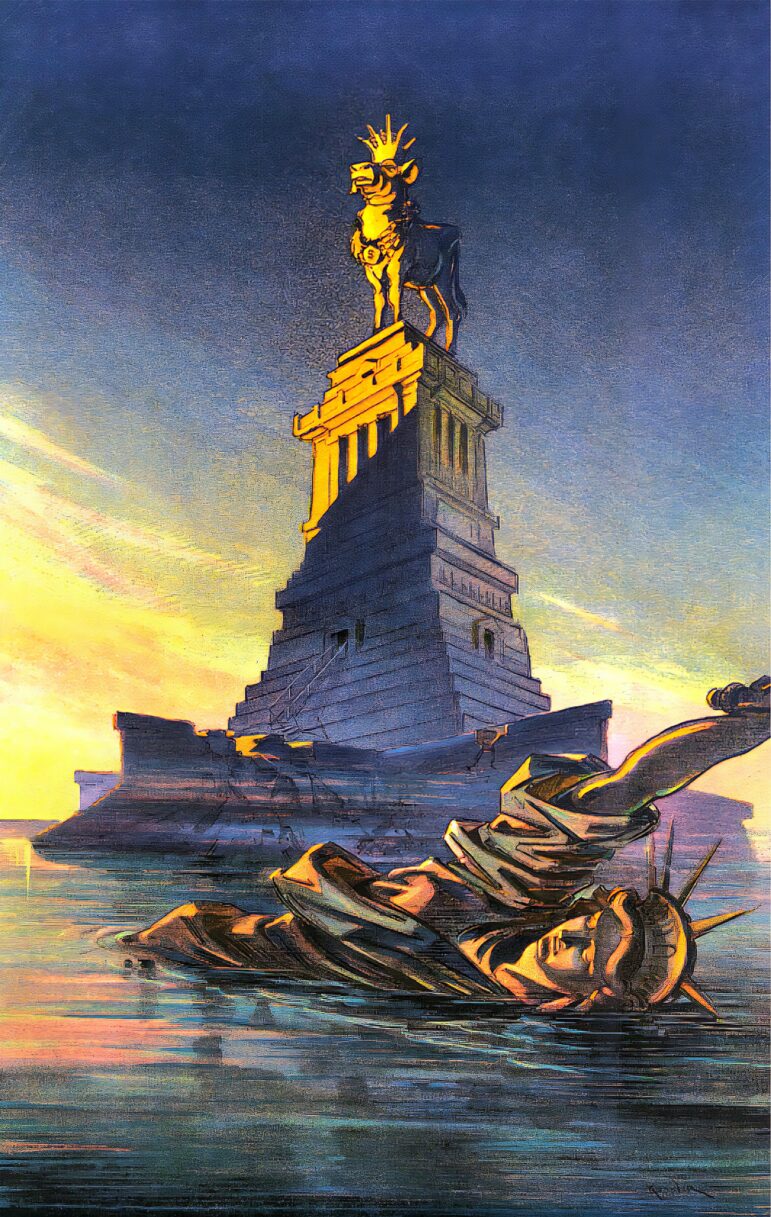
Illustration by Udo J. Keppler (1912) [Public Domain]
Two days later, former ABC reporter Terry Moran shared a tweet stating “MAGA evangelical leaders gather in Mar-a-Lago to bless and dedicate a gold statue dedicate [sic] to Donald Trump.” He added his own comment: “This is pure idolatry. They aren’t Christians. They’re pagans.”
And, as Michael Jordan famously said, I took that personally.
The golden calf
The golden calf appears in biblical mythology, not pagan myth.
In the book of Exodus, the Israelites get tired of waiting for Moses to come down from the mountain, and they say to his brother Aaron, “Come, make us gods who will go before us.”
He collects all the gold earrings worn by men and women, fashions them into a golden calf, builds an altar before the idol, and leads the people in a sacrificial offering to the new deity. Adding insult to injury, the people declare that it was this golden calf – and not the Abrahamic god – who brought them out of slavery in Egypt.
The god of the Israelites is understandably displeased with this and notifies Moses that he will destroy them in the heat of his anger. Moses convinces him to stay his wrath, then descends from the mountain with the tablets of the law.
When he sees the people dancing in front of the golden idol, Moses smashes the tablets before burning the calf, grinding it into powder, scattering it on the water, and making the people drink it.
He then leads a sub-group of the people to kill three thousand of their family members, friends, and neighbors. After the massacre, he tells the killers that his god has blessed them for the killing.
When Moses goes back to talk to his god again, the deity denounces all who have sinned against him, then sends a plague to decimate anyone left who had worshipped the calf.
As a child, it was stories like this that made me think Moses’s god was a bit of a scary monster. He glories in death and destruction, often spreading fear, taking vengeance, and killing the people he once saved. I remember asking my father why this god wasn’t married, like Zeus. The god of the Bible just didn’t seem like a very appealing character.
But we’re all adults here, and we can approach biblical mythology with the same attitude that we take with Greek or Norse mythology. Even if we don’t worship the raging deity of Exodus, we can understand the symbolism of the golden calf.
The calf is made by people who turn away from a traditional relationship with the deity who protected them and make a new god out of their own vanity, fashioning it from the jewelry that adorns their earlobes. As they worship it, they are glorifying themselves and reveling in their fixation on worldly things over spiritual matters.
Christians learn this cautionary tale in a Christian context. It is a biblical myth taking place in Egypt that has no connection to historical European paganism or its modern descendants in the United States.
Shame on Moran for his outdated and lazy use of pagan as a slur for those Christians that he personally doesn’t consider Christian enough or whose admittedly gross merging of Christianity and fascism he finds off-putting. Someone with his experience in journalism should be able to find the words to express his disgust at misbehaving Christians without dragging practitioners of unrelated religious traditions into it.
Pagan idols
In the various forms of ancient Germanic paganism that inspire the modern religions of Ásatrú and Heathenry, idols were generally of divine figures, not human leaders. These included large statues in temples and public holy sites along with so-called god-poles in smaller private structures.
The latter were wood pillars with the features of deities carved into them. Indeed, a main Old Norse word for god is áss, which also means (wooden) pole. The plural form for gods is Æsir, which gives us the modern term Ásatrú (“Æsir Faith”).
Fitting with myths of the jealous and destructive biblical god, we only know about some of the more important pagan idols via written records of their denunciation and destruction by Christians.
The Irminsûl (Old Saxon, “gigantic pillar”) was an idol in a temple of the pagan Saxons. It seems to have been a column of some sort, whether carved or made from a naturally rooted tree. It was either dedicated to a deity or represented the “pillar of the universe which, as it were, supports all things.” In 772 CE, the Christian king Charlemagne destroyed the idol and stole the offerings that had been made to it.
Approximately 50 years earlier, a tree considered sacred to a German version of Thor was chopped down by the Anglo-Saxon missionary later known as Saint Boniface. This was the famous Thor’s Oak, from which my own religious organization takes our name.
Both the Christian King Olafs of Norway famously destroyed idols of Thor. In 998 CE, Olaf Tryggvason entered a pagan temple, smashed the figure of the thunder god, then had his men shove all the other idols of deities from their pedestals. In 1021, Olaf Haraldsson had one of his men smash an idol of Thor to bits in front of the farmers that venerated it.
Fifty years later, German Christian chronicler Adam of Bremen wrote of stubborn Swedes yet to be converted to the new faith and repeated reports of the large pagan temple at Uppsala. Inside, a large enthroned idol of Thor was flanked by figures of Wotan (Odin) and Frikko (Freyr).
In those long-ago pagan times, there were indeed sacrifices made to ancestors and fallen kings, but the idols and idol-like columns and trees represented divine figures. The idol-smashing Christian kings would have had little problem with political statues, in any case, since their own rule was often justified via ancestry traced to the former leaders, despite their pagan practices. Indeed, Christian Anglo-Saxon kings proudly traced their royal lineage back to Woden (Odin) himself.
The trend for statues memorializing legendary pagan heroes and historical or semi-historical leaders of the Germanic pagan past is really a phenomenon of 19th-century nationalist Romanticism that sought to root the histories of the various European nations in tales of glorious ancient origins. It has much to do with that century’s concept of national folk-being and little to do with the practice of historical pagan religions.
Practitioners of Ásatrú in the United States today tend to replicate the divine idols and god-poles of ancient Germanic paganism, most often on a smaller scale as they fashion or purchase idols of various divine figures for veneration as part of personal altars. Golden calves and members of the federal government are not generally included.
American idols
Public monuments in the U.S. tend to echo features of ancient pagan idols but transpose veneration from the divine to the political, even going so far as treating political leaders like divinities themselves.
Even when a monument seems a bit pagan-ish, its roots are invariably in the political world.
There are multiple statues of Norse explorer Leif Erikson in the United States, ranging from Boston to Seattle. Although born into paganism, Leif converted to Christianity while at the court of Olaf Tryggvason, before his famous voyage to North America. Nothing pagan is being promoted by these Viking-ish statues. Instead, they form part of the public political rivalry between Protestants and Catholics in the U.S., with Norwegian-Americans insisting that the Nordic Leif was here long before the Italian Christopher Columbus, thus asserting their own primacy in the American pecking order.
The phallic Washington Monument, “like a great eternal Klansman with his two flashing red eyes,” is reminiscent of what the Irminsûl may have been. While the old pagan Saxons venerated the symbol of a deity or of the pillar that supports the universe, we Americans instead idolize a politician.
The Lincoln Memorial echoes the temple at Uppsala, with its enormous temple-like structure and its enthroned honoree. Again, the idol honoring a god is transmogrified into one deifying a politician.
It’s clear that Americans love war and wartime leaders, but they also love fascism and racist violence.
Here in Chicago, we have a Balbo Drive and a Balbo Monument, both honoring Italo Balbo (1896-1940), co-leader of Italy’s Grand Council of Fascism, head of the fascist Blackshirts, air commander under Benito Mussolini, and colonial governor of Italian Libya. Another column like the Irminsûl, this one is an actual Roman column from c. 120 BCE reworked by Italy’s fascist government as a gift to Chicago in 1934 celebrating Balbo’s transatlantic flight to attend the World’s Fair. Tellingly, Italy itself restored the pre-fascist names of monuments and streets dedicated to Balbo long ago, while Chicago’s government continues to repel all public demands to do the same here in the supposedly democratic United States.
The Confederate statues that publicly celebrate political and military leaders of the racist slave-states who fought a war against the U.S. were not built in the aftermath of the conflict. Instead, they were deployed in two waves that leave little doubt of the deep racism being celebrated. The first frenzy of statue erection occurred as Jim Crow laws were enacted throughout the southern states to deny equal rights to African-Americans. The second happened in the 1950s and 1960s, at the height of the Civil Rights Movement. The rabid reaction to recent removal of the racist monuments conclusively demonstrated America’s dedication to celebrating bigotry via statuary.
The nonsense continues as Trump works to follow up his golden idol of himself with the “Arc de Trump,” a 250-foot-tall triumphal arch honoring himself. It’s unclear what exactly the triumph is that’s being celebrated.
Following his bizarre begging to be given the Nobel Peace Prize, his presentation with the one awarded to Venezuelan opposition leader María Corina Machado, and his receiving of the newly invented “FIFA Peace Prize” from the international soccer association, it’s obvious that Trump wants to be considered a peace president.
Yet he also revels in making himself a war president, following Israel’s lead into a disastrous war with Iran – a war that he has already declared “won” dozens of times, but that continues to drag on and on. War presidents, after all, are the ones who get the biggest monumental dedications.
Given our inglorious history with statues and monuments, maybe it’s time to move past this whole thing,
Monuments no more
Enough with the statues to “great men.” These corny public works are an endless national embarrassment and are becoming even more so, now that politicians can apparently just erect celebrations of themselves without limit or oversight.
If we must have outsized objects in our public spaces, let’s focus on public art.
I don’t mean monuments to artists. My love for and understanding of the work of Jack Kirby would in no way be sharpened or increased by gazing at a gargantuan statue of the comics giant. It’s in appreciation of his actual work that his vision is approached.
I mean commissioning works that engage with our moment, that grapple with these troubled times that we’re all living through together.
Life is short, and art is long. Meditating on a public work that engages with our times or that reflects a past generation facing their own has infinitely more value for the nation than yet another cyclopean monument to a politician’s personal vanity or his devotees’ devotion.
In Chicago, the public artworks by Pablo Picasso, Joan Miró, Marc Chagall, Alexander Calder, Anish Kapoor, Jaume Plensa, and others both reflect and shape life in the city infinitely more and in a decidedly more positive manner than the crass political monuments like the column celebrating the fascist Balbo.
If the cry suddenly goes up that we don’t have the cash on hand for to commission actually meaningful public art, then we definitely don’t have the money to fund yet more vanity projects for politicians and the deluded worshippers who seek to deify them.
As a Pagan with at least some grasp of the history of idolatry, I say we don’t need any more golden calves in our public spaces.
The Wild Hunt is not responsible for links to external content.
To join a conversation on this post:
Visit our The Wild Hunt subreddit! Point your favorite browser to https://www.reddit.com/r/The_Wild_Hunt_News/, then click “JOIN”. Make sure to click the bell, too, to be notified of new articles posted to our subreddit.