
TWH — Four years ago, The Wild Hunt launched a series titled Pilgrimages, beginning with a visit to the Temple of Diana—an exploration of sacred movement, place, and transformation. That first installment framed pilgrimage not simply as travel, but as an encounter with the self through landscape, ritual, and devotion. A newly published academic study now offers some evidence for what many practitioners and observers have long understood: pilgrimage is not merely symbolic, it is profoundly transformative.
In Spiritual Transformation Through Pilgrimage: A Grounded Theory Analysis of Experiences in Taiwan, Japan, and Spain, researchers Wen Huei Chou, Pei-Ching Tsai, and Yi-Ying Wu examine how pilgrimage reshapes the inner lives of participants across three major traditions: the Mazu pilgrimage in Taiwan, the Shikoku pilgrimage in Japan, and the Camino de Santiago in Spain.

The Etruscan Pyramid at Bomarzo, Italy. Photo Credit: M. Tejeda-Moreno
Drawing on in-depth interviews with 15 experienced pilgrims, the study identifies a recurring pattern among participants of spiritual transformation rooted not in doctrine, but in lived experience. Pilgrimage, the authors argue, creates a liminal space—one in which participants step outside ordinary structures of life and enter a state of vulnerability, reflection, and potential renewal.
At its core, the research confirms that pilgrimage begins with a desire to leave. Participants described motivations ranging from religious devotion to personal crisis, stagnation, or simple curiosity. For some, the journey was undertaken to seek blessings or fulfill vows; for others, it was a response to grief, depression, or a sense of being lost. Still others were drawn by the promise of challenge or adventure. This “yearning for change” marks the first stage of transformation, a conscious break from everyday identity and expectations.
Yet departure is only the beginning. What follows is often a confrontation with physical and emotional limits. The study highlights what it terms the “power of vulnerability”—the intense bodily and psychological strain experienced during pilgrimage. Participants reported exhaustion, hunger, pain, loneliness, and even moments of despair. These hardships are not incidental; they are central to the process. In enduring them, pilgrims are stripped of familiar defenses and forced into direct engagement with themselves.
This confrontation frequently gives rise to a state the researchers describe as “self-connection and flow.” As the repetitive act of walking takes over, many pilgrims enter a meditative rhythm. Thought patterns shift. External concerns recede. Attention narrows to the immediacy of movement, breath, and environment. In this state, participants reported a growing sense of clarity and presence, often accompanied by what they described as surrender—letting go of control and accepting the journey as it unfolds.
From this inward turn emerges what the study calls “upward and beyond,” a phase characterized by reflection, meaning-making, and transcendence. Pilgrims engage in inner dialogue, reassessing their values, relationships, and sense of purpose. The journey becomes not only physical but existential. Participants described gaining perspective on life’s difficulties, recognizing impermanence, and cultivating resilience. In many cases, this phase marked a shift from fragmentation toward a sense of wholeness.
Importantly, this transformation is not purely internal. The study emphasizes the role of “external connection and perception,” particularly the emergence of gratitude. Pilgrims often rely on the kindness of strangers, the support of fellow travelers, and the rhythms of the natural world. These interactions foster a deep appreciation for interdependence. Participants reported becoming more empathetic, open, and willing to give back—changes that extended into their lives after the journey ended.
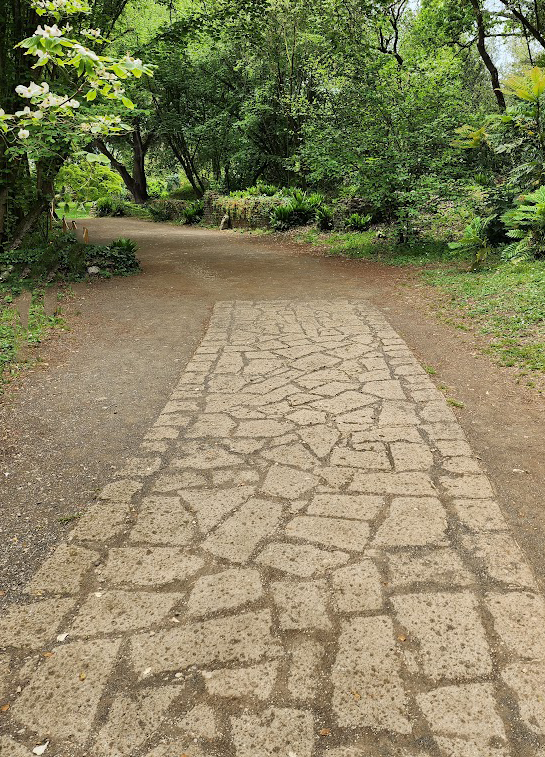
[Photo Credit: S. Ciotti
The final dimension identified in the study: “stability, belonging, and spiritual experience”—anchors these transformations in ritual and place. Across all three pilgrimage traditions, participants engaged in structured practices: prayers, chants, offerings, and symbolic acts. They carried or collected sacred objects, talismans, walking staffs, and stamped passports that served as tangible reminders of the journey. And they moved through landscapes imbued with meaning: temples, shrines, cathedrals, and natural environments that reinforced a sense of the sacred.
These elements of ritual, of object, and of place create continuity and coherence. They provide a framework through which the pilgrim’s experiences are interpreted and integrated. As the study notes, such practices help establish a sense of belonging and reinforce the perception that the journey is part of something larger than the individual.
Taken together, these six interconnected factors outline a dynamic process of transformation. Pilgrimage begins with departure, deepens through vulnerability, unfolds through reflection and connection, and ultimately stabilizes into a renewed sense of self and world. The authors conclude that this process is driven by the interplay of physical experience and psychological reflection, leading to what many participants described as spiritual awakening.
For Pagan readers, this framework resonates deeply. While the study focuses on traditions in Taiwan, Japan, and Spain, its findings echo broader patterns found in contemporary Pagan practice: the use of journeying as a form of initiation, the embrace of liminality, and the understanding that transformation arises through embodied experience. Whether walking ancient routes, visiting sacred groves, or engaging in seasonal rites, the act of stepping outside ordinary life remains a powerful catalyst for change.
As The Wild Hunt’s Pilgrimages series has long suggested, sacred travel is not defined by geography alone. It is a practice of becoming, one that challenges, unsettles, and ultimately reorients the pilgrim. This study affirms that such journeys are not only meaningful but measurable in their impact, offering a rare bridge between lived spirituality and academic inquiry.
In an increasingly secular and fragmented world, the enduring appeal of pilgrimage may lie precisely in its simple capacity to create space for reflection, to foster connection, and to remind us that transformation is not a destination, but a path often walked step by step.
The Wild Hunt is not responsible for links to external content.
To join a conversation on this post:
Visit our The Wild Hunt subreddit! Point your favorite browser to https://www.reddit.com/r/The_Wild_Hunt_News/, then click “JOIN”. Make sure to click the bell, too, to be notified of new articles posted to our subreddit.