
WASHINGTON — The federal Religious Liberty Commission held its final scheduled hearing on April 13, 2026, closing a year of often contentious testimony with a session that underscored deep divisions over the meaning and future of religious freedom in the United States.
Established by President Donald Trump through executive order, the commission is housed within the Department of Justice and is tasked with studying, promoting, and strengthening religious liberty. Its final hearing brought together commissioners, legal scholars, religious leaders, and advocates, while also drawing criticism from civil liberties groups who argue the body has advanced a narrow vision of faith in public life.
The hearing happened against a volatile political and cultural backdrop. In the days immediately preceding the session, President Donald Trump drew widespread criticism after lashing out at Pope Leo XIV on social media and in public remarks on April 12 and 13. The controversy intensified when Trump briefly posted, then deleted, an AI-generated image depicting himself as a Jesus-like figure, prompting backlash from many Christians who viewed the image as blasphemous. Trump acknowledged posting the image and believed it depicted him ‘as a doctor.’”
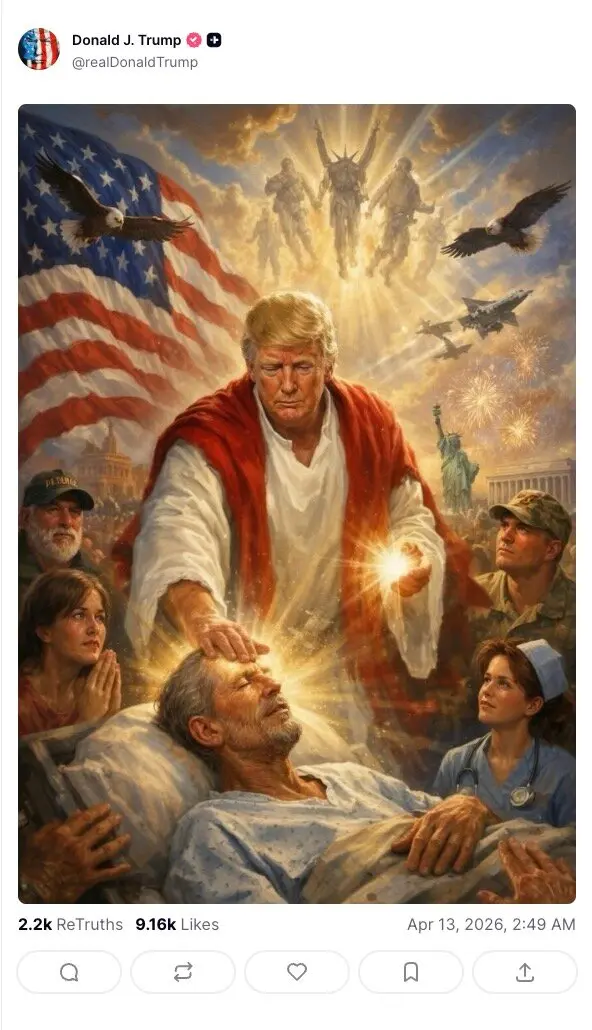
The now-deleted post from April 13, 2026, on Truth Social [via @realDonaldTrump
Despite the national attention surrounding these events, commissioners did not address the controversy during the public hearing.
Instead, the hearing opened with testimony from Helen Alvare, a law professor at George Mason University, who addressed the relationship between religious liberty and church-state separation. Her remarks set the tone for a session that repeatedly returned to the tension between protecting religious expression and maintaining government neutrality.
Commission members, including chair Dan Patrick, Vice Chair Ben Carson, Bishop Robert Barron, media personality Phil McGraw, and White House adviser Paula White-Cain, framed religious liberty as increasingly under threat from cultural and governmental forces.
Barron, in particular, warned of what he called a growing “dictatorship of relativism,” arguing that shifting cultural norms around gender, sexuality, and moral authority are eroding protections for religious believers. He cited concerns about healthcare mandates related to abortion, contraception, IVF, and gender-affirming care, asserting that such policies place religious practitioners in conflict with their conscience.
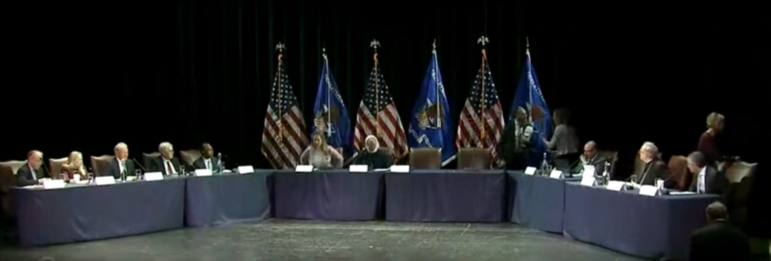
Religious Freedom Commission at the Museum of the Bible, April 13, 2026.
“These represent a very real threat to the religious liberty of those who find such ideas repugnant to their beliefs about the human person,” Barron said during the hearing.
Barron also highlighted rising antisemitism and attacks on religious institutions, calling for stronger protections for houses of worship and clergy. At the same time, he emphasized the need for humane treatment of detained immigrants and access to religious sacraments, an acknowledgment of religious liberty concerns beyond the culture war issues that dominated much of the session.
Commissioners also used the final hearing to float potential recommendations for the administration. Dan Patrick suggested posting “religious liberty rights” notices in schools, universities, and workplaces, and proposed a national hotline for reporting violations. In doing so, he questioned long-standing interpretations of church–state separation, asking whether it was “the biggest lie that’s been told in America since our founding.”
Meanwhile, legal advocates raised longstanding disputes about the Johnson Amendment, which prohibits tax-exempt organizations from endorsing political candidates. First Liberty Institute CEO Kelly Shackelford urged the administration to provoke a legal challenge to the policy, arguing it restricts First Amendment rights.
“There’s a way to deal with this,” Shackelford said, suggesting the IRS issue a fine to trigger a court test case.
The debate reflects a broader and unresolved tension about the role of religion in political life, whether religious institutions should remain insulated from partisan activity or fully participate in it.
Testimony also highlighted conflicts between religious organizations and state governments. Sister Mary Elizabeth of the Sisters of Life described a legal battle with New York officials over efforts to compel disclosure of internal documents from pro-life pregnancy centers.
“Our mission is where women can feel safe with the knowledge that their stories are kept confidential,” she said, framing the dispute as a matter of religious conscience and trust.
Outside the hearing room, critics argue the commission itself represents a threat to the pluralistic vision of religious liberty it claims to defend.
A multifaith coalition, including Muslim, Hindu, and Sikh organizations, has filed a federal lawsuit alleging the commission disproportionately represents a “Judeo-Christian” perspective and excludes minority faiths. The complaint notes the absence of commissioners from those traditions and questions the body’s mandate to promote religious pluralism.
Rachel Laser, president of Americans United for Separation of Church and State, issued a statement on April 13 sharply criticizing the commission’s work.
“Church-state separation ensures we are all free to live as ourselves and believe as we choose,” Laser said, arguing that the commission has “rebuked a foundational pillar of religious liberty.”
Critics also point to a pattern of excluding voices that defend church-state separation, as well as those representing communities most affected by religious exemptions, such as LGBTQ+ individuals, women seeking reproductive healthcare, and religious minorities.
The notes from the hearing reflect these concerns, describing an “us versus them” narrative that casts defenders of church-state separation as adversaries rather than participants in a shared constitutional framework.
Critics continue to underscore that federal agencies and state governments are increasingly promoting overtly Christian messaging, raising concerns about the erosion of religious neutrality in public institutions.
The commission appears to reject those critiques, instead framing their work as a necessary response to what they see as hostility toward religion in public life. Patrick, referencing the lawsuit against the commission, suggested opposition reflects fear of its findings.
“That means they’re really afraid,” he said.
Although the April 13 session marked the commission’s final scheduled hearing, several members signaled their desire to continue its work. Barron urged the administration to allow the body to “persevere in monitoring” threats to religious liberty, a sentiment Patrick echoed.
“Our charter expires in a couple of months,” Patrick said. “We’d like to continue to monitor the outcome and to continue to have hearings as needed.”
The commission is expected to release its final report later this spring, barring court intervention. That report will likely shape ongoing debates about religious freedom, particularly as they intersect with issues of healthcare, education, and civil rights.
At its core, the final hearing highlighted a fundamental disagreement that has defined the commission’s work: whether religious liberty is best protected by expanding the rights of religious actors in public life, or by maintaining a clear boundary between religion and government.
Notably, the commission’s silence on the Trump–Vatican controversy stood in contrast to its broader focus on perceived cultural threats to religion, highlighting the selective scope of issues and priorities addressed during its proceedings.
For supporters, the commission represents a defense of faith communities against cultural and legal pressures. Critics counter that the commission’s membership heavily favors conservative and predominantly Christian perspectives, signaling a shift toward privileging one religious viewpoint at the expense of others.
The Wild Hunt is not responsible for links to external content.
To join a conversation on this post:
Visit our The Wild Hunt subreddit! Point your favorite browser to https://www.reddit.com/r/The_Wild_Hunt_News/, then click “JOIN”. Make sure to click the bell, too, to be notified of new articles posted to our subreddit.