
MIAMI — Ancient Pagans looked up into a night sky that was alive with stars, planets, and the luminous band of the Milky Way. They encountered a cosmos that shaped ritual calendars, mythic narratives, and a sense of place within the sacred order of the universe. Today, that experience is increasingly rare. Across much of the modern world, artificial light has dimmed the heavens, leaving fewer and fewer places on the planet where the night sky can still be encountered in its full splendor.
Each April, during the week of the new moon, International Dark Sky (IDS) Week invites people to reclaim that experience. Timed for the darkest nights of the lunar cycle, the observance encourages individuals and communities to turn off unnecessary lighting and reconnect with the stars. What began as a small grassroots effort has grown into a global movement with profound ecological, cultural, and spiritual implications.
The event traces its origins to 2003, when high school student Jennifer Barlow of Midlothian, Virginia, launched what was then called National Dark Sky Week. Her goal was simple but ambitious: to raise awareness about light pollution and encourage people to experience the night as it once was. The initiative quickly gained support from organizations such as the International Dark-Sky Association, the American Astronomical Society, and the Astronomical League, helping to expand its reach and impact.
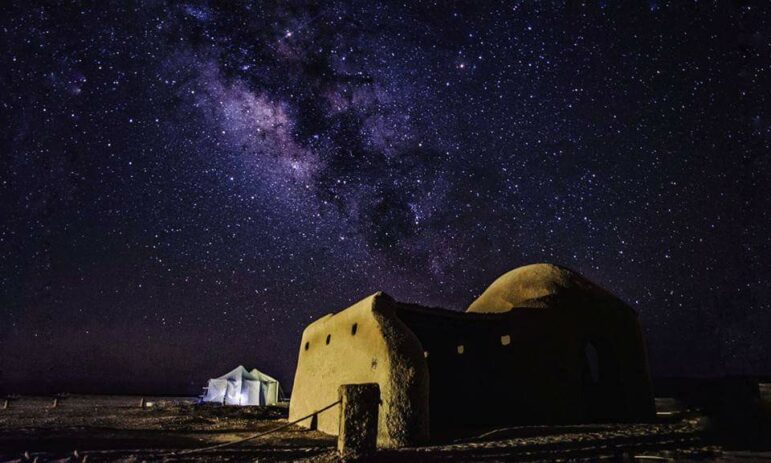
Photo of the Milky Way over Wadi al-Hitan, Faiyum, Egypt [Alaa Adel Awaad, Wikimedia Commons, CC 4.0
Over the past two decades, the broader Dark Sky movement has evolved into a coordinated international effort to protect night environments. A milestone came in 2001, when Flagstaff, Arizona, became the world’s first officially designated International Dark Sky City. Since then, the movement has certified more than 200 places worldwide, safeguarding over 160,000 square kilometers of land across 22 countries. These designated sites adhere to strict lighting standards designed to reduce skyglow and preserve natural darkness.
At its core, the movement rests on a set of guiding principles for responsible outdoor lighting: use light only when necessary, direct it precisely, keep it at the lowest effective level, control it with timers or sensors, and favor warmer color temperatures. These practices not only restore visibility of the night sky but also mitigate the wide-ranging consequences of excessive artificial light.
The loss of the night sky is not merely aesthetic. It represents a disruption of a fundamental relationship with the cosmos. Lunar cycles, planetary alignments, and stellar constellations have long informed human ritual and cosmological understanding, as well as the movement and behavior of other species. When the stars disappear, and artificial light grows stronger, that direct, experiential connection to these rhythms fades.
The implications of light pollution are vast and extend far beyond human perception. Scientific research has documented its significant impact on ecosystems, particularly for nocturnal and migratory species. Birds, for instance, can become disoriented by urban lighting, leading to fatal collisions with buildings. Artificial illumination can also alter migration patterns and reproductive cycles.
Perhaps most striking is the effect on sea turtles. Hatchlings, which emerge at night and instinctively move toward the brightest horizon, historically the ocean reflecting moonlight, are now often misled by the glow of coastal development. Instead of reaching the sea, they are drawn inland toward roads and artificial lights, resulting in mass mortality. In Florida alone, millions of hatchlings die each year due to this disorientation.

Night sky over Ocala National Forest during Florida Pagan Gathering. [Photo Credit: MJTM
Recognizing this threat, targeted interventions have begun to show promise. In 2013, the Florida Department of Environmental Protection partnered with wildlife agencies and DarkSky experts to identify and mitigate harmful coastal lighting. The resulting “turtle-friendly” lighting guidelines are now being implemented to protect nesting habitats and improve hatchling survival rates.
Bioluminescent lagoons, rare ecosystems where waters glow with the light of microscopic organisms, are also increasingly threatened by light pollution. In places like Puerto Rico’s Mosquito Bay and Florida’s Indian River Lagoon, artificial skyglow can outshine this delicate phenomenon, rendering it nearly invisible. Beyond obscuring the display, constant illumination disrupts circadian rhythms and reproductive cycles, contributing to long-term ecological decline.
Urban areas, too, are beginning to see the need to adapt. Cities and towns across North America are pursuing Dark Sky certification by updating lighting codes and infrastructure. These efforts require not only new standards for future development but also the gradual retrofitting of existing systems, a process that can take years but yields lasting benefits for both communities and ecosystems.
Despite this progress, there are still no comprehensive nationwide standards regulating light pollution in the United States. The responsibility largely falls to local governments, advocacy organizations, and individuals. International Dark Sky Week serves as a focal point for these efforts, offering a moment of collective action and reflection.
The restoration of dark skies is not solely about conservation or science; reawakening a sacred relationship can also be at the center of the event. To stand beneath an unpolluted sky is to encounter the same celestial tapestry that inspired ancient rites, guided seasonal observances, and shaped the spiritual imagination of countless traditions.
As International Dark Sky Week unfolds, participants are invited to take simple yet meaningful steps: dim outdoor lights, advocate for responsible lighting policies, or, if possible, travel to one of the remaining dark sky preserves. Even small actions can contribute to a broader cultural shift. The IDS website lists information about events, actions, and opportunities to participate worldwide.
As communities increasingly focus on rewilding landscapes, reclaiming the night has become part of that broader effort. In doing so, we do more than protect wildlife or reduce energy use. We restore a vital dimension of human experience, one that connects us to the past, grounds us in the present, and opens a pathway to our sacred vastness above.
The Wild Hunt is not responsible for links to external content.
To join a conversation on this post:
Visit our The Wild Hunt subreddit! Point your favorite browser to https://www.reddit.com/r/The_Wild_Hunt_News/, then click “JOIN”. Make sure to click the bell, too, to be notified of new articles posted to our subreddit.