
WASHINGTON — The Summit for Religious Freedom, organized by Americans United for Separation of Church and State, convened this weekend with a strong and visible presence from Pagan organizations. These representatives underscored the importance of Pagan voices in national conversations about church–state separation, especially amid the growing threat of Christian dominionism.
Americans United is a “nonpartisan, not-for-profit educational and advocacy organization that brings together people of all religions and none to protect the right of everyone to believe as they want — and stop anyone from using their beliefs to harm others.” The organization’s work spans litigation, legislative advocacy, and public education, all aimed at advancing “freedom without favor and equality without exception.”
The Pagan leaders attending in person were: Rev. Selena Fox and Dennis Carpenter of Circle Sanctuary; Deirdre Pulgram-Arthen and Andras Corban-Arthen of the EarthSpirit Community; Rev. E. Eldrich of the Covenant of Unitarian Universalist Pagans (CUUPS); and Manny Tejeda y Moreno of the Covenant of the Goddess (CoG)1 and The Wild Hunt. They were joined by Rev. Stefano Ciotti of Eventide Grove and David Dashifen Kees of the Firefly House, along with additional Pagan participants attending virtually. Though not formally coordinated, their presence reflected a broad engagement across groups.
Over the past three years, the summit has increasingly focused on the rise of Christian Nationalism and its implications for constitutional governance. Recent remarks by prominent political leaders have amplified those concerns. Texas Lt. Gov. Dan Patrick, who chairs a federal Religious Liberty Commission, recently described the separation of church and state as the “biggest lie” in American history. House Speaker Mike Johnson has similarly characterized the phrase as a “misnomer,” arguing that the Constitution was intended to prevent government interference in religion, not religious influence in public life. President Donald Trump has also publicly encouraged reexamining the concept.
The summit’s opening plenary addressed these developments directly. Rachel Laser, president and CEO of Americans United, pointed to a series of recent court decisions as evidence of a broader shift.
“Over these past five terms, since Trump solidified this ultra-conservative majority, the Roberts Court has ruled in support of cases involving religion 98% of the time,” Laser said. “And to be clear, these cases are not about true religious freedom… They are about people demanding special permission to harm others.”
Laser argued that many of these decisions disproportionately affect marginalized communities. “These are wins for religious privilege, not for religious freedom,” she added, noting that LGBTQ individuals are often among those most impacted. Citing recent scholarship, she described the current Court as “the first to contract rather than expand civil rights since the 1950s,” a trend she acknowledged has left many advocates “in disbelief and dismay.”
The summit also featured keynote speaker John Fugelsang, comedian and author of Separation of Church and Hate. Fugelsang delivered a pointed critique of the intersection of religion and politics in contemporary America, while also praising Pope Leo XIV for publicly challenging political leaders on issues such as war and social policy.
“They’re cutting services to the poorest of the poor… protecting wealthy abusers of children… and using government power to impose their beliefs,” Fugelsang said. “Millions of us were raised to think it’s a religion about peace and love and empathy, and we grew up to find it’s been hijacked.”
In one of his more provocative lines, after mentioning the AI image of Trump as Jesus, he added, “The only way you can follow both Donald Trump and Jesus… is if you’ve never read either of their books,” drawing both laughter and some serious reflection from the audience.
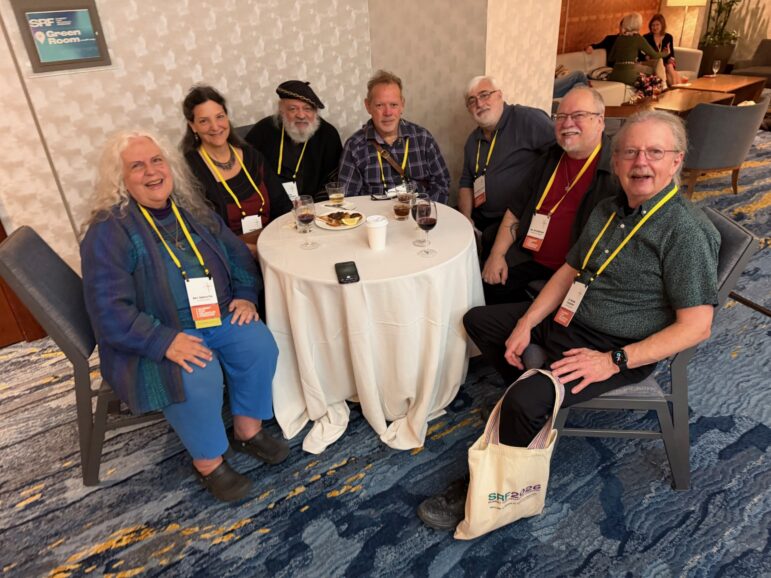
A quick break from sessions and advocacy. Pictured left to right: Rev. Selena Fox, Deidre Pulgram-Arthen, Andras Coban-Arthn, Manny Tejeda y Moreno, Rev. Stefano Ciotti, Rev. E Eldritch, Dennis Carpenter.
Beyond the plenary sessions, the summit emphasized interfaith collaboration and coalition-building. Circle Sanctuary’s Founder Rev. Selena Fox, who serves on Americans United’s Faith Advisory Council, underscored the importance of ensuring diverse faith voices are present in conversations about church–state separation, emphasizing that pluralism is essential to that work.
“I have attended AU’s Summit for Religious Freedom (SRF) each year since it began in 2023,” she said. “SRF provides excellent opportunities to learn more about ways to counter challenges to religious freedom in our nation, while also facilitating education and action on a variety of church–state issues. In addition, SRF is a great way to network with people of diverse religious, spiritual, and philosophical identities across the U.S.”
Rev. E. Eldrich reflected on decades of activism shaped by interfaith work. “I moved to Washington, DC in 1986, and the outbreak of the AIDS epidemic inspired me to become an activist for social justice and liberation,” Eldrich said. “Over the past 40 years, I have experienced the brilliance of interfaith collaboration… This weekend I experienced that same brilliance.”
Eldrich emphasized that Pagans are not only included but also actively contributing to leadership and strategy. “Pagans are welcome and share leadership in crafting options for connection and collaboration through the Summit for Religious Freedom,” they noted.
For Tejeda y Moreno, the summit provided both affirmation and perspective. He described it as an opportunity to engage audiences unfamiliar with Pagan traditions while also recognizing the strength of broader alliances and interfaith collaboration, which are central to the work of the Covenant of the Goddess.
“There are folks there who have never heard of Wicca or nature-based spirituality,” he said. “But what was evident was the broad coalition of diverse faith leaders… ready and willing to call out intrusions into church–state separation.”
He added that the experience countered the discouragement often felt in daily news cycles. “We have more allies than we might think… The Summit gave us a chance to speak to the threat but also celebrate victories.”
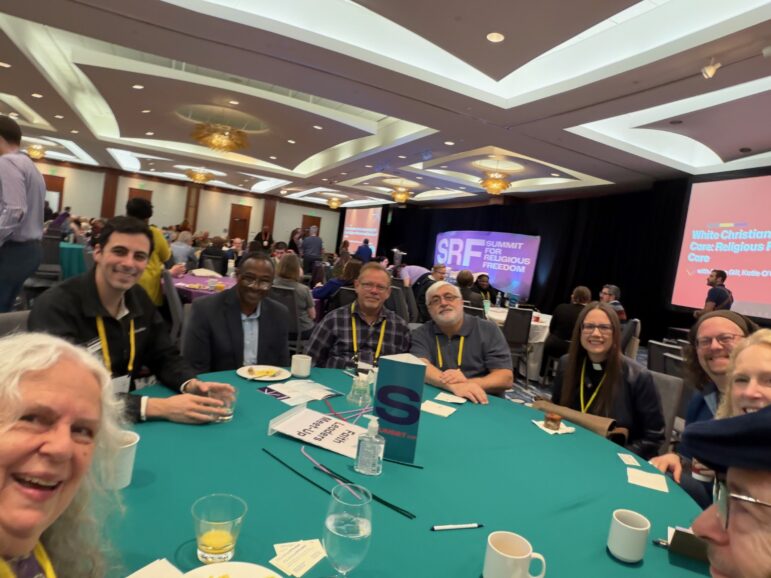
Faith Leaders Breakfast
Tejeda y Moreno also raised concerns about the resurgence of moral panic narratives targeting minority religions. “Pagan and Wiccan communities are often framed as Satanic by Christian Nationalists,” he said, pointing to echoes of the Satanic Panic of the 1980s and 1990s. “We remember what that looked like, and we recognize the warning signs.”
Other Pagan leaders echoed those concerns while placing them in a broader historical context. Corban-Arthen expanded and situated them within a longer historical and political context. He described the original Satanic Panic as “a very intentional and carefully manipulated effort” tied to broader political organizing efforts in the late 20th century.
“Given the current political situation, and the growing number of references to ‘Satanic this, Satanic that’ in the mainstream media, pagans and members of other minority religions need to be on our toes,” he said. He urged continued engagement with advocacy organizations like Americans United, emphasizing the importance of vigilance and coalition-building.
Corban-Arthen also shared a telling anecdote from the summit. In a conversation with a Presbyterian minister, he observed a moment of unexpected role reversal. The minister noted that, in her usual context, her clergy status was met with immediate respect and deference. At the summit, however, she encountered a more neutral reception.
“She suddenly realized that she carried an implicit expectation of deference,” Corban-Arthen said. The experience, while initially uncomfortable, prompted reflection—mirroring the experiences many Pagans have long described in interfaith settings. In this case, he noted, “the shoe was on the other foot,” offering a rare glimpse into what a more egalitarian environment might feel like.
Pulgram-Arthen similarly emphasized the importance of intersectional engagement. She described leaving the summit with “increased awareness about specific ways that Christian Nationalism is manifesting itself—and being fought.”
“The separation of church and state is fundamental to maintaining a free democracy in the U.S.,” she said. She likened Christian Nationalism to “an aggressive and invasive weed” that, if left unchecked, could “gradually strangle out the rights of women and LGBTQI+ folks, secular and scientific education, and freedoms of speech, self-expression, and spiritual practice.”
Her call to action was direct: “We need to come together from all directions to recognize it and rip it up by the roots.”
Dennis Carpenter highlighted the Summit’s success in fostering dialogue across belief systems. He noted that the gathering brought together atheists, religious, and spiritual individuals to explore ways of countering “the growing dominance of radical right-wing fundamentalist Christianity in American politics.”
“It is important to distinguish the hateful and discriminatory values of such Christians from the loving, accepting, and tolerant values of others,” Carpenter said, emphasizing that many faith traditions, including Christian ones, are aligned in defense of pluralism and equality.
Participants also pointed to the summit’s practical value. Both Carpenter and Ciotti noted that sessions provided concrete tools for community engagement, along with messaging strategies designed to respond effectively to current political and cultural trends, particularly in digital and social media spaces.
“This was my fourth time attending the Summit for Religious Freedom. If nothing else, it helps me feel less alone in defending those freedoms and clarifies where I can contribute,” Kees said. “I left with a better sense of what I can accomplish, who I can turn to for support, and the depth of commitment to religious freedom across the country, despite the loud opposition.”
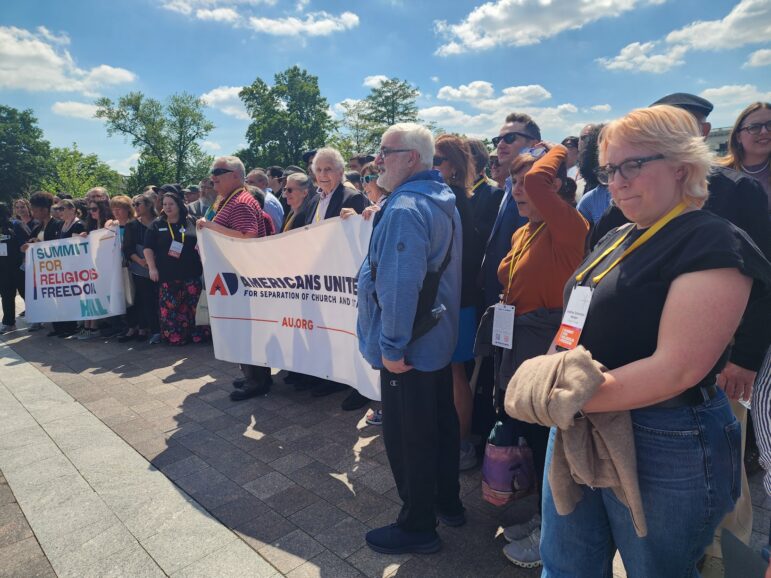
Attending the advocacy event called Hill Day on Monday
On Monday, Tejeda y Moreno, Ciotti, and Pulgram-Arthen continued their advocacy by visiting congressional offices to raise concerns about legislation in both the House and Senate that they warn could erode church–state separation and negatively impact minority faiths. The event, known as “Hill Day,” is organized by AU following the conference to extend advocacy efforts and increase awareness of pending legislation.
As the summit concluded, one theme remained consistent: the importance of sustained, collaborative effort. Laser concluded her remarks by emphasizing resilience: “If you insist on joy, even in the face of mislabeling, and if you value yourself and your identity, what you have, and you let others see that, if you refuse to let your opponents get you down or at least keep you down, if you seek out community, then you’re more likely to live fully, and you’re more likely to fight back against your oppressors and to do so more effectively.”
1. Disclosure: Tejeda y Moreno is the editor-in-chief of The Wild Hunt. His comments on behalf of CoG do not necessarily reflect the editorial position of TWH and are reviewed by an independent editor.↩
The Wild Hunt is not responsible for links to external content.
To join a conversation on this post:
Visit our The Wild Hunt subreddit! Point your favorite browser to https://www.reddit.com/r/The_Wild_Hunt_News/, then click “JOIN”. Make sure to click the bell, too, to be notified of new articles posted to our subreddit.