

Uncovering the Past
Stefano Ciotti contributed to this story.
ITHACA, Greece — As anticipation builds for the upcoming film adaptation of The Odyssey, directed by Christopher Nolan and set for release in July 2026, attention is turning not only to the enduring Homeric storytelling but also to the material traces of ancient devotion tied to its central figure, Odysseus.
The film, starring Matt Damon as the king of Ithaca, promises a grounded and visually immersive retelling of the hero’s long journey home following the Trojan War. As modern audiences prepare to encounter this narrative anew, archaeologists and historians are revisiting evidence that its influence extended far beyond poetry, shaping ritual life, pilgrimage, and sacred geography in the ancient world.

The Odyssey (2026 film) poster [Courtesy
As The Odyssey returns to global attention, interest in these ancient stories is rising across multiple fronts, from renewed academic study to increased cultural and tourism interest in sites associated with the epic tradition.
In June 2025, the Hellenic Republic Ministry of Culture announced findings that many scholars consider among the most significant developments in Homeric archaeology in decades. The results have now begun circulating more widely in both academic and public discourse, possibly related to Hollywood’s attention. The announcement centered on a site long known as “Homer’s School” on the Ionian island of Ithaca, traditionally associated with Odysseus.
Located near the village of Exogi, the site has been the subject of excavation and study for more than a century, with systematic archaeological work conducted between 1994 and 2011. A renewed research program led by the University of Ioannina since 2018 has reexamined earlier findings while introducing new data that deepens understanding of the site’s historical significance.
At the heart of the discovery is a large, terraced complex built into a rocky hillside, featuring monumental architecture, carved stairways, and a substantial rectangular structure believed to have functioned as a ceremonial or communal hall. Archaeologists now argue that this complex can be identified with the “Odysseion,” a sanctuary or hero shrine dedicated to Odysseus, referenced in a 3rd-century BCE inscription.
What makes the site particularly compelling is the breadth of evidence pointing to long-term ritual activity. Artifacts recovered from the excavation include fragments of votive offerings, ritual vessels, jewelry, and more than one hundred coins from various regions, suggesting that visitors traveled to the site over centuries. Among the most striking finds are inscriptions bearing the name of Odysseus, including dedications likely made by pilgrims.
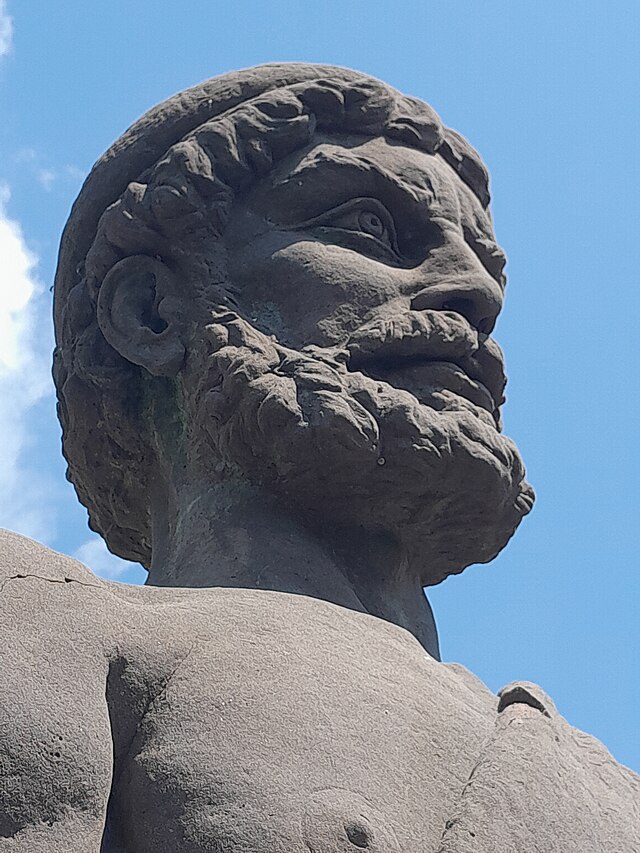
Bust of Odysseus in Stauros, Ithaca, Greece. Photo Credit: Deiadameian CCA-SA 4.0
Equally significant is the chronological range of the material. Evidence of human activity at the site dates back to the late Neolithic period, while Mycenaean-era artifacts from the second millennium BCE indicate occupation during the time traditionally associated with the Trojan War. Later materials from the Hellenistic and early Roman periods show that the site continued to function as a place of communal and possibly sacred importance well into the first centuries CE.
For scholars, this continuity suggests that Odysseus was not merely a literary figure but also a focal point of sustained cultural memory and ritual practice. While archaeologists emphasize that these findings do not confirm the historical existence of Odysseus as described in Homer’s epic, they do demonstrate that ancient communities treated him as a heroic, or even semi-divine, figure worthy of veneration.
The Ministry of Culture noted that the accumulation of inscriptions, architectural features, and votive materials supports the interpretation of the site as a major public complex with religious, social, and potentially political functions. The presence of objects associated with sanctuaries, such as ritual basins and dedicatory items, reinforces the conclusion that this was a place of organized cult activity.
Perhaps most evocative for modern spiritual practitioners is the evidence that the site also functioned as a pilgrimage destination. The diversity of coins and offerings indicates a steady flow of visitors from different regions, suggesting that individuals traveled to Ithaca specifically to honor Odysseus. In this sense, the archaeological record reveals a lived religious landscape in which story, place, and practice were deeply intertwined.
The renewed circulation of these findings, alongside the impending release of a major film adaptation, highlights a broader cultural moment in which ancient narratives are once again being engaged not only as literature but as part of a reconstructed and reimagined spiritual heritage.
The Ithaca site ultimately illustrates how mythic figures can occupy a liminal space between story and devotion, serving as anchors for identity, ritual, and communal memory. It also underscores how sacred landscapes are constructed, not only through divine association but through sustained human engagement across generations.
The Wild Hunt is not responsible for links to external content.
To join a conversation on this post:
Visit our The Wild Hunt subreddit! Point your favorite browser to https://www.reddit.com/r/The_Wild_Hunt_News/, then click “JOIN”. Make sure to click the bell, too, to be notified of new articles posted to our subreddit.