
Pagan Community Notes: Beltaine, 2026


TWH — As we publish this week’s Pagan Community Notes on Hexennacht, we find ourselves at one of the most vibrant turning points in the Pagan calendar. Around May 1, many traditions across the Northern Hemisphere mark the arrival of late spring and the threshold of summer with festivals such as Beltane, Bealtaine, May Day, Floralia, Protomayia, and Walpurgisnacht.

These observances celebrate fertility, vitality, and the flowering of the land—a season of joy, connection, and abundance. It is also widely understood as a liminal time, when the boundaries between this world and the Otherworld grow thin, inviting both celebration and reverence. In many traditions, this is a sacred moment of union—of divine forces, of land and sky, of community and spirit.

Walpurgisnacht, observed on April 30, carries a particularly enduring association with witches and witchcraft. Often called Hexennacht, or “Witches’ Night,” it is traditionally understood as a time when witches gather, marking the eve of May Day with rites, folklore, and celebration that have echoed across centuries.

In the Hellenic world, ancient festivals such as Anthesteria—more commonly associated today with Protomagia—honor the rebirth of nature and are linked to the mythic return of Persephone from the Underworld. While historically observed earlier in the year, many modern Hellenic polytheists celebrate these themes on May 1. Soon after, the festival of Thargelia follows, honoring Apollon and Artemis and continuing the seasonal rhythm of renewal and divine presence.

Yet these seasonal rhythms are not universal. For Pagans in the Southern Hemisphere, this same moment marks the deepening of autumn. Rather than the ascent into summer, May 1 signals the waning of the light, the close of the harvest, and the approach of winter. In many traditions there, Samhain and related observances honoring the dead and the ancestors take precedence, reflecting a different but equally sacred turn of the Wheel.

Beyond religious observance, May 1 also carries global secular significance. In much of the world, it is recognized as International Workers’ Day, or Labour Day—a time to honor the contributions and struggles of workers. While countries such as Australia, Canada, Japan, New Zealand, and the United States observe similar holidays on different dates, the spirit of recognition and solidarity remains shared.

A Garland for May Day 1895, Walter Crane [public domain]

Across traditions, hemispheres, and cultures, this time of year reminds us of the diversity within the global Pagan community—and the many ways we mark the turning of the seasons, the cycles of life, and our connection to one another.

Here are some quotes for this Sabbat:

“We are told that the flesh is weak, that the flesh should be subdued, that the god of some other religion would have us not gratify the flesh. The flesh is understood to be the place where evil resides and from which torment wreaks havoc upon the mind. The flesh is temporary, so it must be trivial. The flesh will not remain, so we must not give it credence. The flesh will pass unto the earth, rot in the ground, turn into dust. We are told again and again to dismiss the flesh. But Whitman says, ‘And your very flesh shall be a great poem.’ Yes. Our very flesh shall be a great poem. That is the message I’d like to offer on Beltane.”Teo Bishop, “Beltane 2013: The Great Poetry of Flesh,” The Huffington Post

Winds of May, that dance on the sea,
Dancing a ring-around in glee
From furrow to furrow, while overhead
The foam flies up to be garlanded,
In silvery arches spanning the air,
Saw you my true love anywhere?
Welladay! Welladay!
For the winds of May!
Love is unhappy when love is away!”

~ James Joyce, 1926

“In the face of so much destruction of the natural world and so much disregard for life, Beltane is also an act of rebellion against the status quo. It says about us–as simple people, as a growing community–that we don’t give in to the death cycles imposed on us from Away, not in this season.  We plant and know that the harvest comes–not in the stately march from Lughnasadh to Samhain–but bit by bit and day by day.  We eat the impossible radishes in two weeks, we rip the dewy and crispy lettuce from the fat stem that sustains it. The hens fluff out and begin to lay again and life is there before us–irresistable, delicious. Magical.”Byron Ballard, “Summer is Come,” PaganSquare

Corinna’s going a Maying

Get up, get up for shame, the Blooming Morne
Upon her wings presents the god unshorne.
                     See how Aurora throwes her faire
                     Fresh-quilted colours through the aire:
                     Get up, sweet-Slug-a-bed, and see
                     The Dew-bespangling Herbe and Tree.
Each Flower has wept, and bow’d toward the East,
Above an houre since; yet you not drest,
                     Nay! not so much as out of bed?
                     When all the Birds have Mattens seyd,
                     And sung their thankful Hymnes: ’tis sin,
                     Nay, profanation to keep in,
When as a thousand Virgins on this day,
Spring, sooner than the Lark, to fetch in May.
Rise; and put on your Foliage, and be seene
To come forth, like the Spring-time, fresh and greene;
                     And sweet as Flora. Take no care
                     For Jewels for your Gowne, or Haire:
                     Feare not; the leaves will strew
                     Gemms in abundance upon you:
Besides, the childhood of the Day has kept,
Against you come, some Orient Pearls unwept:
                     Come, and receive them while the light
                     Hangs on the Dew-locks of the night:
                     And Titan on the Eastern hill
                     Retires himselfe, or else stands still
Till you come forth. Wash, dresse, be briefe in praying:
Few Beads are best, when once we goe a Maying.
Come, my Corinna, come; and comming, marke
How each field turns a street; each street a Parke
                     Made green, and trimm’d with trees: see how
                     Devotion gives each House a Bough,
                     Or Branch: Each Porch, each doore, ere this,
                     An Arke a Tabernacle is
Made up of white-thorn neatly enterwove;
As if here were those cooler shades of love.
                     Can such delights be in the street,
                     And open fields, and we not see’t?
                     Come, we’ll abroad; and let’s obay
                     The Proclamation made for May:
And sin no more, as we have done, by staying;
But my Corinna, come, let’s goe a Maying.
There’s not a budding Boy, or Girle, this day,
But is got up, and gone to bring in May.
                     A deale of Youth, ere this, is come
                     Back, and with White-thorn laden home.
                     Some have dispatcht their Cakes and Creame,
                     Before that we have left to dreame:
And some have wept, and woo’d, and plighted Troth,
And chose their Priest, ere we can cast off sloth:
                     Many a green-gown has been given;
                     Many a kisse, both odde and even:
                     Many a glance too has been sent
                     From out the eye, Loves Firmament:
Many a jest told of the Keyes betraying
This night, and Locks pickt, yet w’are not a Maying.
Come, let us goe, while we are in our prime;
And take the harmlesse follie of the time.
                     We shall grow old apace, and die
                     Before we know our liberty.
                     Our life is short; and our dayes run
                     As fast away as do’s the Sunne:
And as a vapour, or a drop of raine
Once lost, can ne’r be found againe:
                     So when or you or I are made
                     A fable, song, or fleeting shade;
                     All love, all liking, all delight
                     Lies drown’d with us in endlesse night.
Then while time serves, and we are but decaying;
Come, my Corinna, come, let’s goe a Maying.

~ Robert Herrick, 1648


The Flower Moon 

EARTH — The first of May’s two Full Moons will peak on May 1 at 1:23 p.m. ET, with the second, commonly called a “Blue Moon” (and our usual spoiler alert, it won’t be blue), following on May 31 at 4:45 a.m. ET.

The May Full Moon is widely known as the Flower Moon, a name often attributed to Algonquian peoples, who used lunar cycles to track seasonal changes across regions stretching from the Atlantic Coast to the Great Lakes. As spring reaches its height, the landscape bursts into bloom, making the name especially fitting.

Other traditions offer their own names for this seasonal moment. In Anglo-Saxon England, the month of May was known as the Milk Moon, from the Old English Rimilcemōna (“three-milkings month”), reflecting a time of agricultural abundance when cows were often milked more frequently. Other names, often attributed in Celtic and Old English traditions, include Mothers’ Moon, Bright Moon, Hare Moon, and Grass Moon, each capturing a different aspect of late spring’s vitality.

In 2026, the Flower Moon carries added resonance, arriving precisely on May 1, aligning with many Beltane and May Day celebrations.

Despite its evocative name, the Moon itself doesn’t actually change color, this time either. Sadly, it won’t appear floral or bright like a blossom, but it will be spectacular nonetheless. When rising or setting near the horizon, it can take on a warm golden or reddish hue due to Rayleigh scattering, the same atmospheric effect responsible for vivid sunsets.

A final celestial note: because the Sun is climbing higher in the sky as we approach the summer solstice, the Full Moon takes the opposite path, traveling lower across the night sky. This often results in longer shadows and a more dramatic presence as it moves along the horizon.


Thank you! Thank you! Thank you!

And we still need your help this Sabbat!

If you’ve been thinking about supporting The Wild Hunt, now is the time.

👉 This is how you can help:

Tax-Deductible Donation
PayPal
Patreon

As always, our deepest gratitude to everyone who has brought us this far.


May 11, 2026:  EBSAT Meeting 5:00 pm PDT to 5:30 pm PDT
Dr. Jon Cleland Host will share “A Detroit Autoworker Spills the Tea about the EVs in your Future.”

Within the auto industry, views often differ from those in the mass media. As an automotive scientist, I’ve seen a lot of change in the past 5 years, both in the industry’s overall direction and in new technologies quickly moving from the lab to the factory floor. Will Extended-Range Electric Vehicles (EREVs) supplant normal Electric Vehicles (EVs)? Will EVs disappear in a few years? What are the main advantages and disadvantages of the technologies you’ll drive in a few years? What effect will these have on our Earth? Find out at the May EBSAT meeting, and bring your questions!



Events and Announcements

Do you have news to share with our community?

Announcements? Festivals? Elevations? Events?

We’ll share it with the community in the

TWH Events Calendar featured on the Front Page.

(Yes, it’s free, we just need your information.)

Let us know at pcn@wildhunt.org


More Events at our new Events Calendar



Crossings of the Veil

Peter J. Carroll

With the announcement that “The Wizard has gone” on his site, specularium.org, numerous practitioners honored and noted the crossing of Peter James Carroll, the English occultist and one of the architects of chaos magic theory. Carroll was a co-founder of the Illuminates of Thanateros and founder/chancellor of Arcanorium College.

Carroll was one of the foundational voices in modern chaos magic, and his body of work helped define the movement’s core principles: pragmatism, results-based practice, and the centrality of belief as a tool. His writings are widely regarded as both instructional manuals and philosophical frameworks for contemporary magical practice.

His most influential work, Liber Null & Psychonaut (often published together), is considered a cornerstone text of chaos magic. Originally released in two parts, Liber Null (1978) and Psychonaut (1982), these works outline Carroll’s system of magical training, including techniques such as sigilization, gnosis, and paradigm shifting. Liber Null focuses on theory and foundational concepts, while Psychonaut serves as a practical training guide for practitioners.

Carroll expanded and refined his ideas in Liber Kaos (1992), which introduces a more developed cosmology and explores topics such as magical ethics, probability manipulation, and the concept of “Kia,” his term for the underlying source of consciousness and magical will. This work also reflects a shift toward a more systematized and, at times, mathematically influenced approach to magic.

In Psychonaut Field Manual (1989), Carroll provides a more concise and accessible version of his earlier teachings, designed as a practical handbook for students of chaos magic. The text distills key exercises and techniques into a portable format, reinforcing his emphasis on experimentation and direct experience.

Later works, such as The Octavo: A Sorcerer-Scientist’s Grimoire (2010), continue this trajectory, blending magical theory with speculative science and metaphysics. In this text, Carroll explores ideas about reality formation, quantum-like models of magic, and the intersection of consciousness and probability.

Across his publications, Carroll’s writing is characterized by its directness, irreverence toward tradition, and insistence that magic be treated as a discipline grounded in results rather than belief systems. His influence extended well beyond his books, shaping a generation of practitioners who view magic as an evolving, experimental practice.

He is survived by his wife and two daughters. A private cremation will be held for close friends and family. He leaves behind a lasting legacy, which will be honored in a more extensive eulogy and memorial to follow.

Specularium announced that an online memorial page will be made available on the site in the coming days.

What is remembered lives.


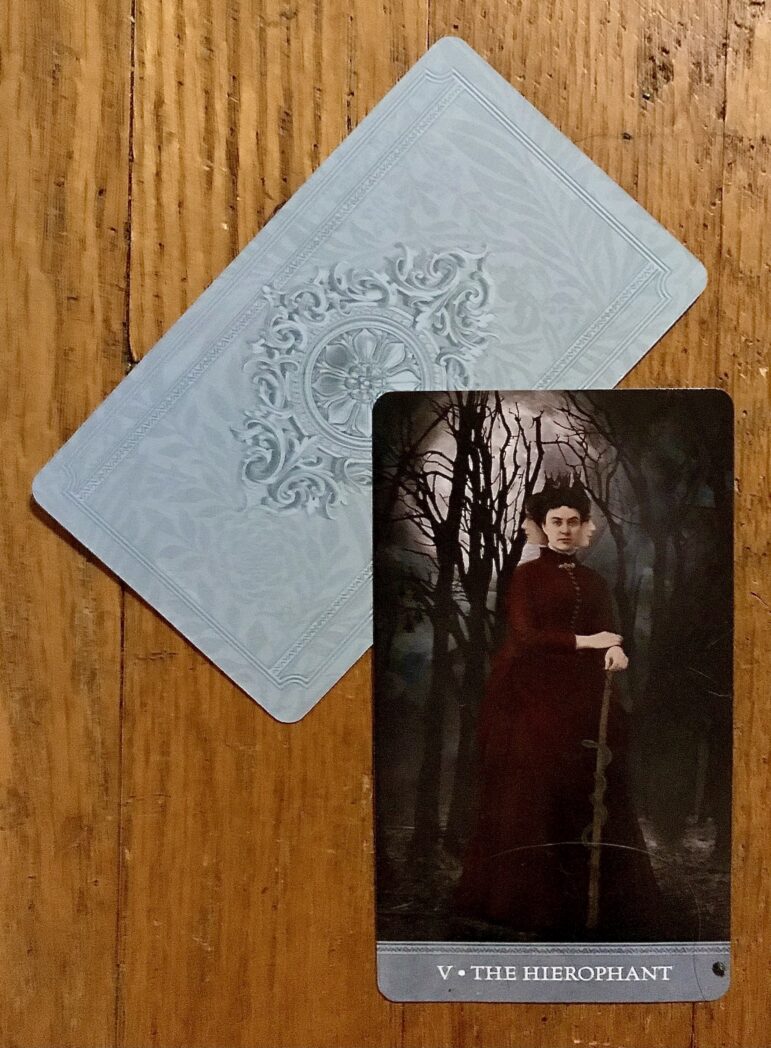
Tarot of the Week by Star Bustamonte

Deck: The Dreamkeepers Tarot, by Liz Huston, published by U.S. Games Systems, Inc.

Card: Major Arcana V (5), The Hierophant

The week ahead is likely to have strong spiritual undertones, with a focus on traditions and institutions—particularly as they apply to building resilient community. The resurrection of spiritual practices borne out of cultural heritage is liable to be emphasized, regardless of past levels of engagement. There may also be a call to examine values and redefine the level of commitment expressed.

In contrast, bucking the system and pursuing new pathways, beliefs, or ways of practicing magic and spirituality are liable to beckon. Elements of activism that reflect a desire for the shifting societal norms could also figure prominently. Challenges to established traditional paths and processes are equally likely.


👉 Don’t forget: supporting The Wild Hunt helps sustain independent Pagan journalism.

Tax-Deductible Donation
PayPal
Patreon

As always, our deepest gratitude to everyone who has brought us this far.


And, of course, some music

https://www.youtube.com/watch?v=EkwqPJZe8m


The Wild Hunt is not responsible for links to external content.


To join a conversation on this post:

Visit our The Wild Hunt subreddit! Point your favorite browser to https://www.reddit.com/r/The_Wild_Hunt_News/, then click “JOIN”. Make sure to click the bell, too, to be notified of new articles posted to our subreddit.

Comments are closed.