

Today’s offering is from Beatrix Kondo. Kondo is a Brazilian journalist and cultural critic with over 20 years of covering pop culture and sociocultural analysis for international outlets. She focuses on feminist readings of genre fiction, trauma-coded narratives, and how beauty, danger, and survival keep rewriting each other in contemporary media. Visit her at beatrixkondo.com.
The Near Witch is only a story told to frighten children.
So begins V.E. Schwab’s debut novel — and so, for nearly a decade, it remained. Published in 2011 and out of print within two years, The Near Witch became what it described: a rumor, a thing half-believed, passed between readers who had heard of it but couldn’t find it. To own a copy was to have wanted it badly enough to go looking for it. There is something almost unbearably precise about that, for a book about what happens when a community decides something inconvenient doesn’t exist.
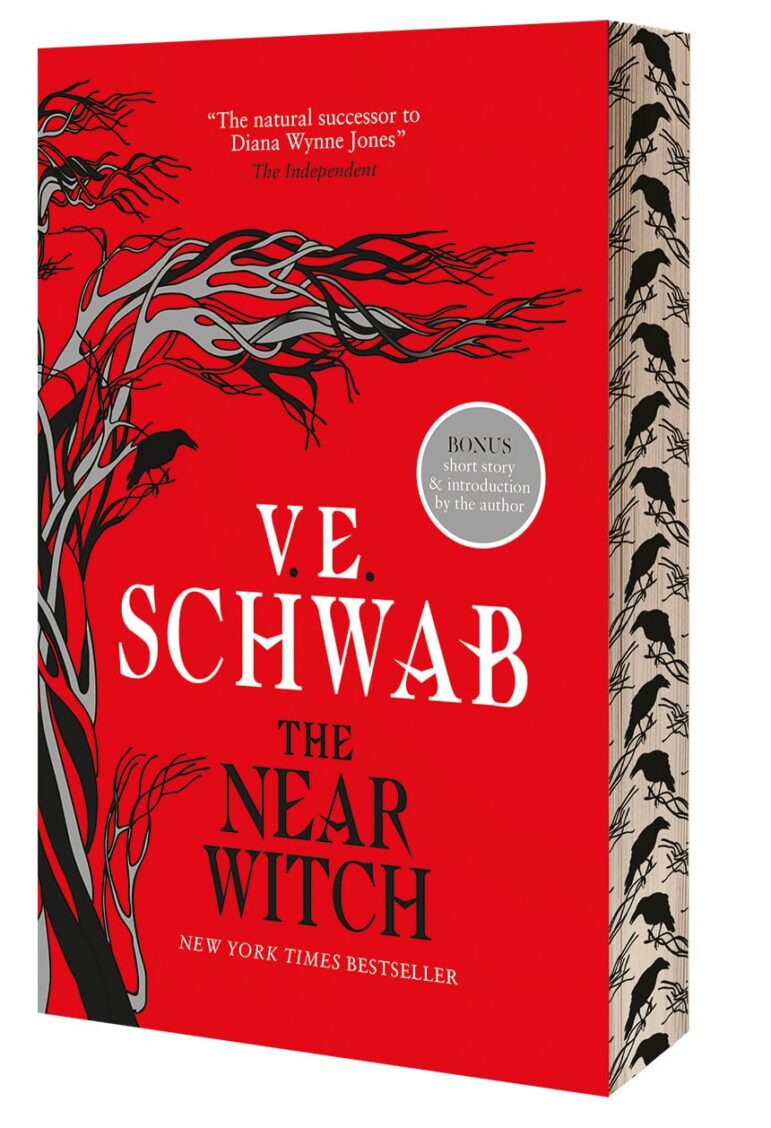
V.E. Schwab’s “The Near Witch” [Titan Books]
That irony compounds when you consider who Schwab has since become. She is now the author of more than 20 books — among them The Invisible Life of Addie LaRue and the Shades of Magic trilogy, which cemented her reputation as one of contemporary fantasy’s most reliably compelling architects of world and character. Her recent Bury Our Bones in the Midnight Soil debuted at the top of the major bestseller lists. The debut that the market quietly shelved belongs, in retrospect, to a writer whose name now moves units—which raises the question the publishing industry prefers not to sit with too long: how many other books were made to disappear before anyone had reason to go looking for them?
Titan Books reissued it in 2019. For readers coming to it now, the publishing history is not incidental context — it’s the first layer of meaning. The book acquired the status of legend before most readers had a chance to hold it — spoken of, searched for, passed between hands like something that shouldn’t exist. Coming to it now, with that history intact, feels less like reading a debut novel and more like recovering a document someone hoped you wouldn’t find.
The village that cannot afford to know itself
Near exists outside of time. Schwab gives it the texture of folklore—moors, oil lamps, stones that hold warmth after dark—but withholds every anchor that would pin it to a century. This ambiguity is not aesthetic laziness. It is load-bearing. A story set in a specific historical moment becomes a document. A story set in Near becomes a mirror.
What the mirror reflects is a community organized around the strategic management of its own fear. The hunters — led by Otto, Lexi’s uncle and the village’s self-appointed Protector, a man who inherited the role from her dead father and wears it like a mandate — are not villains in the conventional sense. They are administrators, whose function is to identify the source of collective anxiety and direct it outward, toward something that can be named, accused, contained. Otto means well, in the way that institutions always mean well: he is enforcing what he has been taught, protecting what he has been told needs protecting, and never once asking whether the lesson itself was sound. When children begin to disappear in the night, Near does not look inward. It looks for a stranger.
René Girard’s scapegoat mechanism is usually described in abstract terms, but The Near Witch renders it with uncomfortable granularity. The mechanism requires a figure who is both proximate enough to be plausible and different enough to be expendable. Cole — who appears at the edge of the village during a storm, who has no name anyone can verify, who refuses to explain himself in the idiom Near recognizes as trustworthy—is a nearly perfect candidate. The children are vanishing. Someone must be responsible. The village’s capacity to sustain its own coherence depends on the accusation going somewhere, regardless of whether it goes somewhere true.
Lexi, as the protagonist and the reader’s guide, watches this process from a position of partial complicity. She is Near-born. She has inherited its grammar. Her resistance to the scapegoating of Cole is not immediate or instinctive — it develops against the grain of everything she has been taught to recognize as reasonable. That is precisely what makes her arc legible rather than heroic. She is not immune to Near’s logic. She simply refuses, incrementally, to let it be the last word.
What the moor remembers
Schwab builds a cosmology in which the natural world holds memory and agency — not as metaphor but as fact. The wind moves through The Near Witch as a conscious presence: grieving, searching, capable of choosing who it speaks to. The moor holds the story the way it holds fog—completely, without editorial judgment. Magda and Dreska, the old women at the village’s edge, know how to read what the land is saying. Lexi is learning. The men with the torches are not listening and never were.
This is animism rendered with narrative precision, and it sits in direct conversation with a tradition Silvia Federici traces in Caliban and the Witch: the systematic dismantling, across the early modern period, of the relationship between women and the living world. Federici’s argument is that the witch hunts were not mass hysteria or theological excess—they were a coordinated campaign to eliminate female autonomy, communal knowledge, and the practices that sustained communities outside institutional control. What was classified as witchcraft was, in substantial part, herbalism, midwifery, ecological literacy, and the capacity to organize collective life without reference to church or market. The women who were killed knew things. That was the “problem.”
Near runs this logic on a slower fire. Magda and Dreska live at the village’s margin because the village has made a tacit decision: this knowledge is tolerable as long as it remains peripheral, available in emergencies, and never permitted to accumulate authority. They are consulted when children are sick and avoided when men are deciding things. The margin is not a neutral position. It is a managed one—close enough to be useful, far enough to be disposable.
When the community requires a direction for its fear, the margin becomes a target. The old women’s knowledge, which the village has quietly depended on for years, suddenly looks like evidence. Their distance from the center, which the village enforced, becomes proof of their untrustworthiness. The accusation feeds on the very conditions the accusers created. Federici would recognize the structure immediately.
The name that cannot be spoken
The Near Witch is a book preoccupied with naming — with what it means to call something by its right name, and what it means to refuse. The Near Witch herself is never named. Cole’s full name is never given. Lexi, in a book where names function as instruments of control, is the character most committed to learning the names the village has suppressed: the witch’s story, the true account of what happened to the children, the history that Near has replaced with a cautionary tale.
The cautionary tale is the community’s primary technology of control. The Near Witch is only a story told to frighten children. The opening line announces the book’s central problem: what happens when a story told to manage children is also a story told to manage what adults are willing to know? The tale functions as inoculation against inquiry. If the witch is already explained—if she is already categorized as a monster, a warning, a lesson—then the question of what actually happened to her becomes not just unnecessary but faintly transgressive. To ask is to suggest that the story might be wrong. To suggest the story might be wrong is to suggest that Near might be wrong. Near cannot afford that.
The namelessness of the witch is not incidental. It is the village’s final act of violence against her: not just to kill her, but to ensure that nothing remains that could generate counter-narrative. A name is an anchor for a story. Without a name, the witch can only ever be what Near says she is. The horror Lexi uncovers is not only supernatural. It is historiographical. Someone made sure the record said what they needed it to say, and then made sure there was no one left to contradict it.
Cole’s namelessness operates differently but in parallel. He cannot be slotted into Near’s existing social grammar because he provides no purchase points—no family name, no origin story the village can verify, no position in any of the hierarchies Near uses to assess credibility. His illegibility reads, to the hunters, as guilt. What cannot be classified cannot be trusted. The scapegoat mechanism does not require evidence of wrongdoing. It requires a figure whose difference from the group can be made to function as evidence.
The pagans Near never stopped burning
The machinery Schwab diagrams in Near did not retire with the early modern period. Contemporary Paganism — Wicca, reconstructionist polytheism, folk practice, earth-based spirituality in its many forms — occupies the same structural position in the modern social imagination that Magda and Dreska occupy at the edge of Near: tolerated at the margins, mined for aesthetic content by the mainstream, and periodically reminded that the tolerance is conditional.
The pattern is consistent enough to be predictable. Pagan ecological knowledge gets absorbed into wellness culture the moment it becomes profitable—herbalism rebranded as “plant medicine,” seasonal ritual repackaged as mindfulness, the wheel of the year laundered through lifestyle content until nothing remains of its relational cosmology. The knowing is extracted. The knowers remain marginal. What Federici describes as primitive accumulation—the seizure of common resources from the communities that maintained them—has a cultural analogue, and it runs on the same logic: take what is useful, discredit what remains, ensure the original practitioners have no claim on the extraction.
And when the fear spikes—when drought comes, or plague, or children start vanishing in the dark—the tolerance evaporates at roughly the same speed it always did. The scapegoat mechanism is not a medieval relic. It is a feature of how communities under stress produce coherence. Near’s hunters are recognizable because the social function they perform has never stopped being useful to the people who benefit from it—history doesn’t need to repeat itself mystically when the machinery was never actually dismantled. The figure at the margin—the one whose knowledge the center depends on but refuses to credit, whose presence the center permits but refuses to integrate—is always available when the village needs somewhere to point.
Schwab’s Near Witch was killed for knowing what the moor was saying. Magda and Dreska survive by making themselves small enough to be forgotten when the torches come out. Lexi’s act of resistance is to refuse that smallness—to learn the names, recover the stories, insist on the counter-narrative even when Near has organized its entire social machinery against the possibility that one exists.
The book was out of print for eight years. It came back. Some things are harder to make disappear than the people trying to erase them would like.
Joy without permission
There is a quality in Schwab’s prose that resists the gothic register even as it borrows its furniture. The moor is not hostile. The darkness is not malevolent. Lexi’s growing capacity to hear what the wind is saying is not a corruption but an education—a recovery of attentiveness that Near has systematically discouraged. The book’s emotional current runs toward something that feels, by the end, almost scandalously gentle: the possibility that the world the village fears is not dangerous but alive, and that the women who knew how to live inside that aliveness were killed not because they were threatening but because they were right.
That is The Near Witch‘s quietest provocation, and its most durable one. The witch was not a monster. She was someone who remembered what the land was saying. Near killed her for it, built a story over the grave, and taught the story to its children as though the telling were an act of protection. Lexi’s work—and the reader’s—is to hear, beneath that story, the original sound. The wind that has been looking for its dead.
The Wild Hunt is not responsible for links to external content.
To join a conversation on this post:
Visit our The Wild Hunt subreddit! Point your favorite browser to https://www.reddit.com/r/The_Wild_Hunt_News/, then click “JOIN”. Make sure to click the bell, too, to be notified of new articles posted to our subreddit.