

Today’s offering is from Beatrix Kondo. Kondo is a Brazilian journalist and cultural critic with over 20 years of covering pop culture and sociocultural analysis for international outlets. She focuses on feminist readings of genre fiction, trauma-coded narratives, and how beauty, danger, and survival keep rewriting each other in contemporary media. Visit her at beatrixkondo.com.
The water must be room temperature. Your hands, washed clean. The first bottle—always the oil cleanser, never skip, never reverse the order—goes between your palms until it warms. You press it to your face in upward motions, counterclockwise on the left cheek, clockwise on the right. Sixty seconds, no less. The makeup dissolves. You are unmaking what you made.
Water-based cleanser next. Foam between your fingers. The pH matters. Everything matters. Toner on a cotton pad, patted not wiped, until your skin drinks it. Essence. Serum. Ampoule. Sheet mask for twenty minutes while you sit perfectly still, a face that is not your face covering your face. Eye cream with your ring finger, the weakest finger, so you don’t damage the delicate skin. Moisturizer. SPF, always SPF, even at night if you’re serious, and you are serious because you have seen what happens to those who are not.
This is not witchcraft.
Or is it?
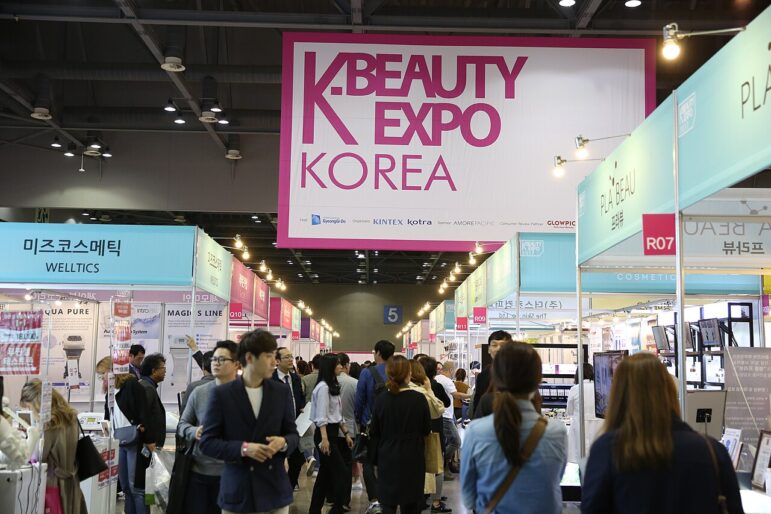
The K-Beauty Expo Korea, 2017 [Kintexsw, Wikimedia Commons, CC 4.0]
This is K-beauty – an approach to cosmetics and skincare that began in South Korea but is now popular around the world. The 10-step skincare routine. The path to glass skin—that translucent, luminous, poreless ideal. Skin that looks like light lives under it. Skin that looks like you have been fundamentally transformed.
The Grimoire You Buy at Sephora
Every practitioner knows: magic requires precision. The words must be spoken in order. The candles lit in sequence. Reverse the steps and the spell collapses. Skip an ingredient and the working fails. Belief matters, but so does technique. So does repetition. So does faith that if you do this correctly, transformation will come.
The 10-step Korean skincare routine operates identically to ceremonial magic. Oil cleanser, then water-based cleanser—never the reverse, because oil binds to oil and water to water, and if you do not respect the nature of materials, they will not respect you. Toner opens the pathways. Essence carries the active magic deep. Serum concentrates the power. Ampoule intensifies it. Sheet mask seals it in. Eye cream protects the vulnerable places. Moisturizer sets the working. SPF wards against the damage that undoes everything.
Each step takes time. Products need minutes to absorb before the next layer. Rush it and you waste your materials, your effort, your money. The ritual requires patience. It requires repetition—not once, but twice daily, every day, forever. It requires belief that this will work, that transformation is possible, that if you commit fully you will see results.
This is a grimoire. The instructions are specific. The ingredients are specialized. You must learn which extracts do what, which acids exfoliate, which peptides build collagen, which ferments penetrate deepest. You must know your skin type, your concerns, your goals. You must study. You must practice. You must have faith.
But here is what makes this grimoire different from the ones that got women burned: you buy this one. Every month. From corporations that tell you what ingredients work. Those that set the standards for what transformation means and profit every time you perform the ritual.
The medieval grimoire passed hand to hand, woman to woman, outside the market. This one costs you.
Glass Skin: Alchemy for the Instagram Age
Alchemists sought to transmute base metals into gold. Flesh into light. The material into the transcendent. Glass skin describes the same process: the transmutation of regular skin—porous, textured, mortal—into something that appears luminous, translucent, poreless. Skin that looks like glass. Base material transformed into precious material.
Before and after photos operate as proof that the magic works. The same face, but changed. Clearer. Brighter. Transformed. The evidence is visible. The transformation is real.
Korean dramas function as instructional texts. In True Beauty, Ju-kyung masters the 10-step routine and makeup application—her grimoire—and transforms from bullied outcast to goddess. The magic works. She gets the boy, the friends, the life she always wanted. But the show also reveals the trap: she cannot let anyone see her real face. The magic only works if she performs it constantly. If she stops, she loses everything. The spell must be maintained or it breaks.
My ID is Gangnam Beauty tells the darker version. Mi-rae undergoes plastic surgery—the most extreme transformation ritual—to escape bullying. The magic works. She becomes beautiful by the standards that tortured her. But the show asks: who set those standards? Who profits from her desperation to meet them? And why does her transformation, instead of freeing her, trap her in new forms of judgment?
Both shows teach the same lesson K-beauty teaches: transformation is possible, but it is not free. Not in money. Not in time. Not in the constant vulnerability of knowing your power depends on rituals you must perform forever, in private, to meet standards you did not choose.
The alchemist sought the philosopher’s stone. The K-beauty practitioner seeks glass skin. Both pursue transmutation. But only one enriches corporations while she does it.
Which Magic Capitalism Permits
In Caliban and the Witch: Women, the Body and Primitive Accumulation (2004), Silvia Federici documents how European witch hunts specifically targeted women’s autonomous knowledge. Herbalism. Midwifery. Contraception. Healing practices. Body transformation knowledge. These women were dangerous because their magic was real—and it operated outside patriarchal and economic control. A woman who could heal herself and others, who understood plants and bodies, who gathered with other women to share knowledge, represented power that neither church nor state could monetize or regulate. The purpose was to facilitate the rise of capitalism.
So they burned her.
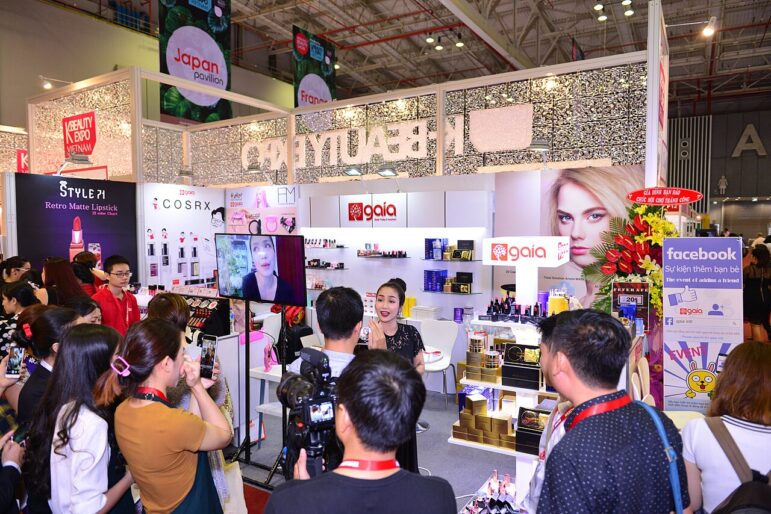
K-Beauty Expo Vietnam, 2017 [Kintexsw, Wikimedia Commons, CC 4.0]
K-beauty resurrects the exact structure of that knowledge. Transformation through plant extracts—snail mucin, centella asiatica, green tea, rice water, ginseng. Repeated ritual performed with specialized knowledge. Understanding of how ingredients interact, which combinations work, how to read your body’s responses. Time invested. Belief in the process. Community of practitioners sharing techniques.
But now knowledge costs money. The ritual serves patriarchal beauty standards. The practice happens alone, in your bathroom, not collectively. And “self-care” operates as an ideological spell disguising compulsory labor as choice.
You are not required to perform the 10-step routine. No one forces you. But if you don’t, you will age faster. Look tired. Fail to meet the standards. Be judged. Lose opportunities. The choice is yours—which is to say, it is not a choice at all.
The witch was dangerous because her magic operated autonomously. She did not need to buy it. She did not perform it to meet men’s standards. She did it with other women, for reasons they decided together.
The K-beauty practitioner performs similar transformative work—real transformation, real magic—while remaining dependent on brands she does not own, standards she did not set, approval she cannot control, and capital she must continuously spend.
Capitalism permits magic it can monetize. It criminalizes magic it cannot. The herbalist who gathers plants and shares tinctures with her community for free is practicing medicine without a license. The woman who spends two hundred dollars a month or more at Sephora is a valued consumer. Both are performing transformation rituals. Only one feeds the machine.
The Spell Called Self-Care
“Self-care” may be the most successful ideological spell capitalism ever cast. It reframes labor as leisure. Spending as nurturing. Exhaustion as indulgence. You are not maintaining your marketability—you are caring for yourself. You are not performing compulsory femininity—you are practicing ritual. You are not spending money you may not have on products you may not need to meet standards you did not choose—you are investing in yourself.
The spell works because it contains truth. The 10-step routine does feel like a ritual. It does create space away from demands. It does produce visible results. The magic is real.
But so is the trap.
Real self-care might be rest. Community. Rage. Collective action against the systems that exhaust you. Rejecting beauty standards entirely. Building power with other women outside capitalist structures. Reclaiming the autonomous knowledge they burned witches for practicing.
Instead, you get a sheet mask. Alone. In your bathroom. That you paid for. That lasts twenty minutes. That you will need to buy again.
The ritual is real. The transformation happens. But the prison is also real.
What We Name When We Name the System
This essay does not judge who practices K-beauty. The witch was not guilty for being burned. The K-beauty practitioner is not guilty for existing under capitalism, for wanting to feel beautiful, for finding genuine joy and power in ritual, for building community with other practitioners, for experiencing real transformation.
The magic is real. That is not in question.
What needs naming is who profits from transforming autonomous knowledge into lucrative dependence. What needs examining is which magic capitalism monetizes and which it criminalizes, and why. What needs interrogating is how “self-care” became something you purchase instead of something you practice collectively, in resistance, as power.
The 10-step routine works. Glass skin happens. The before and after photos prove it. But every grimoire comes with a cost, and this one costs more than money. It costs the knowledge that magic once operated outside markets. That women once gathered to share transformation practices they controlled. That the witch they burned was dangerous specifically because her power was hers.
K-beauty is not the enemy. Capitalism is. Patriarchy is. The system that took autonomous magic, repackaged it, and sold it back to us with the promise that if we just buy enough, perform the ritual correctly enough, believe hard enough, we will finally be acceptable—that system is what needs burning.
The magic is real. Your face does transform. The ritual does create sacred space. Knowledge is valuable.
But imagine what that magic could be if it were free.
The Wild Hunt is not responsible for links to external content.
To join a conversation on this post:
Visit our The Wild Hunt subreddit! Point your favorite browser to https://www.reddit.com/r/The_Wild_Hunt_News/, then click “JOIN”. Make sure to click the bell, too, to be notified of new articles posted to our subreddit.