

My first tarot deck was an oversized major arcana novelty item called the Lover’s Deck. It had that iconic card on the box, all fig-leaved innocence overlaying the infinite mystery I was sure I would find within. I learned to read for my friends in high school, and who could have more drama and intrigue than a group of mostly-queer theater kids, half of whom weren’t out to their parents yet? The practice suited me as a semi-professional gossip and a baby Witch, and I worked at it until I could read a whole deck without the book, without a net.
This year, I’ve turned back to the practice, starting with my marathon read for strangers at my local café on the winter solstice. It’s been a sometimes part of my Paganism for 30 years now, and I’ve always been cautious not to overuse it and never to rely on it. I’ve seen too many people become dependent and obsessed with what the cards (or any penny-ante augury) has to offer. I always think of that episode of the original Twilight Zone, where a young couple becomes obsessed with a “mystic seer” device that purports to tell them the future – though that’s become a better metaphor for AI slopgazers, these days.
As I dig deeper into cartomancy, I remember all the times that the dread revelations of the cards have shown up in stories I’ve loved. Tarot is often misused, represented not only inaccurately, but incorrectly. Sometimes this faux-tarot is deployed for laughs, as in a 1995 episode of The Simpsons titled “Lisa’s Wedding.” Encountering a fortune teller at a medieval times/renaissance faire, the young brainy Simpson girl asks about her future love life. The fortune teller pulls the Death card (accurate, legible) and gives the same spiel every Witch does: it doesn’t necessarily mean literal death, and often represents the turning of a new leaf. Next, the cards show Lisa the Happy Squirrel (not a real card, just Conan O’Brien in the writer’s room making a joke), which fills the stock character of the fortune teller with horror. The Happy Squirrel means heartbreak, naturally.
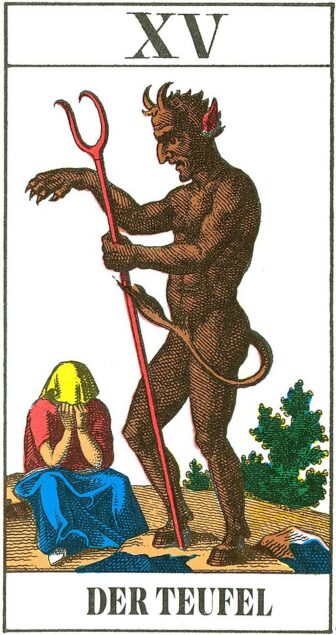
The Devil – Trump The Devil (Nr. XV) from the 1JJ tarot deck. 19th century card design. German version.-See page for author, Public domain, via Wikimedia Commons
Reading for myself, I allow for a great deal of subtlety in the meanings of individual cards. I know myself; I know the Devil card indicates something I want that I absolutely should not have (often revenge, sometimes an extravagance.) Reading for a stranger recently, I pulled the Devil and laid him on the bar between our coasters. I began to explain to the watery-eyed young man that the Devil isn’t about evil, it’s about a trap that you could escape if only you’d let go of what’s in your fist.
Ten minutes later, he was admitting to me that he needed to give up cocaine and go to Iowa to care for his aging father. The cards only tell you what you already know.
I already knew The Red Violin (François Girard, 1998) was going to be my kind of film. My favorite teacher in my final year of high school told me surreptitiously that I ought to see it, realizing as she spoke that it was graphically violent and sexual, and I was still a minor. But the minute I saw the cover in Blockbuster video, with its saturated Man Ray homage playing up the similarity between the curves of a woman’s body and the titular stringed instrument, I knew it was my kind of thing.
That feeling only intensified my 1990s witchcraft halcyon days as the film showed me a tarot reading of perhaps the oldest kind: the Marseille deck being read for the beautiful pregnant wife of a violin maker. (Don’t get attached: she’s about to be mega-fridged.) Paradoxically, her cards say she will go before a powerful magistrate (Justice) and travel far (Six of Swords). The reader predicts fire and death and brings the Devil back in, scaring this devoutly Christian pregnant woman who nonetheless worships the moon. But as the story unfolds – spoiler alert! – we come to understand that this future was not hers, but that of the long-lived violin that the widower varnishes with her blood, painting with a brush made from her hair after she has died in childbirth. The cards weren’t wrong; they were just about the life beyond the one she was living.
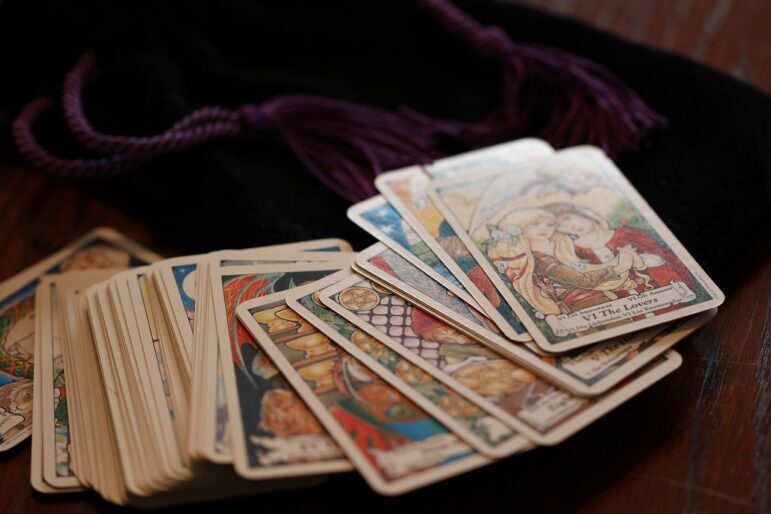
Tarot cards [Pixabay]
The second life is either the unreal one or the one that matters most, depending on who you ask on the HBO series Westworld (2016-2022). In this show, the tarot is used to typify the inner journey of the homunculi hotties of the simulated West, whom their creator intended to experience the ultimate mystery of personhood. A reading for Dolores, a synthetic approximation of a woman constructed for the pleasure and brutality of rich men (Evan Rachel Wood, on-screen and off, to be honest), shows the Judgement card, indicating that these violent delights will ultimately come to a violent end when the good are separated from the folks whose money the amusement park can do without. Beside it, the fortune teller lays a numberless card: the Maze. The Maze is Westworld’s symbol for the journey within; the trajectory of the computer-girl who can gain sentience if she tries hard enough to be more than a sexbot with a six-shooter.
The Maze is a much better fake tarot card than the Happy Squirrel, in the end. Tarot is always about an inward journey, a set of twists and turns that lead ever inward, toward the center of yourself. They don’t tell you anything you don’t already know.
As I turn my own cards for the coming spring, I see all the things I knew would be in my way: the work that must be done, the long fallow period of looking for work studded with the odd gem of a gig, and the Ten of Wands burden that is mine to carry up this hill. The folks writing Westworld understand that the tarot is for people who are looking for insight on the Great Work. The writers of The Simpsons think this stuff is strictly for nuts.
Tarot on the screen is never as good as tarot on my table. Amused and undeterred, I’m shuffling them to go again. I’m hearing the playing of that red violin, plaintive and painted with tragedy. I’m always ready to greet Death with a smile.
The Wild Hunt is not responsible for links to external content.
To join a conversation on this post:
Visit our The Wild Hunt subreddit! Point your favorite browser to https://www.reddit.com/r/The_Wild_Hunt_News/, then click “JOIN”. Make sure to click the bell, too, to be notified of new articles posted to our subreddit.