

 TWH – Krampuslauf (Krampus Run) and Krampusnacht (Krampus Night) celebrations have seen a notable resurgence across Europe and the UK in recent years—and they have become increasingly popular throughout North America as well. Krampusnacht falls on the evening of December 5, immediately preceding the Feast of St. Nicholas on December 6. The most familiar image of Krampus is that of a horned, anthropomorphic goat—something like a satyr who has decidedly chosen the darker path.
According to tradition, St. Nicholas brings gifts to well-behaved children, while those who have been less virtuous hope that Krampus somehow misplaces their address. Folklore depicts Krampus wielding a bundle of birch switches, a heavy stick, or even a sack of ashes, used to punish those who misbehaved in the past year. In some tellings, he smears ash on the faces of wrongdoers; in others, he drags the worst offenders away to some dark and distant place—perhaps for a year, perhaps forever. However the story is told, Krampus is never a comforting figure.
The precise origins of Krampus remain unclear. While some contemporary accounts claim he predates Christianity or emerges from pre-Germanic Paganism—sometimes even describing him as a child of the Norse Goddess Hel—there is no historical or textual evidence to support a Norse connection. What we have instead is a patchwork of regional folklore. The character varies significantly depending on country, century, and storyteller, and in many traditions he works alongside St. Nicholas as part of a paired moral team.
As Al Ridenour notes in his 2016 book The Krampus and the Old, Dark Christmas: Roots and Rebirth of the Folkloric Devil, the strongest historical roots of the Krampus tradition lie in Austria and Bavaria, with western Austria emerging as the most likely point of origin. Across Europe, a number of wintertime figures resemble Krampus in role if not in form—such as Knecht Ruprecht in Germany, Père Fouettard in the Alsace region of France, Schmutzli in Switzerland, and even Zwarte Piet in Belgium, the Netherlands, and Luxembourg. This range of similar figures suggests that “Krampus” may be less an individual being and more a type of wintertime enforcer within broader Alpine and Central European folklore.
Krampus was once popular enough to appear on postcards. Austria became the first country to deliver postcards in 1869, and by the late 1880s Krampuskarten—illustrated Krampus cards—were circulating widely. Their imagery shows a mix of Pagan motifs and Catholic visual rhetoric. Some scholars have suggested that the classical image of Pan may have influenced the developing Christian iconography of the devil, which in turn shaped how Krampus was drawn.
A number of misconceptions about Krampus persist, amplified by modern media. Films, television, and even widely shared articles—such as a 2013 feature in National Geographic and a later Smithsonian Magazine piece that relied on it—have helped spread inaccurate claims about Krampus’s origins and meaning. Confusion between the Catholic St. Nicholas and the Protestant Santa Claus only further muddies the waters, contributing to Krampus being popularly labeled the “Christmas Devil.”
Ridenour also proposes a possible connection between Krampus and the spirits of the dead. The word Krampus may derive from the Middle High German kralle (“claw”) and the Bavarian krampn (something “dried out,” “shriveled,” or “lifeless”), which could hint at associations with the dead. In several traditions, St. Nicholas travels with dark, ragged companions who mark wrongdoers with ash—a detail that Ridenour links to motifs found in stories of the Wild Hunt, a spectral procession often composed of the restless dead.
Whatever his origins, Krampus has proven remarkably difficult to banish. There are unverified claims that the Catholic Church attempted to suppress the tradition as early as the 12th century, though evidence for this is uncertain. What is documented is that the Krampus tradition was prohibited in parts of Austria during the 1930s under the Nazi regime. In the 1950s the Austrian government—likely influenced by conservative religious groups—distributed pamphlets warning that “Krampus Is an Evil Man.”
Those efforts did not last. By the late 20th century Krampus had returned, and in the 21st century he has surged back into popular culture—fiery, folkloric, and impossible to ignore.
Indeed, Krampus is set to run through the streets of San Antonio again this Friday, following last year’s wildly successful debut that drew an estimated 10,000 spectators. Even more fun, Local fundamentalists denounced the event, urging city leaders to intervene and warning—quite literally—that the parade would open a “portal to hell.”
There are numerous Kampus runs around the world this coming weekend. Check your local listings for dates and times.
Viel Spaß bei der Krampusnacht und Gruss vom Krampus!

Events and Announcements
More Events at our new Events Calendar
Tarot of the Week by Star Bustamonte
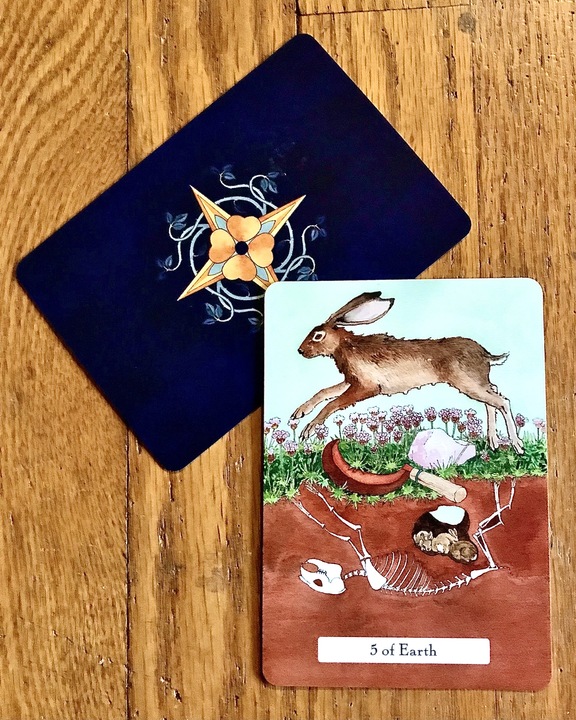 Deck: The Witches’ Wisdom Tarot, by Phyllis Curott, artwork by Danielle Barlow, published by Hay House.
Card: Five (5) of Earth (Pentacles) – One Thing Becomes Another
The incoming week has the potential to hold a bit of a snapback when it comes to financial excesses, overindulgence, and the squandering of resources from the preceding week. Taking more than is needed, exploiting natural resources beyond sustainability, and even abusing support from the community and family, is likely to have harsh consequences.
Conversely, being mindful and deliberately judicious in not only what is being consumed but also in eliminating or reducing the waste of generated is heavily indicated. Underlying that sentiment is the expression of gratitude and finding ways to both give back and share any excess bounty. Even small and seemingly insignificant acts of kindness have the potential to make much larger impacts than imagined.



The Wild Hunt is not responsible for links to external content.
To join a conversation on this post:
Visit our The Wild Hunt subreddit! Point your favorite browser to https://www.reddit.com/r/The_Wild_Hunt_News/, then click “JOIN”. Make sure to click the bell, too, to be notified of new articles posted to our subreddit.