

Just the other day, as I was mulling around ideas for upcoming articles, I tried to come up with topics I had not previously addressed. As my thoughts wandered back in time, it suddenly struck me that I had been writing for The Wild Hunt for quite a while. A quick check on the admin side of the website later told me that I had already penned 75 articles, the oldest one of which published in the end of 2015. Ten years already!
This anniversary of sorts made me think back a little bit about both my “career,” The Wild Hunt, and Pagan journalism in general, and how it has all evolved in the years I have been a part of it. As a former reader turned writer, maybe some of my comments will resonate with you, the audience? Don’t expect any flashy revelations or dramatic storytelling though – what comes next is nothing more than a largely unfiltered series of observations about the decidedly unglamorous workings of our modest enterprise.
However, before I get into this, I feel it might be worth to go back in time even further, and reminisce about the early years of the site and how I came to discover it.
How it All Started
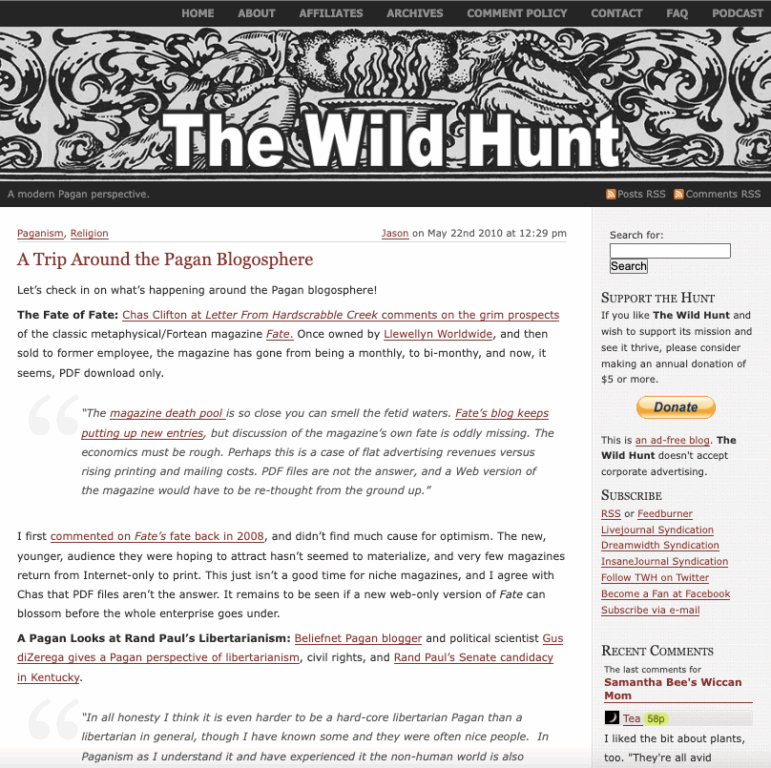
The site as it looked in the days the author first laid eyes on it (access via the wayback machine)
Although I cannot put a date to it, I am pretty sure that I first visited wildhunt.org sometime in late 2009 or early 2010. This corresponds to the period of my life when I finally moved away from home, learned English, and got easy access to the world wide web. I did not own a computer at the time, so I spent most of my time on campus in one of the many computer-labs strewn over the various faculties’ buildings.
If there ever was a formative time of my life, this was it. I quickly learned English (and a bit of Norwegian), met people from all over the world, and got exposed to a whole lot previously foreign influences, cultures, media, and whatnot. Crucially, I, for the first time, met representatives of the fascinating yet daunting land of the U.S. of A. Growing up in a strident anti-American cultural milieu corresponding quite exactly with the Bush years, I had come to think of the States as a kind of backward realm populated with nothing but gun-totting zealots.
Thankfully, meeting with actual Yankees significantly nuanced this clichéd stereotype. Thinking about it, meeting a cute half-American, Wiccan-coven initiated girl (whom I later married) probably played an outsized part in this process. Before I knew it, I started spending a whole lot time surfing on the English-speaking corners of the web, researching everything from contemporary history, politics, culture, to religion.
I distinctly recall finding about and avidly reading atheist-blogs that constantly poked fun of Christian fanatics (the only one I remember by name being Hemant Mehta’s Friendly Atheist blog), and eventually, hyperlinks through hyperlinks, blogs covering so-called alternative faiths. This is how I encountered a strange website featuring a funny-looking goat-like creature in its banner and a bunch of Pagan content in its columns: The Wild Hunt.
By that time, the website, which had grown out of Jason Pitzl-Waters’ personal website, had been functioning as a Pagan-themed blog / news-aggregator / commentary space for a couple of years, though Jason still wrote and published everything on his own. Of this early incarnation of The Wild Hunt, I recall articles on religious liberty, chaplaincy, environmentalism, Witchcraft conventions, and, of course, Halloween.
What really struck me in those days about the site was how dynamic it was. Not only were articles well-written and lengthy, they often included plenty of links to other blogs, fora, social media profiles, and more. My favorite, though, was always the comment section. Even the shortest, most run-of-the-mill article wishing people a happy Beltane would attract dozens of comments. Site regulars chatted with each others sometimes for days on end, bringing up aspects of the daily’s news piece in novel ways and overall seemed to have a very good time. Breaking news or other significant reports could get well over a hundred comments, often bringing updates to the cases, something that was highly valued in a time before Twitter really got huge.
After graduating (and losing access to the campus’ computer labs), I kind of lost touch with the site, which soon moved over, like so many Pagan blogs and site to patheos.org. The internet was changing. Individual sites were out; media, news, entertainment slowly but surely consolidated themselves into fewer and fewer urls.
Over the following couple of years, I occasionally checked the site out here and there, especially after I acquired my first internet-connected personal computer sometimes in the fall of 2012. Still, at that time, my mind was somewhere else: I wrote a whole lot for the student newspaper, deepened my knowledge of Norwegian, and slowly got more and more into Medieval Norse literature, which eventually lead me to move to Iceland in the fall of 2013 to study Norse myth and religion.

The site layout in its Patheos days (access via the wayback machine)
Investigating the Depths of Faith
For three long years, my studies almost took over my life, and I did not have much time to slack around online. Still, by the very nature of my academic path, I started encountering more and more Pagans and Heathens, and as I began to gain a deeper understanding of the old myths and religions of the North, the idea of taking that knowledge outside of stuffy classrooms and obscure grade papers began to take a hold.
Back in Norway, I started visiting the site more and more, and while it retained a lot of the appeal it held in earlier times, The Wild Hunt was in the midsts of a radical transformation. Upon separating from Patheos, Jason Pitzl-Waters began to bring in a lot more writers. 2013 and 2014 saw the introduction of a number of new, exciting writers who all brought their own flair to what had been until very recently a one-man affair.
Hooked with the diversity of the contributors, their styles, and area of focus, I began to eagerly check the site pretty much every day. I still fondly remember writers such as Clara Schultz and her highly informative pieces on both ancient history and politics, Alley Valkyrie and Rhyd Wildermuth’s lyrical, meaningful and entrancing prose, or Eric O. Scott’s deeply relatable pieces on Iceland and the North.
This period also saw longtime contributor Heather Greene taking over the role of editor in chief from Jason, a transition which was accompanied by a heightened focus on social justice and identity politics in the context of worsening international crises, wars, and terrorism.
As I hinged closer to the completion of my studies, the itch to start writing about Pagan topics outside of the confine of academia became impossible to ignore, but then, a golden opportunity arose: at the time, I was still writing on and off for the local student newspaper, and received news that a shamanic festival would take place not far from town. This is when I got a wild idea: what if I got a press pass to the event via the student paper, but wrote not one but two articles? One for the paper, and the other for The Wild Hunt?
By then, I had already exchanged a couple emails with Heather Greene and hoped that this first attempt at writing from a Pagan perspective would be accepted. It did, and you can read the piece here. Soon after, I got promoted from guest writer to bonafide columnist and opinion writer, a role I still fulfill to this day, a decade later. Somehow, I had become a Pagan journalist.
The Life of Pagan Journalist
How does it work, in practice, to be a Pagan journalist? If you were to ask me, I would answer: “somehow.” There is not really any guidebook on what to do and how to do it. While everyone at The Wild Hunt signed a short pledge (which basically boils down to: be respectful and don’t plagiarize), each and every writer is pretty much free to cover whatever they like, as long as it is (at least somehow) Pagan-related.
When it comes to my person, it is pretty simple: under my frequent walks, jogs, or bike rides, I get ideas which eventually turn into vague article outlines that sometimes get turned into opinion pieces, reviews, reports, or even actual journalistic investigations. The existence and maintenance of actual deadlines makes the writing both focused and urgent. As a procrastinator with always too much on my plate, I rarely manage to send my pieces more than a few days before publication, something that my much-esteemed editor Eric O. Scott gracefully never berate me about (although he would be in his right mind to!)
My perspective, when I write, has always been the same: I write from a deeply subjective point of view, and each and every article I write embeds at least a little bit of my person: what I feel is important to talk about, which voices to mediate, what aspects of the faith(s) are more relevant to me, what matters most in my here and now, and so on.
In practice, it has often translated by a focusing on the greater European and Nordic area. From pieces about wandering between ancient grave-mounds, a reflection on repeated visits to a cemetery, or musings about the local majestic mountain, a lot of what I write about is anchored in my immediate environment.
Still, and somehow without even being planned, quite a bit of my writing has focused on what has not been my immediate environment for a very long time, but still keeps its claws in my mind and soul: my old homeland of France. Articles highlighting ethno-religious strife, deeply Pagan yet also secular symbolism, or the intersections between Christianity, Paganism, and national heritage were all born out of necessity. Who would write about these hugely important stories if not me?
Likewise, I have never felt my writing to be more important (all proportions kept) than when I got the opportunity to cover actual news. The full-scale Russian invasion of Ukraine and the countless tragedies it brought in its wake left many of use in Europe dazed and shocked. Yet in the face of it all, many among The WildHunt staff found it critical not to subscribe to pessimism and inaction and, on our very limited level, try to cover aspects of the war relevant to Pagans, in and outside of Ukraine. Most importantly, we understood that giving a platform to victims of the war was of utmost importance, which lead to a number of interviews of Ukrainians directly affected by the Russian invasion
In the same vein, I took upon myself to reach out to Israeli Pagans and Witches to get their perspective on the gruesome October 7 attacks and the resulting war. This article which generated quite a bit of (at times) heated debate was probably the hardest and most laborious piece I ever authored, necessitating months of work getting in touch with people, gathering testimonies, and tying it up into a coherent whole.
Although I never start writing an article with the intention of provoking the audience, quite a few pieces of mine were designed to make readers think about various aspects of Paganism and faith from in less than orthodox ways. I don’t fancy myself a philosopher at all, but essays on the over-reliance of the written world and passivity, musings on faith and the lack thereof, or the spiritual implications of the rise of AI “art” felt just as necessary to write than any of the more journalistic pieces mentioned earlier, even if they rarely got as much traction.
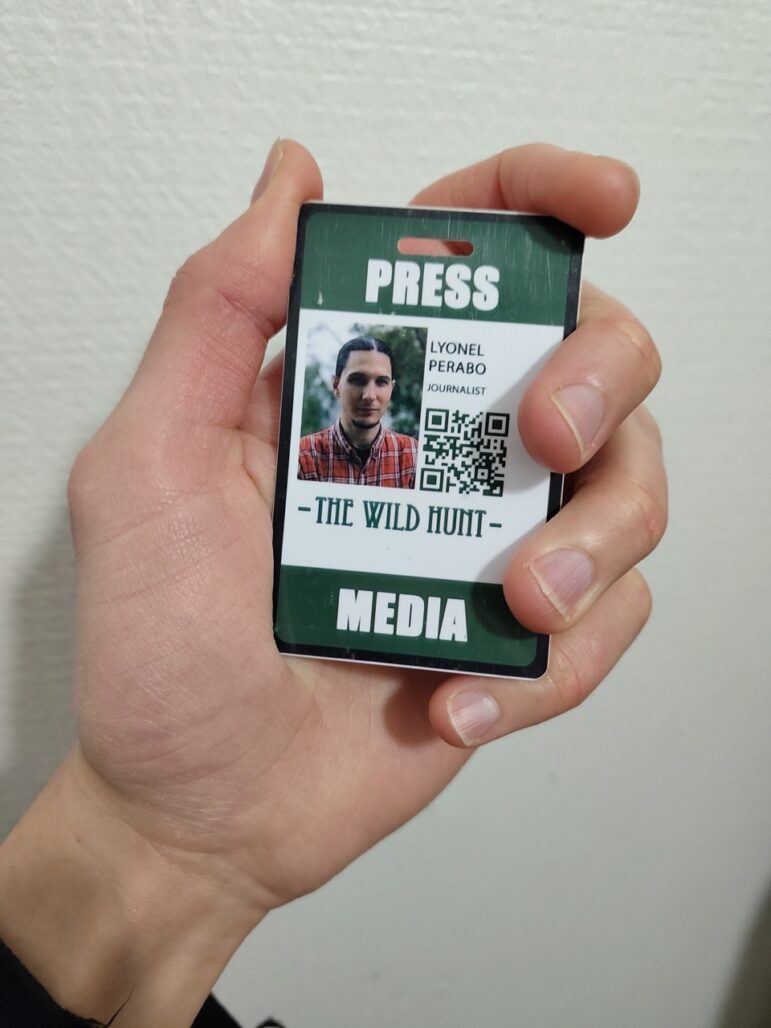
The author’s press pass
Here to Stay?
This later point is, in my opinion, something that still very much eludes me even after a decade on the job. I simply cannot quite figure what among my writing will be popular and what won’t. Sure, I never set out to write an article with the intention of making something unremarkable and shallow, but some articles in a much lighter tone sometimes get a whole lot more press than pieces I personally feel ought to resonate with the audience and “do well.”
Here I partially blame the demise of the comments. Like I wrote earlier, the comments section was always an integral part of any of the site’s articles, and in some cases, provided almost as much entertainment and information as the article they were attached to. Unfortunately, in early 2017, the costs associated with maintaining a commentary section became too high and the feature was discontinued. In its stead, a lightly-frequented subreddit was set up, which, alongside the site’s Facebook page are the only real avenue for audience interaction.
This reliance on outside social media sites is, in a way, the logical conclusion of the consolidation of information on the web. From individual sites, to standardized blogs, to massive news site, and finally, the dopamine and drama-fueled wastelands of social media. In that respect, the fact that, as niche and small as it is, The Wild Hunt still exists as an independent news website after 20 years, is nothing short of miraculous. When thinking about it, “minuscule cash-strapped niche daily news agency and website still standing after a generation” might actually make for a decent headline.
This tenacity is especially notable considering that there is not a whole lot competition. “Is there really no other Pagan news website out there?” asked a buddy of mine when he sighted an article he thought very little about. “Not really,” I answered. Unsurprisingly, keeping up a non-profit organization with essentially what feels like a few pieces of string, the odd line of code and a few nickels found behind the couch is not exactly easy. Besides us, I can think of maybe one other online news platform that has managed to keep the light up, PaganPages.
To that, one could also add a couple of blogs (on Patheos, mostly), a handful of social media channels that mostly just reshare outside content and recycle old overused memes, and a heap of long dead, barely active, or barely Pagan-related individual sites. If I wanted to be snarky, and 100% ironic, that is where I would say that it definitely gets quite lonely at the top.
Where does this leave us all? Are we, Pagan journalists, still relevant in 2025 CE? In a world where blogs and fora feel like fossils from antediluvian times and online influence gets concentrated into fewer yet larger hands, how long will there even be a need for Pagan journalism? I am going to be honest here, I have no answer. As far as we are concerned, as long as our heroic editor in chief and dear leader Manny Tejeda y Moreno manage to pour as much of himself in keeping the site functional, I know we will be in good hands.
That kind of self-sacrificing grunt work, which is shared with fellow editor Eric O. Scott and managers Stacy Psaros and Star Bustamonte, would be made a whole lot easier if anyone could actually dedicate themselves fully, or even half-fully to the byzantine work of running the site. Alas, although The Wild Hunt receives significant financial support from its readership (that means you), it simply is just enough to lightly compensate individual writers and columnists.
Besides awaiting some sorts of financial mana from heaven or the conversion of a deep-pocketed billionaire or two to the old ways, the situation is unlikely to change anytime soon. That means that, as niche, as flawed, and as small scale as The Wild Hunt is, we will nevertheless have to keep on going on, always carrying the hope that maybe the words we write on the screen will find their readers and that by serving our community, we may serve the gods, the spirits, and the ancestors too.
Skål, then, I say, to 20 years of The Wild Hunt, ten of which I can proudly say I have been a part of, and to many, many more years to come !
The Wild Hunt is not responsible for links to external content.
To join a conversation on this post:
Visit our The Wild Hunt subreddit! Point your favorite browser to https://www.reddit.com/r/The_Wild_Hunt_News/, then click “JOIN”. Make sure to click the bell, too, to be notified of new articles posted to our subreddit.