
TWH – Cats hold a special place for Witches and other Pagans, serving as familiars, confidants, and occasional co-conspirators in mischief. They watch us, plotting our murder while purring, offering eldritch affirmations, just never enough to make us big-headed or think we’re important. So cute.
The true origins of our feline allies, however, have always been shrouded in mystery. Now, two groundbreaking genetic studies reveal that the story of how cats came to walk beside us is far more complex, far more recent, and far more winding than the tidy tale long repeated in textbooks.
For decades, the dominant theory held that humans and cats first partnered around 9,500 years ago in the Levant, the region spanning the eastern Mediterranean and parts of the Middle East. According to this model, the rise of agriculture created grain stores, which attracted rodents, which attracted wildcats. People tolerated, and eventually welcomed, these early mousers. A famous Neolithic burial in Cyprus reinforced this narrative. But that long-standing framework is now cracking apart under the weight of ancient DNA.
The first study, published in Science and led by De Martino et al., examined 87 ancient and modern genomes from Europe, the Middle East, and North Africa. The results were striking: domestic cats (Felis catus) originated in North Africa, not the Levant. Their ancestors were African wildcats (Felis lybica lybica), and every true domestic cat alive today belongs to a single genetic clade rooted in the north of the continent.
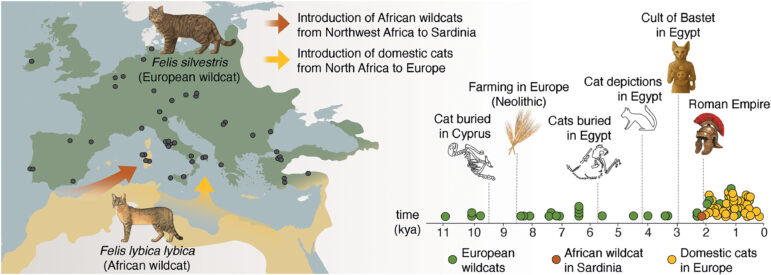
The introduction of domestic cats to Europe. via M. De Martino et al. ,The dispersal of domestic cats from North Africa to Europe around 2000 years ago.Science390,eadt2642(2025).DOI:10.1126/science.adt2642
Just as surprising is the revised timeline. No genetically domestic cats appear in Europe or Turkey before the 2nd century BCE. Many earlier remains once believed to represent domestic cats instead turned out to be European wildcats that had hybridized with Near Eastern populations, genetic lookalikes, but not members of the domestic lineage. True domestic cats only began appearing after 200 BCE, spreading rapidly across Europe, often alongside the Roman military and expanding imperial trade routes.
This dramatically reshapes our understanding of domestication. It suggests a relatively late, North African origin, followed by explosive dispersal. It also raises new questions about Egypt’s role. While Egyptians famously revered cats, depicting them as beloved family members adorned with collars and jewelry, the study cannot yet confirm whether Egypt was the cradle of domestication or simply an important hub in a broader North African process. A scarcity of ancient Egyptian DNA leaves room for future revelations.

China, meanwhile, reveals an entirely different and previously unknown chapter in feline history. A second study, published in Cell Genomics, analyzed DNA from 22 felid bones spanning 5,000 years and discovered that domestic cats did not reach China until around 730 CE, during the Tang Dynasty. Their arrival coincided with the height of Silk Road trade, and the earliest confirmed domestic cat in China genetically resembles African wildcats and matches a contemporaneous specimen from Kazakhstan. In other words: cats likely traveled east along the same caravan routes that carried silk, spices, ideas, and religions.
Before that arrival, an entirely different species lived alongside humans in Neolithic and early historic China: the leopard cat (Prionailurus bengalensis). These small, spotted wildcats were commensal, benefiting from life near humans and offering rodent control in return, but they were never domesticated. For more than 3,500 years, leopard cats played the role filled elsewhere by F. catus. Artistic depictions from tombs, including the Mawangdui Han feline, strongly resemble leopard cats, confirming their cultural presence.

Graphical Abstract via Han, Yu et al. Cell Genomics, Volume 0, Issue 0, 101099
Around 200 CE, however, leopard cats abruptly vanish from archaeological contexts. This disappearance coincides with the fall of the Han Dynasty, political upheaval, ecological stress, and transformations in poultry farming. Leopard cats, known in folklore as “chicken-catching tigers,” became unwelcome predators in the new cage-based poultry systems, and retreated into forests where they remain shy, elusive neighbors today.
The arrival of Felis catus in China marks one of the last major Eurasian domestication events. The earliest known Chinese domestic cat, nicknamed FS12, was male, short-haired, long-tailed, and either fully white or a white-patched mackerel tabby, eerily foreshadowing the white cats so common in later Chinese art.
Taken together, these two studies overturn the long-held belief that cat domestication began early, in a single place, and spread gradually. Instead, the evidence now suggests that domestic cats originated in North Africa, not the Levant; that leopard cats (not domestic cats) lived alongside humans in China for millennia; and that the true domestic lineage did not begin its wide dispersal until after about 200 BCE, moving into Europe with the Romans and reaching China via the Silk Road around 730 CE.
Much remains unknown, and researchers emphasize that additional ancient samples—especially from Egypt—will be crucial to solving the remaining mysteries. But what is clear is that the story of the cat is a story of movement, hybridity, empire, trade, ecological change, and human fascination.

Vladi establishing control at TWH HQ
Wherever they came from, North Africa, divine intervention, or a magical experiment gone delightfully wrong, we’re grateful that these mysterious creatures chose to curl beside our hearths and occasionally ponder our murder. Their secrets may be ancient, but their companionship is timeless.
The Wild Hunt is not responsible for links to external content.
To join a conversation on this post:
Visit our The Wild Hunt subreddit! Point your favorite browser to https://www.reddit.com/r/The_Wild_Hunt_News/, then click “JOIN”. Make sure to click the bell, too, to be notified of new articles posted to our subreddit.