

Uncovering the Past
LIMA, Peru – A new discovery at the Chankillo Archaeoastronomical Complex in Peru’s Casma Valley is reshaping what scholars believed about the origins of astronomy in the Americas. Located about 310 km (200 miles) north of Lima and 16 km (10 miles) inland from the Pacific coast, the site has long been recognized for its 2,300-year-old Solar Observatory and its iconic Thirteen Towers. Now archaeologists with Peru’s Ministry of Culture (MinCul) have uncovered an architectural structure that predates this famous observatory, revealing that sophisticated sky-watching practices emerged far earlier than previously understood.
The announcement, made by archaeologist Iván Ghezzi Solís, director of the Chankillo program, confirms that the newly identified structure has a clear astronomical orientation and construction techniques distinct from those used in the later observatory built around 250 BCE. “There are structures that apparently had an astronomical function long before Chankillo,” Ghezzi explained. “They have an astronomical orientation and feature different construction techniques, using stone, mud, and adobe.”
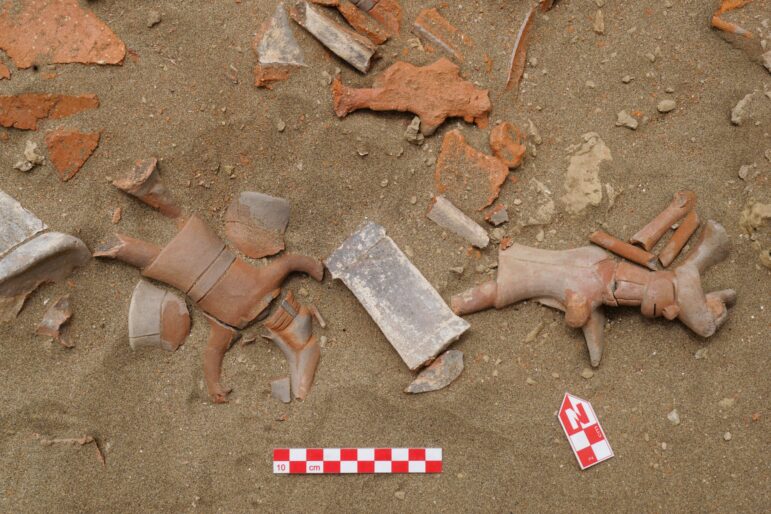
Warrior Pottery discovered. Courtesy: Peru’s Ministerio de Cultura
Researchers excavated the site between April and November, uncovering stratigraphy and architectural alignments consistent with deliberate sky observation. Stratigraphy—the study of layered deposits at archaeological sites—helps determine the sequence of construction and use. Although radiocarbon dating is still underway, the Ministry of Culture reports that the building’s solar orientation and construction materials indicate an astronomical function and date older than the UNESCO-recognized observatory and its Thirteen Towers.
The discovery is significant not only for its antiquity but also for what it reveals about the breadth of astronomical knowledge in pre-Hispanic Peru. In addition to the solar structure, archaeologists identified a corridor intentionally aligned with the lunar cycle—evidence that ancient observers at Chankillo tracked both solar and lunar movements with precision. This dual focus expands previous understanding of the site, which had primarily been celebrated for its solar horizon calendar, the only complete one known from the ancient world.
Adding to the findings is the recovery of a one-meter-tall ceremonial vessel discovered in a restricted access area near the observatory. This Patazca-style piece—an artistic tradition native to the ancient Casma Valley—was intentionally broken as part of a ritual act. Decorated with stepped motifs echoing Chankillo’s architecture, the vessel features clay figurines of warriors locked in combat, underscoring the intertwined roles of ritual, political authority, and astronomical knowledge.
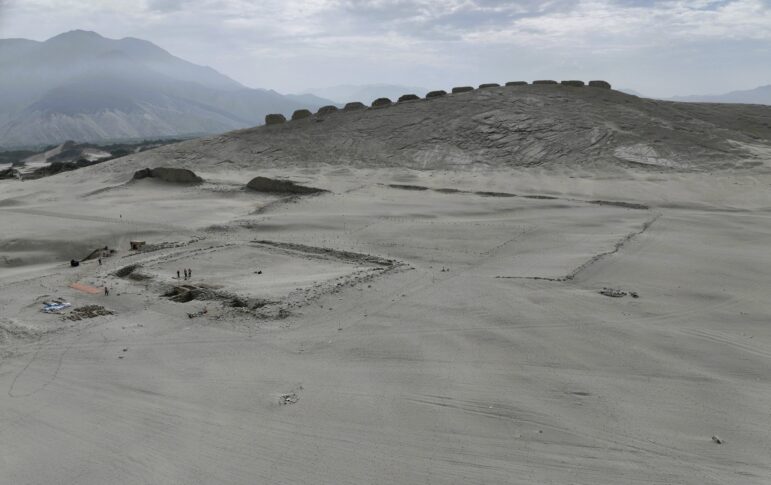
Chankillo and the excavation site in the lower left. Courtesy: Ministerio de Cultura
“We see a wonderful integration: astronomy and combat,” Ghezzi said. “These figures were leaders who possessed precise astronomical knowledge and, at the same time, were successful warriors.” The paired figurines likely represent ritual duels, reinforcing the idea that Chankillo’s elites held both military and cosmological authority and suggesting a symbolic link between astronomical knowledge, political power, and martial identity.
The vessel was found near the entrance to the Fortified Temple—the 300-meter-long structure once interpreted as a defensive complex but now understood as a political-ritual center. According to the Ministry of Culture, ceremonial pieces like this “conveyed messages of identity and authority,” linking astronomical expertise with leadership and reinforcing Chankillo’s role as a sacred and administrative hub.
As excavations continue, the Chankillo Project Management Unit has announced the identification of 12 new astronomical points across the Casma and Nepeña Valleys. These sites, aligned with solar observations and integrated into Chankillo’s broader astronomical landscape, will be proposed to UNESCO as additional World Heritage locations. Ghezzi estimates that the international recognition process could take five to six years, with the first sector of Chankillo opening to the public within two to three years. Radiocarbon dating of the newly discovered structure remains ongoing.
Recognized as a World Heritage Site in 2021, Chankillo remains one of the world’s most important ancient astronomical centers. These discoveries not only deepen the historical record but also position the Casma Valley as an emerging global destination for archaeoastronomy. As Ghezzi noted, Chankillo’s long legacy “continues to reveal secrets about astronomical knowledge, social organization, and the rituals of one of the most advanced cultures of ancient Peru.”
The Wild Hunt is not responsible for links to external content.
To join a conversation on this post:
Visit our The Wild Hunt subreddit! Point your favorite browser to https://www.reddit.com/r/The_Wild_Hunt_News/, then click “JOIN”. Make sure to click the bell, too, to be notified of new articles posted to our subreddit.