

I created The Norse Mythology Facebook Page more than 15 years ago. The numbers have wiggled up and down over the years, but it’s hovered around 250,000 followers since the great Vikingdom battle that played out in the Malaysian news media way back in 2013 (if you know, you know). These days, it’s a couple hundred or so over the quarter-million mark. The page gets about 1.4 million views per month, according to dashboard insights.
Whatever else the page is or isn’t, it’s functioned as an enormous long-term social experiment regarding popular perception of Norse myth, non-specialist understanding of the Viking Age, and – bridging both of these subjects – ways in which today’s practitioners of Ásatrú and Heathenry present themselves to and interact with the general public.
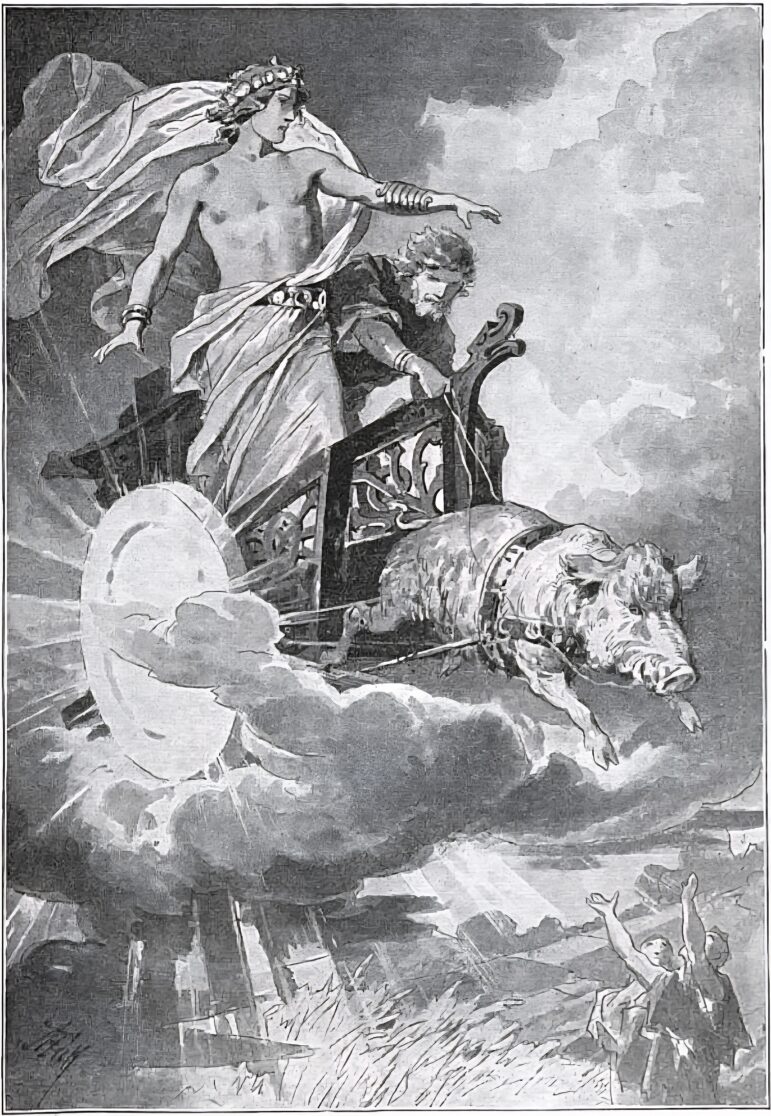
Freyr waves to his worshipers (Alexander Zick 1845-1907) [Public Domain]
The comment sections under my daily posts are where the action happens. One recent meme of mine that poked fun at “American Vikings” has 1.4 thousand comments. That’s definitely more than normal, but there are around 3.5 thousand comments monthly.
These numbers don’t reflect the regular reduction in followers brought about by my free use of the ban hammer, which tends to be drawn down by the more obnoxious Heathen-ish types ranting about bloodlines and whatever racist nonsense they’re being fed this week on Reddit or 4chan or wherever. There are a non-insignificant number of comments that get deleted when I get tired of making fun of whichever particular knuckle-dragger vomited them up.
For sure, not all the commenters are Heathens. Not even most of them are. But boy howdy, when things get going, there are a lot of folks who will just say any old thing on the internet, damn the torpedoes. Those are the interesting times that put a finger on the pulse of people who – although they may not be prominent participants in large orgs or celebrity practitioners who’ve made a name for themselves on the Heathen interwebs – nevertheless self-identify as Heathens.
Observing and interacting with this wide array of people over the past decade and a half has given me plenty of opportunity to reflect on how newcomers to this little cluster of new religious movements see themselves and project that self-image online. It’s also pushed me to reflect on my own early beginnings when first arriving in Ásatrú.
I made plenty of mistakes. Lots and lots of mistakes. Newbie excitement over diving into something new and life-altering can affect adults of a certain age as much as it can affect kids and teenagers.
The mistakes can sometimes lead to exceedingly embarrassing moments and truly terrifying confrontations, but they can also – hopefully! – lead to self-reflection and self-improvement. They can also lead to the gathering of wisdom-nuggets that we can pass on to the latest gang of newbies, if they’re interested.
Near the end of the Old Icelandic poem Hávamál (“Sayings of the High One”), the god Odin offers a variety of advice to the mysterious Loddfáfnir – possibly an acolyte, devotee, or apprentice wizard – and tells him (in Carolyne Larrington’s translation), “it will be useful if you learn it, do you good, if you have it.”
Hopefully, some of the following will be useful to someone. If not, well… I suppose you could ask for your money back.
Six things that are probably better to avoid
1. Don’t give yourself a “Heathen name” or wear “Heathen garb.” If you enjoy cosplaying as a Viking at Renaissance fairs or masquerades or comic cons and declaring yourself a Heathen as part and subset of that hobby, more power to you. Have fun! But if you are, at the heart of it, a serious practitioner of a serious religion that you take seriously, calling yourself Bloodaxe Deathstar and wearing a braided beard and a linen tunic to your office job is more than a bit wack. So is appropriating an Icelandic name from the Icelandic sagas, unless you’re actually one of the Icelandic-Americans who make up 0.015% of the U.S. population. Then it’s only slightly wack. This ain’t a costume party.
2. Don’t advertise your faith like it’s a brand. I will raise my hand as formerly guilty of this one. When I first arrived in Ásatrú, I definitely wore t-shirts with Norse gods and runes and all that stuff. There are many reasons why this is, as the kids say, cringe. For one thing, the really nice embroidered Asgard shirt I had turned out to be made by a company with ties to the extreme right in Germany. Yikes. For another, reflect on what you’d think of Christians or Muslims or other faith folks in your neighborhood constantly wearing t-shirts declaring their beliefs or covering their car in religious stickers. We can be enthusiastic about all this without being fanboys.
3. Don’t treat pagan metal like it’s sacred music. Back in the 2010s, I did lengthy interviews with several of the most prominent pagan and Viking metal bands of the time. Despite album covers full of pagan imagery and lyrics bursting with mythology, history, and even overt “pagan pride,” none of these dudes practiced Heathenry. Some were overtly hostile to Heathens and angrily dismissive of modern Paganism. Yes, I know there’s a New Wave of Scandinavian Pagan Metal (NWSPM) bands that act like they’re performing rituals onstage, but come on. These are entertainers, and it’s all part of the act. Enjoy it, for sure! But it’s only rock ‘n’ roll, and it’s no less cringey than Christian country music.
4. Don’t constantly tell people you started practicing this religion because of your DNA test results. So you’re really excited to find out you have some percentage of northern European in your DNA. That doesn’t make you a Viking. It doesn’t even mean your ancestors were Vikings. It does mean that you have a whole lotta Catholic and Lutheran ancestors. Claiming that you have Heathenry in your blood or that you’re practicing your hereditary religion doesn’t make you seem more authentic. It makes you sound just like the neo-völkisch, far-right, white nationalist American Heathens who have been insisting since at least the 1980s that DNA is a determinant of religious faith. It’s gross.
5. Don’t get hoodwinked by the hoodwinkers. Going on chatboards to ask random strangers with names like OdinBloodPriest9000 for guidance on your personal religious life really isn’t the best practice. Neither is watching endless YouTube monologues by the same guys. Small alternative religions tend to attract spiritual nomads – people who are Heathen this year but were Wiccan last year and will be Hindu next year. Often, this type of wanderer quickly climbs to a place of prominence in the subculture, makes a bunch of noise, then moves on to another group to do the same thing. They tend to be dogmatic and manipulative, for whatever personal drive of their own. Be careful out there.
6. Don’t join Heathen organizations. The same type tends to dominate Heathen organizations, whether regional groups, national orgs, internet forums, or Facebook groups. Worse, all of these groups tend to have neo-völkisch lurkers, regardless of their public stance. The groups talking loudest about inclusivity and against racism not only have overlapping membership with white nationalist orgs, they often have folks quietly making screencaps of comments and sending them to truly nasty hate groups. If you speak out about all this – especially publicly – you can expect to face years of whisper campaigns against you that are full of half-truths, manipulations, and outright fabrications. No bueno.
Six things that are definitely better to focus on
1. Read the Eddas, early and often. I’ve avoided the Heathen Internet™ for many years (see above for just a few of the reasons why), so I don’t know if it’s still trendy to tell new practitioners to avoid the Eddas. I have the opposite view. The poems are the closest we can get to hearing the voices of the old practitioners of the old pagan era, and Snorri Sturluson adds so much material of which we would be totally ignorant without his work. Yes, he sprinkles some hooey about Troy and the Christian god over the top, but our critical thinking skills can use the exercise. Reading the poems and myths is the best way to find out what this is all about, especially when we ourselves try to figure out what they mean in a religious context.
2. Read professional scholarship but understand that it’s not religious instruction. We have no secondary theology from the old pagans, no secondary texts from the period in which pagans reflect upon religious meanings of myths or discuss theology driving ritual practice. Instead, we read the work of modern academics who investigate, theorize, and write treatises. These academics are not writing works of emic (insider) theology but rather works of etic (outsider) scholarship. It has great value, but it is by no means required that modern practitioners apply the theories of academics to our modern practice, especially given the outright hostility many scholars have towards modern practitioners.
3. Make use of interlibrary loan. Many Heathens have built collections of PDFs and eBooks like I did at The Norse Mythology Online Library. The problem is that they’re often full of older public domain books. Many old translations and much old scholarship on Norse myth and Germanic religion came from völkisch, racist, and/or colonialist perspectives. Old Norse terms for family, kindred, and generation were regularly translated as race, which gives the myths a sense of racial conflict that is absent in the original. The scholarship often waxes lyrical about “northern blood.” Screw that noise. Ask your local librarian for help borrowing modern translations and current scholarship.
4. Talk to other Heathens face-to-face. In case my above advice to stay away from Heathen orgs sounded like I’m advocating being a lonely only, I’ll say this very clearly: make Heathen friends, but make them in real life. Community is great! Discuss together. Perform blót together. Celebrate together. Just do it in person, not on the internet. It may sound like heresy to say it, but internet relationships aren’t real. I can already hear the squeeing, but it’s true. The best way to build community is to get together with people of like mind. You may have to take a bus to blót. You may only be able to get together four times a year. But what you build will be real and will have a better chance of lasting.
5. Prioritize documented Heathen values. I absolutely do not mean the Nine Noble Virtues or Nine Cheeky Charges or any of that neo-völkisch hooey. I mean real Heathen values like welcoming the stranger, something that is explicitly discussed at length in Hávamál. The poem isn’t subtle in its emphasis on hospitality. Odin just lays it right out. Call yourself a Heathen? Join that ICE protest and show us how serious you really are. Another documented value is hóf (different from hof, “temple”), a term meaning moderation, measure, proportion, equity, fairness, reasonableness, temperance, and justness. We’re in desperate need of all these things right now. Be the light that shines a new way forward.
6. Let your religion drive you to positive action. Prioritize doing good in the world. Put your phone down, get out there, and work to make the world a better place. I’ve written before about my admiration for Jimmy Carter’s dedication to practicing the positive teachings of his faith. We can do like he did. We can take the lessons learned from study and practice, the values that we say we so strongly believe in, and go out into the public sphere and really put our faith into action. Campaign for a progressive candidate or run for office yourself. Join a social movement that works for positive change. Apply for a job at a nonprofit that does good work in the world. Show us what your faith makes you.
Maybe none of this applies to you. Maybe none of it appeals to you. Maybe it all just makes you angry.
If so, all I can say is meh.
I try to do better now than I did at the beginning, to be better today than I was yesterday. Part of that attempt is reflecting and writing. If my writing reaches even just one person who it can help even a tiny bit, I’m fine with that. Mission accomplished.
See you in the comment section!
The Wild Hunt is not responsible for links to external content.
To join a conversation on this post:
Visit our The Wild Hunt subreddit! Point your favorite browser to https://www.reddit.com/r/The_Wild_Hunt_News/, then click “JOIN”. Make sure to click the bell, too, to be notified of new articles posted to our subreddit.