
TOKYO – Amaterasu holds a central place in Shinto belief as the goddess of the sun and the source of all light and warmth. Her full title, Amaterasu Ōmikami, translates as “the great divinity illuminating heaven.” She is one of the most revered deities in the Shinto pantheon and is also considered the divine ancestor of the Japanese imperial family, a lineage that historically linked the emperor’s authority to her celestial power.
Last week, a Japanese research team announced the discovery of a new mineral found within jadeitite, the national stone of Japan. The mineral has been named Amaterasuite, honoring the sun goddess and reflecting the deep connections between Japanese stone culture, science, and spirituality.
“As a tribute to Japanese stone culture, the new mineral, amaterasuite, was named after Amaterasu Omikami (also known as Amaterasu for short), the goddess of the sun in Japanese mythology,” the researchers wrote in their scientific analysis. “Her name appears in Kojiki and Nihon Shoki, the oldest chronicles in Japanese history, compiled around 710–720 CE. The commonality of duality was also one of the reasons for the naming: Amaterasu has a duality of spirits, Ara–Mitama (wild spirit) and Nigi–Mitama (gentle spirit), and amaterasuite has a dual nature in its crystal structure.”
The discovery was made through a collaboration of scientists from the University of Tokyo, Yamaguchi University, the Japan Synchrotron Radiation Research Institute (JASRI), Kyoto University, and Rigaku Corporation, working alongside amateur mineralogists Masayuki Ohnishi and Mitsuo Tanabe.
The International Mineralogical Association’s Commission on New Minerals, Nomenclature, and Classification has formally approved both the mineral and its name.
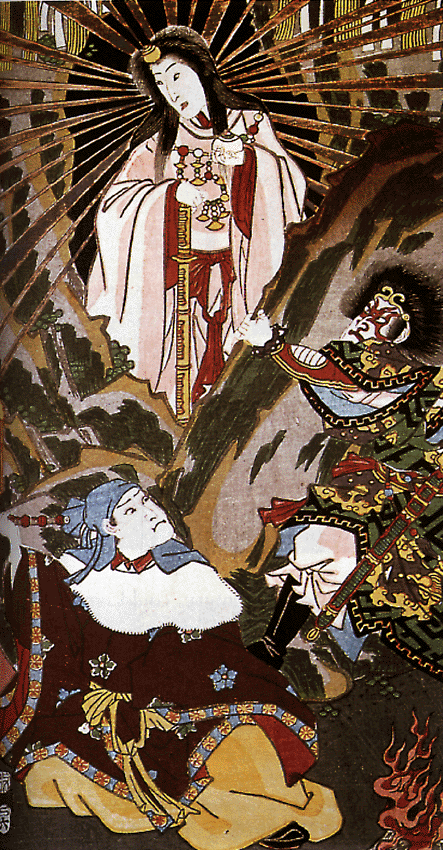
Amaterasu by Utagawa Kunisada (歌川国貞), 1856 [crop of larger artwork, public domain
Amaterasu: The Sun Goddess
One of the best-known stories about Amaterasu tells of her retreat into the Ama-no-Iwato, the “Cave of Heaven,” after a conflict with her storm-god brother, Susanoo. In her absence, the world was plunged into darkness. The other gods tried to lure her out, and finally, the goddess Ame-no-Uzume’s lively, risqué dance brought laughter to the heavens. Curious, Amaterasu peeked out and saw her reflection, at which point the other deities pulled back the cave’s stone door, restoring light to the world.
Amaterasu is also honored at the Ise Grand Shrine (Ise Jingū), the most sacred Shinto shrine in Japan. The shrine is ritually rebuilt every 20 years in a process called Shikinen Sengū, a tradition symbolizing renewal and purity. The naming of a new mineral after Amaterasu, therefore, ties scientific discovery to this enduring spiritual heritage.
pic.twitter.com/1mrMQ9KgQz
A new mineral named Amaterasuite has been discovered in Okayama Prefecture.
Technical Specialist Daisuke Hamane and colleagues identified it within jadeite, Japan’s national stone.
Its dual crystal structure inspired the name, referencing the dual nature…— 東京大学 物性研究所 (@UTokyo_issp) August 18, 2025
A Jewel Within Jadeitite
The brilliant mineral was discovered within jadeitite from the Osayama region of Okayama Prefecture. Jadeitite is a rare rock composed mostly of jadeite, prized for its strength and toughness, and worked in Japan for more than 7,000 years. In 2016, jadeitite was formally designated the national stone of Japan, reflecting both its cultural importance and its deep ties to Japanese identity.
While jadeitite is mainly jadeite, it can also contain trace minerals rich in elements such as strontium and titanium. Amaterasuite belongs to this group. Researchers observed it as tiny bundles of needles and plate crystal shapes, sometimes appearing deep blue or green, and showing “pleochroism”, the ability to change color from blue to brown under polarized light.
The crystals are very small, up to 0.15 millimeters long, but distinctive enough to study.
Physically, Amaterasuite has a Mohs hardness of 6 (comparable to feldspar).
A Unique Crystal Structure echoes Mystical Patterns
Chemical analysis revealed that Amaterasuite has the formula Sr₄Ti₆Si₄O₂₃(OH)Cl. This means its framework is made mostly of strontium (Sr), titanium (Ti), silicon (Si), and oxygen (O), with a small amount of hydroxide (OH) and chlorine (Cl). Its atoms form an unusual arrangement: ribbons of titanium octahedra and rings of silicon tetrahedra, with strontium and chlorine filling the gaps.
Most intriguingly, Amaterasuite exhibits what the scientists referred to as a dual nature in its crystal structure. Within a single unit, two different arrangements (called type A and type B) coexist. This kind of structure had been predicted theoretically but had never been observed naturally until now.
The mineral is also closely related to other rare minerals found in Japanese jadeitite, but the Amaterasuite crystal structure is unique. Its discovery not only deepens scientific understanding of jadeitite’s formation but also highlights the ongoing dialogue between geology and cultural meaning in Japan.
In naming Amaterasuite, the researchers honored both a scientific breakthrough and Japan’s cultural traditions. Jadeitite is more than just a geological curiosity: it is a material that has been used since the Jōmon period for tools, ornaments, and ritual objects. By uncovering a new mineral within it and tying it to Amaterasu—the radiant goddess of the sun—the discovery shines light on the intersection of earth science, history, and spirituality.
The mineral is also expected to be a topic of discussion at the 2025 Annual Meeting of the Japan Association of Mineralogical Sciences this coming September.
The Wild Hunt is not responsible for links to external content.
To join a conversation on this post:
Visit our The Wild Hunt subreddit! Point your favorite browser to https://www.reddit.com/r/The_Wild_Hunt_News/, then click “JOIN”. Make sure to click the bell, too, to be notified of new articles posted to our subreddit.