

AMESBURY, England – Over a century ago, archeologists discovered the jawbone of a cow placed at the south entrance to Stonehenge. Now, researchers with the British Geological Survey have analyzed one of that cow’s teeth and found tantalizing evidence regarding the construction of the world’s most famous megalith.
As reported by the BBC, researchers sliced one of the jawbone’s molars into nine pieces and analyzed them to measure carbon, oxygen, strontium and lead isotopes. These measurements suggest much about the cow’s life while the tooth was growing, when the cow was likely two years old.
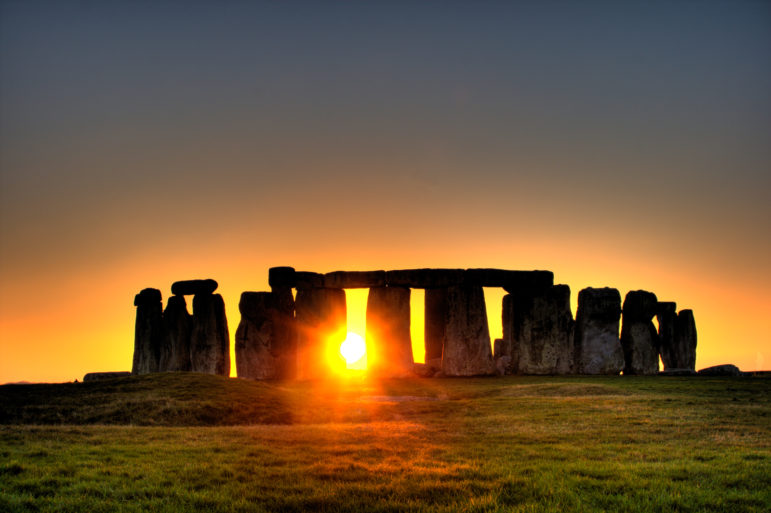
Mid-winter sunrise – simonwakefield – https://www.flickr.com/photos/simonwakefield/3149066878/ ), CC BY 2.0, https://commons.wikimedia.org/w/index.php?curid=6029740
The most immediately gripping finding was that the lead in the cow’s tooth suggested that the cow spent the late winter to spring feeding on ground with a much older source of lead than she fed on the rest of the year – findings that researchers say are consistent with the cow having spent that time in Wales.
“The composition suggests the cow originated from an area with Palaeozoic rocks,” said the scientists, “such as the bluestones found in Wales, before moving to Stonehenge.”
One possibility of the finding is that cattle were used as beasts of burden to transport material to Stonehenge during its construction around 5000 years ago. As Artnet News describes, while the bluestones at Stonehenge had been geologically matched to quarries in the Preseli Hills in southwest Wales a decade ago, there has not yet been a scholarly consensus on how those stones were transported over 140 miles to Stonehenge.
“While an early theory that glaciers moved the stones 500,000 years ago has largely been dismissed,” writes Artnet News’s Richard Whittington, “disagreement remains over whether they were dragged cross-country by sledges or transported over sea and river using rafts. The latest evidence seems to weigh in on the side of the overland route.”

Welsh Black Cattle near Penderyn [Darren Wyn Rees at Penderyn Online, Wikimedia Commons, CC 4.0]
“There’s been no evidence that cattle were used as beasts of burden in the Neolithic,” Professor Jane Evans of the British Geological Survey told the BBC, “but that changed in 2018 when there was a paper that showed that oxen had structures in their feet that were typical of animals that were pulling additional weight and working of beasts of burden.
“It feeds into this new narrative that cattle were perhaps important as beasts of burden,” Evans continued. It’s possible that oxen were used for the heavy stones and cows might have been used to carry lighter loads.
It’s likely that it would have taken two to four months to carry the stones overland from Wales to Stonehenge, which, for Evans, leads to all sorts of questions about the material circumstances surrounding the project.
“You’ve got to have food supplies. A turnover of people and animals to help pulling. You’re probably going to have all the domestic requirements of living on the land,” Evans said. “It’s rarely considered that women were involved. Surely they’ve got to have been there. And probably as many women as men, and children. Making food, providing accommodation, there’s a lot involved.”
“This is yet more fascinating evidence for Stonehenge’s link with south-west Wales, where its bluestones come from,” Michael Parker Pearson, professor of British later prehistory at University College London, told the BBC.
The researchers also found that the cow was likely pregnant during the season recorded in the tooth and drawing on her lead reserves due to the stress of calving.

Cromlech a gwartheg – Cromlech and cattle. (“Nothing ancient about this – probably a farmer’s folly, making use of some of the many stones removed from these pastures beside the A487.”) Alan Fryer, Wikimedia Commons, CC 2.0
While this analysis brings much information about the animal and its life into the light, much still remains obscure. In the article produced by Evans and her team from the British Geological Survey for the Journal of Archeological Science, the authors note that the cow did not seem to have been brought to Stonehenge alive and buried shortly after death:
The remains of this elderly animal were found buried at Stonehenge. It is not known if it travelled to Stonehenge alive, or its remains were, curated and deposited there. However, it is possible that the animal held some significance to the population as the cow probably died 55–270 years (at 68 % probability) before being placed on the bottom of the ditch and may have been be curated.
The ritual significance of the jawbone will remain a topic of speculation, as with so many things surrounding Stonehenge, but the evidence from the tooth suggests much about the material conditions surrounding the construction of the site.
“A slice of one cow tooth has told us an extraordinary tale,” said Evans.
The Wild Hunt is not responsible for links to external content.
To join a conversation on this post:
Visit our The Wild Hunt subreddit! Point your favorite browser to https://www.reddit.com/r/The_Wild_Hunt_News/, then click “JOIN”. Make sure to click the bell, too, to be notified of new articles posted to our subreddit.