
SAN ANTONIO – A legal and political showdown is unfolding in Texas after a federal judge temporarily blocked a law requiring the display of the Ten Commandments in every public school classroom. The decision has set the stage for a fierce confrontation over church–state separation and the scope of religious freedom in America’s schools.

[Wikimedia Commons
Part One: Judge Biery Blocks the Law
On August 20, 2025, U.S. District Judge Fred Biery in San Antonio granted a preliminary injunction halting Senate Bill 10 (SB 10), which was set to take effect September 1. The law, signed by Gov. Greg Abbott in June, required every elementary and secondary school classroom to post a framed 16-by-20-inch copy of the Ten Commandments.
Biery, an appointee of former President Bill Clinton, ruled in favor of 16 families from across Texas who argued the law would harm their children’s religious development and violate their First Amendment rights. His 55-page order leaned heavily on Supreme Court precedent, including the 1980 Stone v. Graham decision that struck down classroom Decalogue postings, and a recent federal appeals ruling declaring Louisiana’s similar law “facially unconstitutional.”
“SB-10 crosses the line from exposure to coercion,” Biery wrote, warning that children could be stigmatized by peers if perceived as “the other.” In his characteristically colorful style, he added: “Ultimately, in matters of conscience, faith, beliefs and the soul, most people are Garbo-esque. They just want to be left alone, neither proselytized nor ostracized, including what occurs to their children in government-run schools.”
The ruling prevents 11 school districts—spanning San Antonio, Austin, Houston, and Dallas suburbs—from implementing the law. These include Alamo Heights, North East, Lackland, Northside, Austin, Lake Travis, Dripping Springs, Houston, Fort Bend, Cypress-Fairbanks, and Plano ISDs (Independent School District).
But it’s complicated. Austin Independent School District (ISD) was dismissed from the lawsuit on the condition it follow any injunction; Houston ISD was exempt from the hearing but still included in the injunction’s coverage. Meanwhile, in Conroe ISD, things had moved more quickly prior to the ruling: the district received a donation of 330 Ten Commandments posters. It remains unclear how those posters are being handled. Furthermore, it is unclear if the judgment applies statewide.
Reaction from plaintiffs and advocacy groups was swift.
“As a rabbi and public school parent, I welcome this ruling,” said plaintiff Mara Nathan of San Antonio. “Children’s religious beliefs should be instilled by parents and faith communities, not politicians and public schools.”
Heather Weaver, senior counsel with the ACLU’s Freedom of Religion and Belief Program, emphasized the broader implications: “Today’s decision ensures that our clients’ schools will remain spaces where all students, regardless of their faith, feel welcomed and can learn without worrying that they do not live up to the state’s preferred religious beliefs.”
Rachel Laser, president of Americans United for Separation of Church and State, hailed the decision as a national signal: “Today’s decision will ensure that Texas families—not politicians or public-school officials—get to decide how and when their children engage with religion. It sends a third strong and resounding message across the country that the government respects the religious freedom of every student in our public schools.”
Other groups underscored the First Amendment stakes. “It is gratifying to see the federal court honoring our First Amendment, with the wisdom to understand how wrong it would be to impose Bible edicts on public students as young as kindergartners,” said Annie Laurie Gaylor, co-president of the Freedom From Religion Foundation.
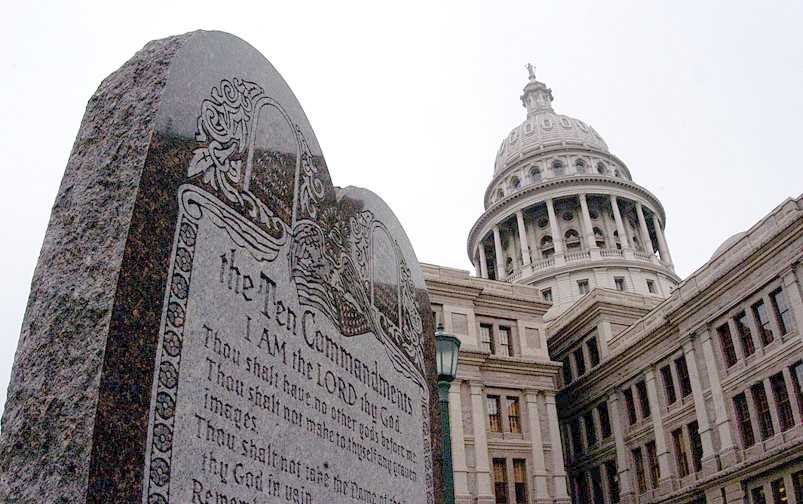
Ten Commandments Monument by Texas State Capitol. [Public Domain]
Part Two: Paxton Appeals and Defies the Ruling
On Thursday, Texas Attorney General Ken Paxton (R) filed an appeal to the U.S. Fifth Circuit Court of Appeals and publicly instructed schools to follow SB 10 despite Biery’s injunction.
“From the beginning, the Ten Commandments have been irrevocably intertwined with America’s legal, moral, and historical heritage,” Paxton said in a statement. “Schools not enjoined by ongoing litigation must abide by SB 10 and display the Ten Commandments. The woke radicals seeking to erase our nation’s history will be defeated. I will not back down from defending the virtues and values that built this country.”
Paxton clarified on social media that Biery’s ruling applied only to the districts named in the lawsuit, suggesting that other Texas school districts remain obligated to comply. His stance has raised alarms among legal experts and educators, who note that the federal injunction casts serious constitutional doubt on the law statewide, but only in the listed 11 districts.
School districts themselves have expressed caution. A Lake Travis ISD spokesperson said, “Since the ruling and with the injunction now in place, we are blocked from displaying the Ten Commandments at this time. As for next steps, we will await further court developments.” Conroe ISD’s legal counsel similarly advised against hanging donated Ten Commandments posters until the litigation is resolved.
The controversy has highlighted growing national tensions. Similar laws passed this year in Louisiana and Arkansas have also been blocked by federal courts. Meanwhile, in Oklahoma, parents and teachers are suing to halt directives requiring a Bible in every classroom and a Christian-infused curriculum.
Critics argue that forcing a religious text into classrooms undermines the rights of minority-faith or nonreligious families. Supporters, led by Paxton and Abbott, contend that the Ten Commandments are part of the nation’s heritage and provide essential moral grounding.
Zeph Capo, president of the Texas American Federation of Teachers, pointed to the deeper constitutional concern: “This legislation reflects the deterioration of the long-held understanding that the constitution calls for a separation of church and state.”
Judge Biery captured the classroom dilemma in his ruling: “Even though the Ten Commandments would not be affirmatively taught, the captive audience of students likely would have questions, which teachers would feel compelled to answer. Teenage boys, being the curious hormonally driven creatures they are, might ask: ‘Mrs. Walker, I know about lying and I love my parents, but how do I do adultery?’ Truly an awkward moment for overworked and underpaid educators.”
A National Bellwether?
As the legal battle moves to the Fifth Circuit, Texas has become the latest flashpoint in a national debate over the boundary between faith and public education. With federal courts already rejecting similar laws in neighboring states, advocates say Biery’s ruling may mark another major affirmation of religious liberty in schools.
Weaver of the ACLU stressed that the ruling should guide all Texas districts, not just those named in the case. “This ruling makes clear that SB 10 is unconstitutional. Every school district should heed it, even if they are not a defendant in the case.”
For now, the Ten Commandments will not hang on the walls of Texas classrooms in the 11 districts under the injunction. But how long that remains the case is far from clear.
The Wild Hunt is not responsible for links to external content.
To join a conversation on this post:
Visit our The Wild Hunt subreddit! Point your favorite browser to https://www.reddit.com/r/The_Wild_Hunt_News/, then click “JOIN”. Make sure to click the bell, too, to be notified of new articles posted to our subreddit.