

The trope of the wicked counselor manipulating the good ruler is an ancient one.
Way back between the first century BCE and the third century CE, the monumental work known as the Arthaśāstra (“treatise on statecraft”) was compiled, composed, and revised in India.
In this massive manual on governance, the king is repeatedly warned against counselors who may seek to “bring under their grip all his affairs and act like lords themselves” (Patrick Olivelle translation).
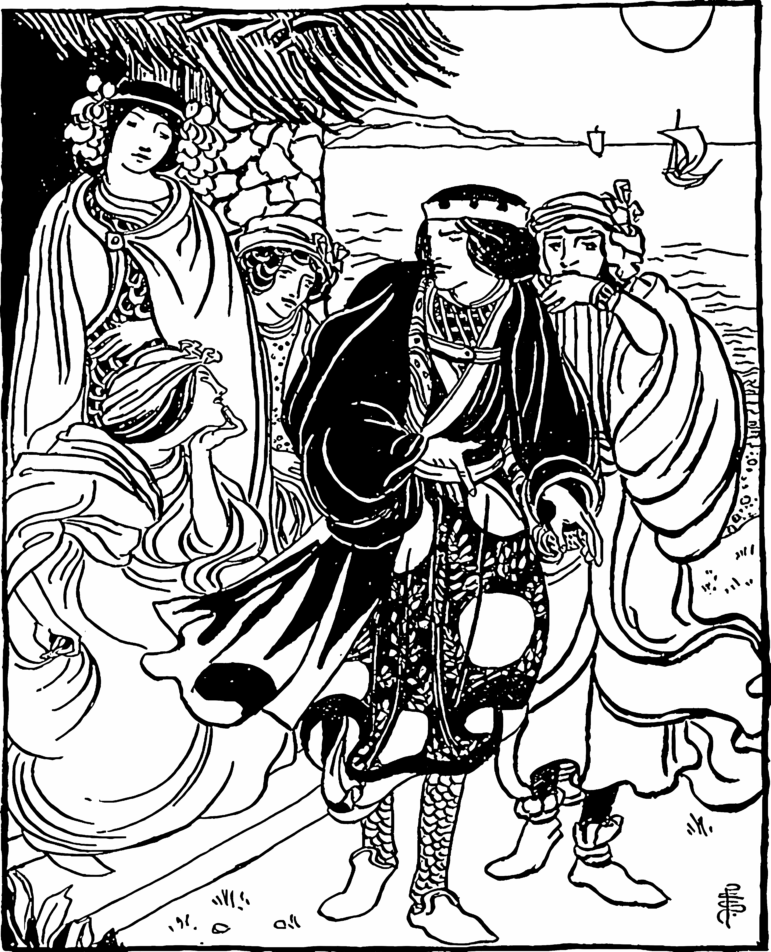
King and counselor (Pamela Colman Smith, 1899) [Public Domain]
To help the king guard against counselors of foul intent, the text provides a myriad of instructions for choosing advisors and testing their loyalty. Given the sheer amount of verbiage devoted to this particular topic, it’s clear that wicked counsel was of great concern in that long-ago era.
The goal of these passages in the Arthaśāstra is clearly to instruct the ruler in guarding himself against those who would willfully steer him wrong.
Over on the Germanic branch of the family tree of Indo-European languages, the trope takes a different tack and has another goal altogether.
“His many wicked persuasions”
At the conclusion of the thirteenth-century Old Icelandic Saga of the Völsungs, in a passage reminiscent of the romance of Tristan and Isolde, King Jormunrek sends his counselor Bikki to accompany his son Randver on a voyage to ask King Jonakr for the hand of young Svanhild on his behalf.
Svanhild is the daughter of the Odinnic hero Sigurd and his wife Gudrun. Sigurd is long dead, and Gudrun – after much revenge-taking – has married Jonakr.
After the parties reach an agreement regarding the royal marriage, Svanhild sails back to Jormunrek’s land with Randver and company.
Along the way, Bikki offers his counsel to Jormunrek’s son: “It would be more proper for you to have so beautiful a wife, rather than for an old man to have her” (Jesse L. Byock translation). Randver likes the idea and proceeds to canoodle with his father’s betrothed.
As soon as the return journey concludes, the treacherous Bikki tells Jormunrek of the affair and admonishes him to “not let such a wrong go unpunished.”
At this point, the narrator tells us more about the counselor:
In the past, Bikki had given the king much bad counsel, although this outstripped any of his previous ill advice. The king listened to his many wicked persuasions. He could not still his anger and ordered that Randver should be taken and hanged on the gallows.
Even after Jormunrek realizes the horror of what he has done, he listens to Bikki’s next piece of ill advice – that Svanild “die in disgrace.”
The malevolent counselor oversees Svahild’s public humiliation and violent death, binding her to the gate of the fortress as horses are driven at her to trample her. The wrongful killing brings to mind the unfair punishment of Rhiannon in The Mabinogi, which describes her being installed at a public horse block and being forced to carry strangers into the court on her back.
Gudrun, ever obsessed with revenge, sends the sons she has had with Jonakr to kill Jormunrek. They make a complete mess of it but prove extremely difficult to dispatch.
Odin himself appears and tells Jormunrek how to kill the brothers, making a final end to the line of heroes he began at the saga’s beginning. At least, it’s final until the Saga of Ragnar Loðbrók, in which the titular hero has four sons via Áslaug, daughter of Sigurd and the Valkyrie Brynhild.
The little codicil at the end of the Saga of the Völsungs begins with Jormunrek getting harmful advice from the wicked Bikki (whose name means “[son of a] bitch”) and ends with him receiving helpful advice from the god Odin.
What is the message here?
The tale provides an exemplar of the good king only making bad decisions when manipulated by wicked counsel. The proof that the king is an inherently good ruler is underscored both by his remorse after killing his own son (on Bikki’s bitchy advice) and by his Odinnic role in bringing the saga to an end (on Odin’s divine advice).
The story also absolves the king of guilt for his own bad decisions, since they aren’t really his. Yes, Jormunrek had his own son and his own betrothed both executed, but it was all Bikki’s fault.
Again, this is underscored by Odin’s brief appearance. When Jormunrek defends himself from clumsy but seemingly unbeatable assassins, his actions are divinely inspired.
The king takes none of the blame for his mistakes but gets a divine imprimatur on his successes.
There are other examples of this excusing process in related texts.
Doing the dark deeds
At the beginning of the Middle High German Nibelungenlied (“Song of the Nibeluings”), written down around 1200 CE, Hagen is a dark figure who gives dark counsel to his king, the somewhat naïve Burgundian ruler Gunther.
Hagen advises Gunther to bring the hero Sivrit (the German parallel of the Icelandic Sigurd) with him to Iceland to provide supernatural help so that he can deceitfully win the hand of the virgin warrior-queen Prünhilt (Brynhild the Valkyrie in Old Icelandic sources). This deception sets a series of unfortunate events in motion, with Hagen always scheming and manipulating.
In an echo of the Arthaśāstra’s warning against overreaching counselors quoted at the top of this column, the narrator tells us that
Hagen of Tronege, and also Ortwin [his nephew, a privileged relationship in older Germanic cultures], showed clearly what power they wielded. No one dared fail to carry out all they commanded (Cyril Edwards translation).
Hagen wants to commandeer Sivrit’s treasure – the legendary hoard of the Nibelungs – for the Burgundians, and he advises his king and queen (Gunther and Prünhilt) to do away with the hero and seize his treasure.
The heroes had declared hostilities against Sivrit without cause. No one would have pursued the matter, except that Hagen suggested again and again to Sir Gunther that if Sivrit were no longer alive, then many kings’ lands would become subject to him. Gunther the hero grew sorrowful at that.
And there’s the crux of the matter. By repeatedly protesting against Hagen’s advice to kill their ally and in-law, “the wondrously valiant man,” Gunther is able to keep up a pretense of nobility despite inevitably doing the dark deeds suggested by Hagen.
The Nibelungenlied runs with this absolution of Gunther’s guilt via deflection to Hagen’s counsel. In the second half of the epic, the Burgundian king is solidly portrayed as heroic even as he fights against the assembled forces of Kriemhilt (Gudrun in the Saga of the Völsungs), his sister and the widow of his shamefully murdered ally Sivrit.
As in the tale of Jormunrek, the whispering of the wicked counselor is blamed for the unheroic actions of the noble king.
One way to read the relationship between Loki and Odin in the Icelandic Eddas of the 1200s also fits with this pattern of wicked counsel being used as a cover for the central ruler.
Blame and benefits
Although endlessly cited, there’s really just the one line (9.2) in the one poem (Lokasenna, “Loki’s Quarrel”) about Loki and Odin swearing blood brotherhood. It’s spoken by a furious Loki, not the most trustworthy witness at the best of times, and Odin’s response neither confirms nor denies the claim.
Much less discussed is the description of Loki in Sörla þáttr (“Sörli’s Story”), a mythological narrative embedded within the Greatest Saga of Óláf Tryggvason in the 1300s.
This is a not unimportant mythological text, since it is the unique source for the famous tale of Freyja getting her necklace from the dwarfs and Loki turning himself into a fly so he can steal the necklace for Odin. That story is often cited without discussion of Loki’s introduction by the narrator.
[Loki] was not a big man, but he early developed a caustic tongue and was alert in trickery and unequalled in that kind of cleverness which is called cunning. He was very full of guile even in his youth, and for this reason he was called Loki the Sly. He set off to Odin’s home in Asgard and became his man.
Odin always had a good word for him whatever he did, and often laid heavy tasks upon him, all of which he performed better than could have been expected. He also knew almost everything that happened, and he told Odin whatever he knew (Nora Kershaw translation, names normalized).
When attaching himself to Odin, Loki becomes hans maðr (“his man”) and does his bidding – more a manservant than a blood brother.
The fact that Loki gathers information about happenings and reports back to Odin makes him seem closer kin to the god’s data-gathering ravens than to the divine inhabitants of Asgard.
As in the Edda myth of Loki messing with the dwarfs who make the treasures of the gods, he transforms into a fly – not an eagle like Odin, not a falcon like Freyja or Frigg – which also situates him lower in the mythological hierarchy.
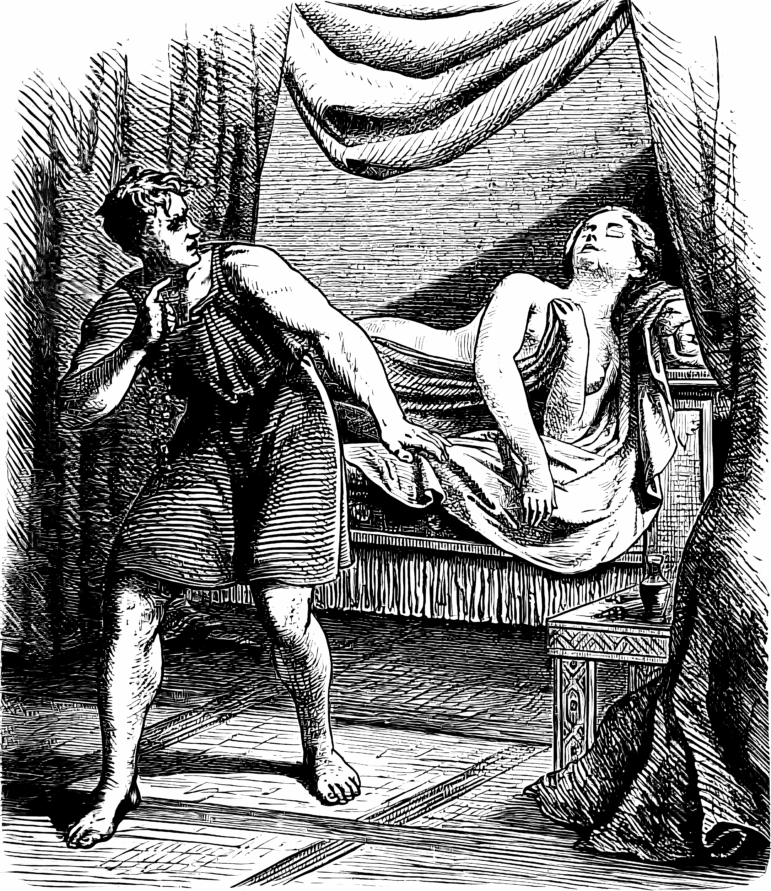
Loki steals Freyja’s necklace (Friedrich Wilhelm Heine, 1882) [Public Domain]
Throughout the myths, Loki serves the needs of the gods as a figure who is truly at home with neither the Æsir nor their enemy jötnar (“giants”). He is the one who can bounce back and forth between the two groups and make the deals that eventually redound to the benefit of the gods, who are happy to benefit from Loki being “alert in trickery and unequalled in that kind of cleverness which is called cunning.”
Odin, himself an ambivalent figure, is able to reap the benefits of Loki’s dishonest dealings and deceitful advice – a wall for Asgard, a mystical horse, the treasures of the gods, the return of Thor’s hammer, and so on – without having to openly be the one doing the dirty deeds himself.
Again, the wicked counselor takes the blame, and the ruler gets the benefits without the censure. The Germanic sources are fairly consistent in their use of this particular trope.
But why should we care about these bad advisors from literature of so long ago?
One valuable answer comes from the author who himself created arguably the best-known instance of the exculpatory trope, written seven centuries after the Eddas.
Hypnotic counsel
In 1954, J.R.R. Tolkien published The Two Towers, the second volume of The Lord of the Rings. It features the memorable character of Gríma Wormtongue, wicked advisor to the noble King Théoden.
When the Odinnic Gandalf and his companions first meet Théoden, he is “so bent with age that he seemed almost a dwarf” and barely manages to stand long enough to croak out a short and bitter non-welcome to the wizard. Sitting at his feet on the steps like a monstrous pet, Wormtongue encourages the king to spurn the visitor and ignore the traditions of hospitality.
Gandalf famously awakens Théoden from the hypnotic counsel of Gríma, and the king – not so elderly and not so frail, after all – goes on to play a heroic role in the epic as an inspirational warrior-king.
Once again, the ruler is absolved from blame by the revelation that it was all the fault of bad advice.
If only we could all shake off our age and our bitterness so easily! Tolkien’s work sometimes verges on fairy tale, as in this wistful scene that is both about our impossible desires for our own aging selves and our wishes for the infallible nobility of our leaders.
In his 1965 foreword to the second edition to The Lord of the Rings, Tolkien responded to those who saw in his epic an allegory for the horrors of the Second World War. He insistently denied any allegory whatsoever.
But I cordially dislike allegory in all its manifestations, and always have done so since I grew old and wary enough to detect its presence. I much prefer history, true or feigned, with its varied applicability to the thought and experience of readers. I think that many confuse ‘applicability’ with ‘allegory’; but the one resides in the freedom of the reader, and the other in the purposed domination of the author.
If we follow Tolkien’s reasoning, then part of the value of a text is in its applicability to our own lives and our own situations.
Therefore, we should care about the trope of the wicked counselor manipulating the good ruler because it can help us to recognize the self-serving deflections of blame by our own leaders.
“I don’t take responsibility at all”
In his 1990 memoir In the Arena, Richard Nixon tapped into the trope with his full chest as he absolved himself of guilt in the Watergate scandal that had ended his presidency sixteen years earlier.
I made the inexcusable error of following the recommendations from some members of my staff – some of whom, I later learned, had a personal stake in covering up the facts.
Oh, those wicked counselors! Nixon himself surely would never have tried to cover anything up. Honest!
In retrospect, while I was not involved in the decision to conduct the break-in, I should have set a higher standard for the conduct of the people who participated in my campaign and administration.
If only those bad advisors had been blessed with the virtuous nature of the president whom they so cruelly misdirected. Wormtongues, the lot of ‘em!
Donald Trump, a past master of deflecting blame, famously told reporters in 2020 that “I don’t take responsibility at all” when asked about fumbles in his response to the coronavirus outbreak.
And when you say me, I didn’t do it. We have a group of people. I could ask – perhaps in my administration – but I could perhaps ask Tony [Fauci] about that because I don’t know anything about it. You say we did that. I don’t know anything about it.
The most powerful man in the world is happy to take all the credit for anything positive but resorts to the ancient trope of bad counsel for anything negative.
Such attitudes aren’t bound by party lines.
In October of last year, reports surfaced that Kamala Harris had spent over thirty minutes screaming at her campaign manager Julie Chavez for the fact that her own decision to skip a Catholic charities fundraiser traditionally attended by presidential candidates had led to Trump – who did attend – publicly mocking Harris for her absence.
Chavez was in tears during the phone call as Kamala shred her to pieces, called her an idiot, inept, horrible at your f-ing job, and told her that her stupid advice is going to be the reason she loses.
Few things in life are as certain as a politicians blaming advisors for their own mistakes, especially when those mistakes result in political losses. For a politician to admit a serious error of judgment is both to show weakness to watching enemies and invite consequences from angry voters. Who among our leaders would welcome that kind of trouble?
The applicability of tropes from ancient texts to modern situations helps us to recognize that our leaders are still playing the same old deflective games, but it also suggests a way for modern Pagans to relate to the hoary lore of their own traditions.
Both/and
There seems to be an endless battle between those who ask “What did the ancient pagans mean by these texts?” and those who ask “What meaning can modern Pagans find in these texts?”
Sometimes, the battle rages within a single person. I go back and forth between the two questions all the time.
It’s always good to do the work of attempting to understand the myths and poems in their original context. Practitioners of Ásatrú and Heathenry generally spend a lot of time studying not just the mythological sources but also the sagas, other period texts, scholarly work on the texts, works of historiography, cultural studies, comparative religion, etc.
And yet we continue to disagree about what the myths and poems mean. I’ve changed my mind over time many times about myths, poems, verses, and lines. The richness of the texts and their availability to be interpreted in multiple ways is part of why they continue to fascinate.
No matter what effort we put into it, can we ever really know the intentions behind the mythological material? The texts are anonymous, and – unlike in the Hindu tradition – we have no secondary materials from the early pagans, no works of ancient theology that discuss the religious meanings of the myths.
Snorri Sturluson composed his Edda more than two centuries after Iceland’s conversion to Christianity. He generally avoids any discussion of religious elements in his material and sometimes seems to actually miss what now seem like obvious religious meanings.
The poems of the Poetic Edda have some more plainly religious material but survive with no pagan commentary or ancient exegesis.
The Icelandic sagas that tell tales of pagan ancestors of their Christian authors provide much colorful material having to do with religious practice but are best categorized as works of historical fiction composed centuries after the events they purport to describe. That is an altogether different category than records written by participants.
We work hard to understand the sources and the times in which they were created, but we are living our own brief moments on this planet a thousand years after the end of that great pagan period. Dedicated study and the search for understanding is immensely valuable, but – if that understanding is the final and ultimate goal of the process – then we would be scholars and not practitioners.
It is Tolkien’s dictum of applicability that helps us to bridge the gap between study and practice.
Instead of demanding an either/or choice between ancient meaning and modern meaning, we can embrace a both/and bridging that seeks to understand the sources in original context – as much as that is possible – while bringing the texts into our own times and applying them to our own situations.
If this process means that our own interpretations of the deeper meanings of myths conflicts with what academics argue may have possibly been the original meanings, so be it. We are postmodern peoples, not ancient ones. We are inspired by the old texts, informed by scholarship, and bound by neither.
We may even come to recognize that it is not the Wormtongues around us that we must be most wary of.
Instead, we must be ever on our guard against those who endlessly blame their supposedly wicked counselors and insist that they themselves would never had made such bad decisions on their own.
Honest!
The Wild Hunt is not responsible for links to external content.
To join a conversation on this post:
Visit our The Wild Hunt subreddit! Point your favorite browser to https://www.reddit.com/r/The_Wild_Hunt_News/, then click “JOIN”. Make sure to click the bell, too, to be notified of new articles posted to our subreddit.