

FLORENCE, Italy – A painting of the Roman god Bacchus by the Baroque master Caravaggio was removed from its gallery in the Uffizi Museum in mid-September after a leak in the gallery’s skylight led to rain falling directly on the painting’s protective glass case.
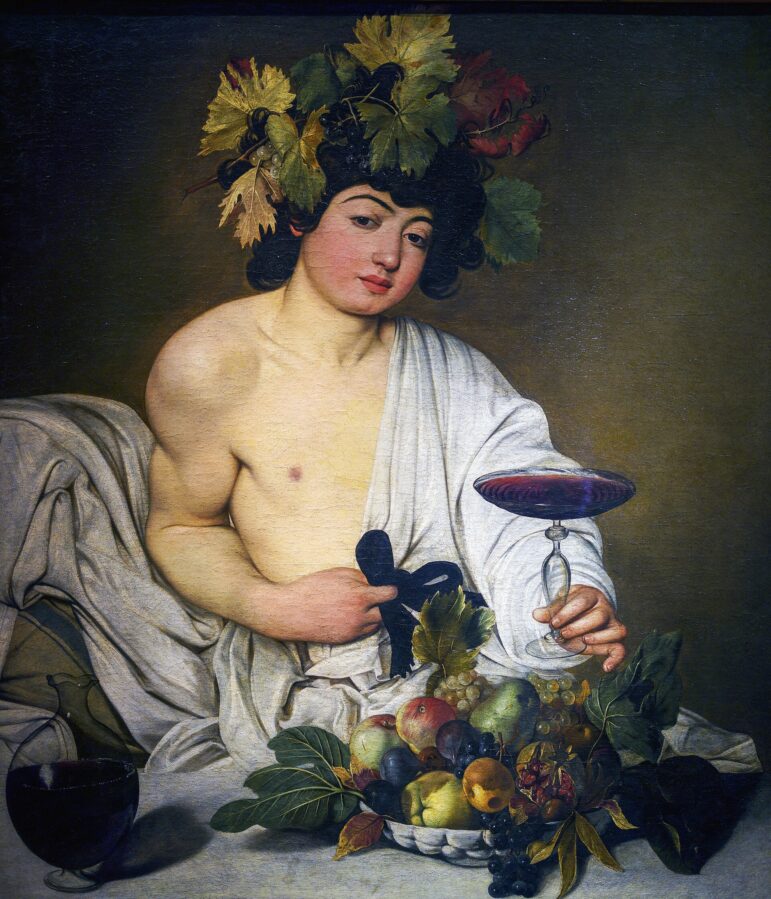
Caravaggio, “Bacchus,” c. 1596, oil on canvas, 95 cm x 85 cm [public domain]
According to Euronews, torrential rains on September 17th in Florence led to water leaking out of the skylight and splashing up from the floor – it would have splashed directly onto “Bacchus” had it not been for the glass. The Corriere della Sera described the scene more poignantly: “Before the visitors’ eyes, the image of the 1598 oil-on-canvas painting appeared hazy and streaked with long lines of water.”
“Bacchus” portrays the god as a youth, his head adorned with grapes and vines, seated before a bowl overflowing with ripe fruits – in the case of one apple, overripe and rotting. In his hand, he holds a glass chalice of red wind, lifted toward the viewer in an inviting manner; perhaps just as inviting, he plays with the drawstring of his loose white robe, which already slides down to reveal his bare chest.
Bacchus, also known as Dionysus, was widely worshiped in the ancient Greek and Roman worlds. Although today often reduced to simply the “god of wine,” he held a vast array of associations in the classical world, including wine and wine-making, fertility, theatre, and the closely-related concepts of madness and ecstasy. In the post-classical world, he remained a source of inspiration, wonder, and dread, appearing in the art of the Renaissance and the philosophy of Nietzsche. He has consistently been one of the most popular classical gods in the modern Pagan revival, as well.
The work is from early in Caravaggio’s career, circa 1595 or 1596, when he was in the patronage of Cardinal del Monte, one of many Catholic functionaries who had a taste for the old gods. The model for the painting may have been Caravaggio himself, working from a mirror, or it may have been Caravaggio’s pupil (and, as speculated by some critics, lover) Mario Minniti. Cardinal del Monte eventually donated the painting to the Medici family. According to Artnet News, “Bacchus” was rediscovered in the Uffizi’s storage in 1913 and identified by the art historians Roberto Longhi and Matteo Marangoni as Caravaggio’s work, and has since been recognized as one of the prizes in the Uffizi’s extensive collection.
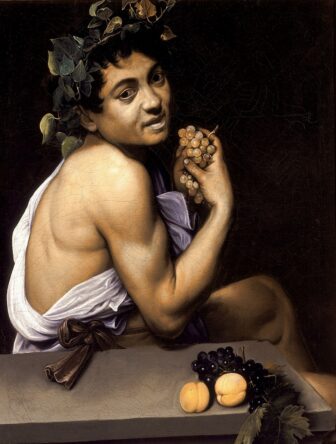
Caravaggio, “Young Sick Bacchus,” c. 1593, oil on canvas, 67 cm x 53 cm [public domain]
Caravaggio would grow into one of the most important painters in the European tradition, best known for his mastery of the dramatic contrast of light and shadow known as chiaroscuro. “Bacchus” was not his only portrait of the god of wine – several years earlier he painted an image, “Young Sick Bacchus,” that portrayed the god in a less sensual manner, jaundiced and turned away from the viewer. (It is, again, unclear whether the model for “Young Sick Bacchus” is Caravaggio himself or Marangoni.)
Museum officials said that neither “Bacchus” nor any other paintings in the gallery suffered damage. “Bacchus” was back on display the following day, enticing viewers to join him in his sensuous pursuits once again.
The Wild Hunt is not responsible for links to external content.
To join a conversation on this post:
Visit our The Wild Hunt subreddit! Point your favorite browser to https://www.reddit.com/r/The_Wild_Hunt_News/, then click “JOIN”. Make sure to click the bell, too, to be notified of new articles posted to our subreddit.