

Two of the major moments in Norse mythology where the tales directly demonstrate theological principles are stories of gods and monsters.
The gods are Tyr and Thor, both of whom are portrayed as guardians of the community and defenders against destructive forces, and both of whom take on personal harm as the immediate result of their confrontations with the monsters.
The monsters are children of Loki, who appears in the myths less as the charming chaos agent of today’s popular culture and postmodern Paganism and more as a selfish, jealous, murderous, and destructive figure. Notably, he sires the monsters not with his endlessly loyal and loving goddess wife Sigyn (“victory friend”), but with his giant mistress in Jötunheim known by the sinister name Angrboda (“sorrow evoker”).
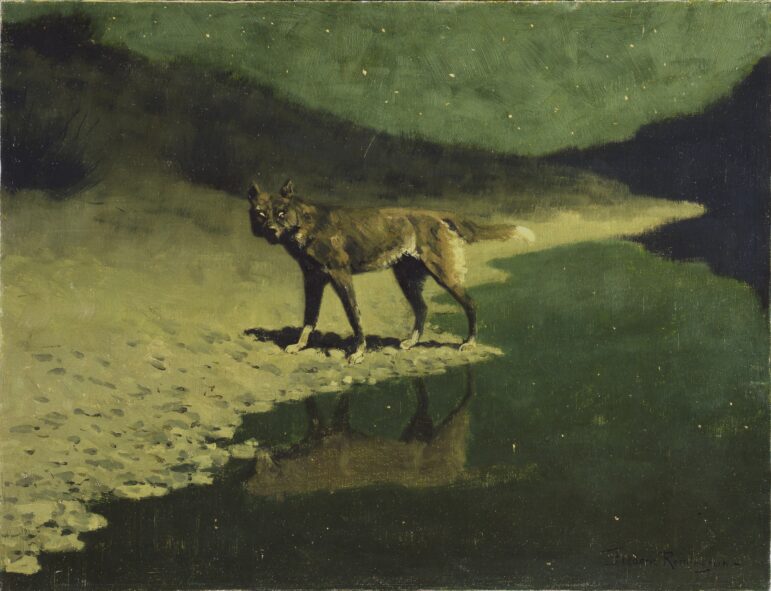
Moonlight, Wolf by Frederic Remington (c. 1904) [Public Domain]
One offspring is the World Serpent and the other is the enormous wolf Fenrir (“fen dweller”). When the gods learn via prophecies that both will bring great disaster for the denizens of Asgard, they remove one to the outer seas and the other to an overgrown island on a dark lake.
The Edda tells us that “evil was to be expected from them, to begin with because of their mother’s nature, but still worse because of their father’s” (Anthony Faulkes translation). This is not a nature documentary, and they are not a harmless garden snake and a cute little wolf cub. This is mythology, and they are symbols of harm to the community.
Tyr and the Wolf
Relatively early in the mythological timeline, when the wolf still lives among the gods, only Tyr is brave enough to approach and feed it. Its enormous daily growth and the fact that “all prophecies foretold that it was destined to cause them harm” lead the gods to make a plan for binding it. Following fairy tale form, the first two attempts fail before magic and sacrifice allow the third to succeed.
After the wolf easily breaks free of the first two bonds placed upon it, Odin sends Freyr’s messenger Skirnir to fetch a magical fetter from the dwarfs. The gods bring Fenrir out to the isolated island, supposedly to prove its strength by breaking the deceptively slender band. Suspicious of this latest test, Fenrir only agrees to participate if one of the gods will “put his hand in my mouth as a pledge that this is done in good faith.”
Again, only Tyr is brave enough. The fetter is placed, the dangerous wolf is bound until Ragnarök, and Tyr loses his hand.
At both ends of the story, Tyr’s lonely bravery in facing the monster is emphasized. Even when they all stand together, the other gods are afraid of the beast. Tyr isn’t stupid; he fully knows that he will lose his right hand as the price of binding the monstrous threat to the divine community. He quietly accepts this extreme harm to his person as the price of protecting others, even when his only recognition is the gods’ triumphant laughter at finally binding the wolf.
Thor and the Serpent
Again following the form of fairy tale rather than nature documentary, it takes three tries for Thor to defeat his monstrous nemesis. In a reversal of the progression with Tyr, however, it is the absence of magic in the third attempt that allows the World Serpent to be defeated.
In their first confrontation, Thor is deceived by the illusory magic of the giant Utgarda-Loki and believes that he is trying to lift an enormous cat. The higher he lifts it, the more it arches its back. Try as he might, Thor only manages to bring one paw off the ground. The story is sometimes misunderstood as exposing Thor’s lack of strength or failure of divinity, but the illusionist himself tells the god what was learned from the test – Thor’s strength is so great that he was able to lift the magically disguised World Serpent nearly to the dome of the sky, a feat that utterly terrifies the giants.
In their second meeting, it is Thor who turns to illusion. He takes the form of a young boy, walks across Midgard, and goes fishing with the giant Hymir. In a reversal of the previous tale, this time it is the giant whose senses are fooled as he believes the god to be “small and just a youth.” When Thor catches the serpent on his fishing line, he again nearly reaches the sky, but this time it is because he summons his ásmegin (“divine strength”), casts aside his assumed form, and grows so large that his feet rest on the bottom of the sea as he lifts his hammer high in the air. Once again, the giant of the tale is terrified by this display of godly power. Hymir cuts the fishing line, and the serpent disappears into the sea.
Finally, at Ragnarök, all magical illusion is dispensed with, no giant interferes, and Thor and the World Serpent face each other as they are. At this momentous moment in the mythic timeline, the poem Völuspá (“Prophecy of the Seeress”) refers to Thor as Miðgarðs véurr (“Midgard’s defender”), underscoring that – as Tyr is the protector of the divine community – Thor is the protector of the human community. The god kills the monster but then falls back nine steps and succumbs to the poison the serpent had spit at him.
As in the tale of Tyr, Thor knows exactly what the stakes are. He chooses the largest of all monsters as his personal nemesis, a creature so enormous that “it lies in the midst of the ocean encircling all lands and bites its own tail.” There is no sense that Thor is at all concerned with his own personal safety as he battles the beast. He is consumed by righteous anger at the monster that threatens to destroy the human world as it “spit[s] so much poison that it will bespatter all the sky and sea.” Like Tyr, Thor accepts the painful consequences of standing up for others.
Ásatrú Theology and the Wider Community
I began by stating that these particular myths directly demonstrate theological principles, and I would argue that both the demonstrations and the principles are clear. In Ásatrú, a modern religion that revives, reconstructs, and reimagines ancient Northern European paganism, some of us strongly believe in a Heathen tradition of standing against wolf and serpent to protect the wider community.
I say wider community, because there is no sense in the Norse myths themselves that the gods only exist for certain groups of people or that Thor is only concerned with protecting some of us. The gods come from the divine realm of Asgard to protect all the human realm of Midgard. As they are concerned with all of humanity, so we should also feel kinship with those outside of our own insular subgroups.
The core elements of the Tyr and Thor tales are that (1) both deities are ready and willing to stand up against the forces that threaten the community (2) even when they must do so alone, and (3) they understand and accept that doing so may have serious consequences, but (4) they do it anyway and (5) face the fallout without flinching.
I’ve written about this topic now and again, because I see this call to stand up as one of the central tenets of progressive Ásatrú public theology. Personally, I’m less interested in theories of parts of the soul or the relative merits of various afterlife destinations than I am in engaging with the world via the worldview of this world-affirming religious tradition.
We have a responsibility to the myths that we love and to the gods that we venerate. When we read, re-read, tell, and re-tell these tales, when we gather around the oak tree and raise a drinking horn to Tyr and Thor, we are pledging ourselves to doing deeds that live up to these mythical models and ancient archetypes. We are dedicating ourselves to standing up as they do.
An academic editor once told me that I need to be more specific about what exactly these deeds are and what exactly it means to stand up. At this point, I’d like to get more specific.
Macklemore Stands Up
On September 4, during his opening set for English pop singer Ed Sheeran in New Jersey, the American rapper Macklemore made a short speech addressing Israel’s ongoing actions in Gaza.
I’ve been trying to figure out a way to say this all day. One of the reasons why I wanted to come on this tour was because I wanted to stand up here on stages and stadiums across America and say two words that are very near and dear to my heart: free Palestine. I said free Palestine!
I want those words to be loud and clear, so that people from Gaza all the way to the occupied West Bank know that we have not forgotten them.
And this next song was inspired by the bravery of Columbia University students who led an encampment movement that mobilized the entire world, opened up hearts, myself included. So, thank you to those students that risked their diplomas, that risked their tuition, that risked their scholarships, that stood up and said no. CUAD students, Students for Justice in Palestine, and Jewish Voices for Peace, thank you guys.
To all of my Jewish brothers and sisters: criticism of Israel, criticism of apartheid, being against genocide in no way is a criticism of you. My message is for peace, love for all human beings to be treated with dignity, respect, and equality.
So I say free Palestine. I say free Lebanon. I say free Cuba. I say free Congo, free Sudan, free all people in America living in fear over this terrorist organization ICE. None of us will be free until we are all free.
At the same venue the next night, Macklemore made another speech. It started and ended the same but had a middle section that specifically addressed the ongoing killing of children in Gaza by Israeli forces.
I have an 11-year-old daughter. Her name is Sloane. She’s here tonight. If any of you guys are parents, then you know that that love that you have for your kids cannot be put into words, right? And I want to see her grow up. I want to see her go to school, to fall in love, to figure out meaning, purpose, joy. Her existence on this planet, I want it to be the most beautiful possible.
And I think that every single human being that walks this earth deserves that exact same freedom. To know safety and peace before they know the sound of violence. To know the sound of laughter on a playground before planes and bombs. For parents to be able to say bye to their kids in the morning and not have to wonder if this is going to be the last time that they kiss their child goodbye.
And if I let that fear that I felt on the plane yesterday stop me from speaking my heart in order to keep my own comfort and the audience’s comfort, that is the day that I no longer [inaudible] need to be on stage.
It seems impossible to hear any of this as anti-Semitic hate speech, and yet…
The Backlash
Two days later, Macklemore announced that Ed Sheeran had removed him from the tour. It quickly came out that 85-year-old billionaire and Gillette Stadium owner Robert Kraft had banned the rapper from performing at his venue and convinced other stadium owners to follow suit.
Since 2006, Kraft has donated nearly 25 million dollars “to a host of pro-Israel advocacy groups that attack critics of Israel, spread content that critics warn is Islamophobic, and have steadfastly defended Israel against mounting evidence of its ongoing genocide of Palestinians in Gaza.” Recipients include Friends of the Israel Defense Forces (IDF) and the American Israel Public Affairs Committee (AIPAC), a lobbying organization dedicated to defeating “candidates who criticize Israel’s genocide in Gaza and U.S. military support for Israel.”
Ed Sheeran’s own backing band then dropped out of the tour, stating that they “believe in dialogue as a means of progressing the plight of the Palestinian people.” All the opening acts on the tour also quit, including Billie Eilish’s brother Finneas, who wrote, “Artists must not be silenced when they speak up for the oppressed… I stand with Palestine and its people.”
In his first performance after the mass defection, Sheeran stood by himself on stage in Philadelphia. He read a prepared statement reminiscent of Donald Trump’s notorious “very fine people on both sides” remarks and insisted that “everyone is welcome” and can “stand beside people who have opposing views” at his concerts. He quickly lost 500,000 Instagram followers, ticket prices for his remaining tour dates plunged, and Ticketmaster stated that it was refusing all refund requests, deferring to the same stadium owners who had demanded Macklemore’s ouster.
The Horror Remains
According to Israel’s own data, 36 children were among the 695 Israeli civilians killed in the 2023 terrorist attack by Hamas. According to the Ministry of Health in Gaza, the Palestinian death toll of more than 73,000 since the Israeli reprisal began includes more than 21,280 children. These numbers are simply not proportional, and they are impossible to justify according to any sane metric.
Killing children is a clear war crime according to international law. This isn’t something that it is seriously debated, yet the repercussions seem to only be for those who speak out against the slaughter, not for those who continue to commit it.
Corporate media was quick to bring up a 2014 costume incident of Macklemore’s, in which he disguised himself in an exaggerated nose, beard, and wig in order to “disguise himself and move freely around” during a “secret show” in Seattle. When he was publicly accused of purposefully promoting anti-Semitic stereotypes, he insisted he had no such intention, acknowledged that it could “within a context of stereotyping, be ascribed to a Jewish caricature,” apologized, and recommended the Anti-Defamation League (ADL) as a positive organization working to fight anti-Semitism.
The ADL publicly responded, “We take him at his word that he did not have any ill intent and unreservedly accept his apology. We know that Macklemore is someone who has used his platform in the past to stand up and speak out against intolerance and bigotry, particularly homophobia.” So it’s a bit odd that the ADF responded to Macklemore’s “free Palestine” remarks by calling his speech “performative, biased and hateful” and stating that the rapper “has a record of demonizing Israel and Israelis, falsely accusing Israel of genocide and engaging in antisemitic rhetoric and behavior.”
To avoid any misreading, let me be clear: the wolf and the serpent of the myths function as symbols representing monstrous forces and beastly threats. They are not to be read literally as mistreated little critters, but they also should not be interpreted as stand-ins for specific individuals or ethnicities. Richard Wagner and J.R.R. Tolkien both interpreted the dwarfs of Norse myth as Jews, conflating the mythical figures and the historical people while using grossly anti-Semitic stereotypes in their work.
In the liner notes to my 2008 album Blue Rhizome, I explained my guitar-drums duet “Destroy All Monsters” by saying it represented “the anger that can grow out of sadness, whether the Monster is racism, sexism, or the Snake That Encircles the World.” Eighteen years later, I would say that we also face the monsters of anti-Semitism, Islamophobia, genocide, war crimes, and an utter disregard for the lives of children.
These are the true monsters. The people who embrace these evils come and go, but the horror remains. There will always be others ready and willing to commit the most monstrous of acts.
Theological Necessity
With the recent speeches that caused the backlash, Macklemore stood up, spoke out, and took the consequences – whether fair or undeserved. We don’t need to support his past actions or even enjoy his music to respect these latest deeds.
We can also respect the deeds of all the other musicians on the tour who dropped out. They could have taken the easy road and simply made some saccharine social media posts about respecting differences but “being there for the fans” or whatever. Instead, they took massive losses of income and were brave enough to state that they agreed not just with Macklemore’s right to say what he said but also with the substance of what he said.
Those of us who live, work, and pay taxes in the United States are enabling the ongoing killing and maiming of children. We are the ones funding the horror. The latest of innumerable examples is a 2.8-billion-dollar arms deal between the Trump administration and the Israeli government in which U.S. taxpayer funds are being given to Israel so that Israel can then turn around and use the money to buy arms from the United States. The deal notably includes 40,000 bombs weighing 2,000 pounds each. The resultant death and destruction are directly funded by our labor.
What can we do about it?
At the very least, we can say both of these things with integrity:
- The October 7 attack on civilians was a horrific act of terrorism. Israelis deserves the support of the international community to find, arrest, and try as terrorists those who planned and committed it, and finally to punish the guilty to the fullest extent of the law.
- The ongoing killing of Palestinian civilians is a horrific war crime. Palestinians deserve the support of the international community to end this ongoing and illegal slaughter, then to find, arrest, and try as war criminals those who planned and committed it, and finally to punish the guilty to the fullest extent of the law.
This is the opposite of Trumpian “very fine people on both sides” rhetoric. Instead of whitewashing evil, it exposes it. Instead of insisting that we must respect the abhorrent views of those who would destroy us, it acknowledges that we are surrounded by people filled with monstrous hate, and that we must stand up against them – whatever political, religious, ethnic, or national tribe they belong to.
Unfortunately, in this nation of ours, corporate media, super-wealthy individuals, educational institutions, political lobbyists, elected officials, and so many others with money, influence, and power laud those who say one of these things but seek to destroy the careers of those who say the other.
The fact that there are patently unbalanced consequences does not mean that we should be silent in the face of horror.
Many good people of many faith traditions feel an obligation to speak out. For those of us who practice a progressive form of Ásatrú, to do so is a theological necessity.
The Wild Hunt is not responsible for links to external content.
To join a conversation on this post:
Visit our The Wild Hunt subreddit! Point your favorite browser to https://www.reddit.com/r/The_Wild_Hunt_News/, then click “JOIN”. Make sure to click the bell, too, to be notified of new articles posted to our subreddit.