

Uncovering the Past
CALONGE I SANT ANTONI, Spain — An obscure mystery cult may have had a much wider network than its sparse archaeological footprint suggests. New archaeological research from north-eastern Spain may provide some of the earliest evidence that the mystery cult of the Thracian and Phrygian god Sabazios reached rural communities on the western edge of the Roman world.
Researchers examining pottery excavated from the Roman villa of Collet, overlooking the Bay of Palamós in modern Catalonia about 90km (55 miles) north of Barcelona, identified fragments of a large ceramic vessel decorated with a distinctive two-headed serpent. Writing in the journal Antiquity, researchers Marc Bouzas Sabater, Josep Burch Rius, Elisabet Moner Coll, Carles Roqué Pau, and David Vivo Codina argue that the vessel’s iconography connects it with the cult of Sabazios and suggests that his private worship may have spread into the surrounding countryside from the Roman city of Emporiae, modern Empúries.
Sabazios is a deity associated particularly with Thrace and Phrygia whose worship entered Greek and subsequently Roman religious life. He was commonly represented as a bearded god or horseman and became associated through religious syncretism with deities including Zeus and, in the Roman world, Jupiter.
In Classical Athens, Sabazian rites could also be treated with suspicion or ridicule because of their foreign origins and ecstatic character. Aristophanes mocked Sabazios and other imported gods, while later sources associated his mysteries with noisy ritual, initiation, and serpents.
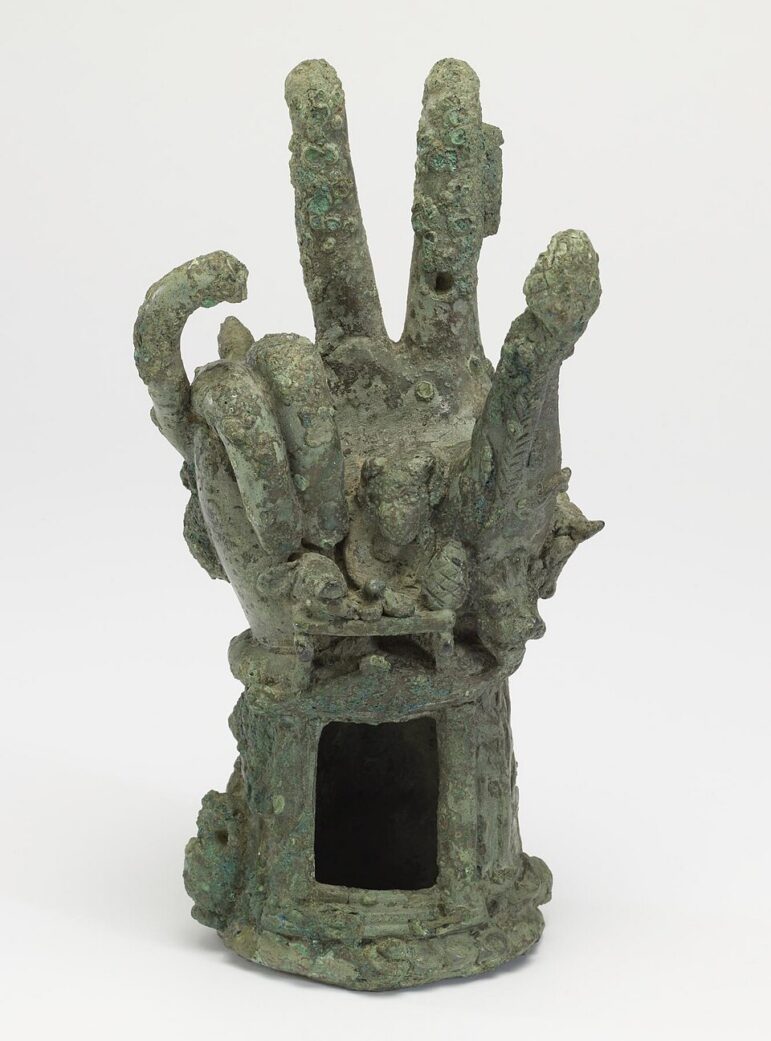
Copper alloy Roman hand of Sabazios used in ritual worship. Note: This item was not part of the current research. Walters Art Museum, Baltimore. Public Domain
By the Roman period, however, the cult had spread widely around the Mediterranean while remaining comparatively limited. Worship appears to have frequently taken place in private or domestic settings, making archaeological evidence difficult to recognize. The researchers note that the cult is principally identified through distinctive objects, including bronze votive hands known as sabazeas, portable triptych-like plaques, and unusually decorated ceramic vessels.
Among the most recognizable objects associated with Sabazios are bronze hands covered with religious imagery. Snakes are particularly prominent in Sabazian iconography and appear winding around many surviving hands alongside other animals and religious symbols.
Ancient literary sources also connect serpents with Sabazian initiation. Greek and later Christian writers described rites involving a serpent passing through or beneath an initiate’s clothing. Although their descriptions were sometimes hostile or mocking, they reinforce the archaeological association between Sabazios and snakes.
Evidence for the cult is especially uncommon in the Iberian Peninsula. Finds include a bronze hand recovered near Cartagena and a small bronze bust from l’Alcúdia, while other proposed Sabazian sites remain disputed. A particularly important discovery at Empúries consisted of silver-plated bronze plaques forming a portable triptych depicting Sabazios surrounded by religious symbols and accompanied by the Dioscuri, Castor and Pollux. The researchers suggest such objects may have belonged to itinerant priests spreading the god’s mysteries.
The Collet discovery adds another piece to that sparse archaeological record.
The fragments belong to a large vessel approximately 230 millimeters, or nine inches, in diameter. Its surviving handle is fashioned as a serpent with a head at each end. Rows of semicircular incisions imitate scales, while the heads preserve recognizable eyes and mouths. The researchers created a 3D reconstruction and compared the vessel with serpent-decorated ceramics found elsewhere in the Roman world.
Laboratory analysis, including optical microscopy and X-ray diffraction, found that the vessel was made from a compact red ceramic paste containing quartz, mica and other minerals. Its composition differs from pottery manufactured at a nearby workshop. The researchers say the mineral composition and traces of a white slip could point toward an African origin, although they emphasize that the evidence is not sufficient to establish where the vessel was produced.
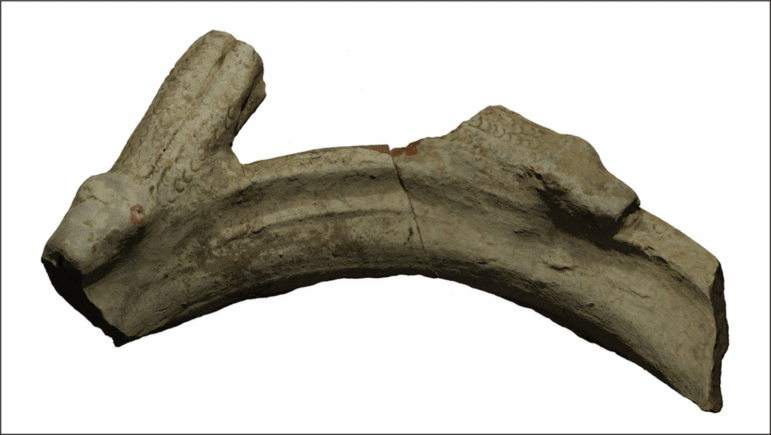
A reconstruction of the Sabazios vessel Source: Universitat de Girona.
The archaeological context provides another significant clue. The fragments were already broken and deposited during the Augustan period, placing the vessel’s use around the reign of Augustus, 27 B.C.E. to 14 C.E., or shortly beforehand. That makes Collet an unusually early rural example of the serpent-decorated pottery associated with Sabazios.
Similar vessels decorated with snakes, lizards, frogs, and toads have been recovered at Empúries and the nearby Roman settlements of Tolegassos and Camp de la Gruta. Serpent vessels alone cannot prove the worship of Sabazios; comparable pottery occurs in Mithraic, domestic, and other ritual contexts. But the concentration of serpent vessels around Empúries, together with the Sabazios triptych discovered there, strengthens the researchers’ interpretation.
They propose that an itinerant Sabazian priest may have operated from Emporiae, perhaps bringing the cult from the eastern Mediterranean. From there, Sabazian practices could have entered the sacra privata, the privately observed religious life of households and rural estates such as Collet.
The discovery consequently offers evidence not simply for the presence of an unusual god in Roman Spain, but for how less widespread religious traditions could travel enormous distances through the empire.
Despite leaving relatively little archaeological evidence, the cult of Sabazios may have formed part of a network extending far beyond the regions where it originated. The Collet vessel suggests that network reached not only major Roman cities, but private worshippers in rural communities at the opposite end of the Mediterranean world.
The Wild Hunt is not responsible for links to external content.
To join a conversation on this post:
Visit our The Wild Hunt subreddit! Point your favorite browser to https://www.reddit.com/r/The_Wild_Hunt_News/, then click “JOIN”. Make sure to click the bell, too, to be notified of new articles posted to our subreddit.