

In the era of erasure, we may have fortune as material wealth remains valued in the year 2026 over the richness that maintaining the honesty and ethical standards that have governed the past. We also have music. Regardless of the patchwork of our nation’s haves and have nots, we have a varied musical legacy that entertains us, teaches us, and reminds us of our values.
We mark 250 years in the year 2026 with cage fights at the White House and the thrill of seeing drivers race through the streets of our nation’s capital because we can, but not necessarily with the reverence, awareness and hope that existed in 1976. Fifty years ago, despite barely bandaged conflicts over race, gender, and sexual orientation, we were more free in criticism of our government, our societal values, and how we needed to approach and solve our problems as a country.
The president then was also a Republican, Gerald Ford, who served for a short period of time after the former President of the United States, Richard Nixon, resigned upon the realization that he did not have the votes necessary to beat an impeachment through friends in the House of Representatives and in the Senate. As a former senator, Nixon knew the rules and how to play the political landscape like a royal flush in poker. He served in the Senate from 1950 to 1953 before becoming the vice-presidential running mate for Dwight D. Eisenhower.
Unlike in 2026, Republican President Ford presided over a Democratic Congress.

Franklin 1776 Bicentennial 13c 1976 issue Bureau of Engraving and Printing; Imaging by Gwillhickers, Public domain, via Wikimedia Commons
Gas prices of sixty-five cents a gallon were relatively high when adjusted for inflation ($4.51 in 2026 values). Stamps were only 13 cents instead of 2026 prices of eighty-two cents, an increase of 530.77% over 50 years. In short, life was hard for middle and lower-middle class folks, yet we kept pride in who we were as Americans. It showed in where and how music appeared.
Producer Norman Lear’s shows like All in the Family (1971), and three of its five spin-offs – Maude (1972), Good Times (1974), and The Jeffersons (1975) were memorable for their focus on controversial issues affecting American life at the time: racial relations (All in the Family, The Jeffersons, Good Times), working-class life (All in the Family, Good Times ), women’s rights and the right to an abortion (Maude), and intra-racial relations (The Jeffersons, Good Times).
More importantly, each of these shows had memorable musical theme songs that centered the viewer into the theme of the show: “Those Were the Days” (All in the Family), “And Then There’s Maude” (Maude), “Good Times”(Good Times), and “Movin’ on Up” ( The Jeffersons) performed by Ja’Net DuBois know best from her role as the gossip lady Willona Woods of Good Times.
While 21st century situation comedies and programs are not known for their memorable ear worm singable tunes, an entire era comes easily to the forefront of memory in hearing Jean Stapleton’s excellent singing voice harmonizing off-key vocals with Carrol O’Connor on “Those Were the Days.”
Musicians voices’ played a role from Donny Hathaway’s smooth vocals, and upbeat jazz and catchy tune for “And Then There’s Maude” that combined a historical rendition of past female role models from Lady Godiva to Joan of Arc, Isidore, Betsy Ross to feminist 1972 Maude. The theme song from Good Times, performed by Jim Gilstrap and Blinky Williams included a full gospel choir. The essence of Black cultural influcence seeped into each of the three theme songs where there is a partial or full gospel focus: “And Then There’s Maude” (small hint), “Good Times” (full gospel choir), and “Movin’ on Up” (gospel structure, hand claps, foot stomps, jazz piano, and organ).
Looking back, the choice to intertwine race and culture through their musical theme songs aided the feel and popularity of these three spin-off shows. It became a silent nod to a larger societal integration and acceptance of differences in race, culture, sexual orientation, as well as gender freedom for women.
With these types of entertainment in the early 1970s, it comes as no surprise that the musical landscape provided the voices of the people – those whose lyrics and melodies proved that among the populace there was a strong consideration regarding the need as well as the right as Americans to uphold the implicit guarantees and values given by those who founded what would become the United States of America.
As a nation, the bicentennial was the American attempt to enjoy a blissful harmonic period as emphasized in music with singles and albums that praised our ability to reach two centuries of existence without killing each other, or destroying the country that began as an experiment.
In 1976, songs like “Bicentennial” (The Ohio Players), Stevie Wonder’s album, Songs in the Key of Life, and “America the Beautiful” (Ray Charles) blended with the excellent jazz-poet-rap featured in Gil Scott-Heron’s “Bicentennial Blues.”
The message was one of hope, not fear, and the need to connect as humans who sought unity rather than division. Unity requires awareness however.
Ray Charles reminded the nation of sacrifice in his rendition of the original “America the Beautiful,” which begins with the third verse instead the traditional first; however, this change makes the version stronger.
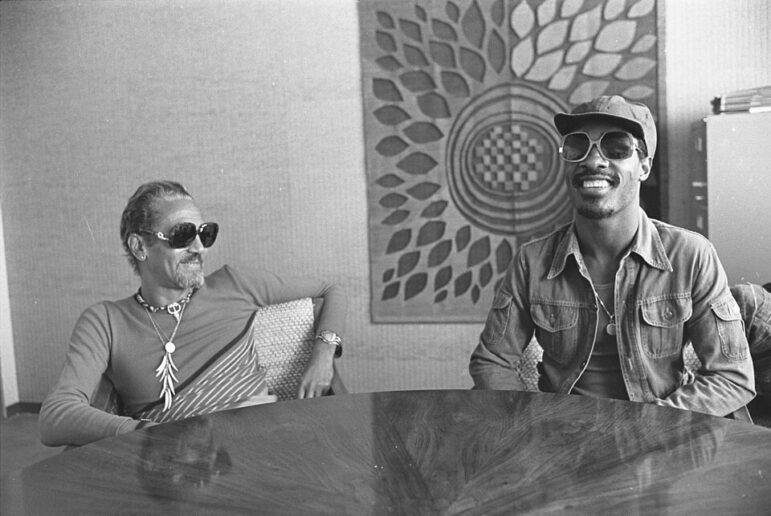
Musician Stevie Wonder with music executive Ewart Abner in Los Angeles, California, 1975 [CC 4.0, Wikimedia Commons, Los Angeles Times Photographic Collection at the UCLA Library]
Stevie Wonder’s 1976 album begins with a song that reminds us in 2026 of what we need: “Love’s in Need of Love Today.” As a child, I usually skipped this track for either the very practical but upbeat “Have a Talk with God” (“well, he’s the only free psychologist who’s known throughout the world”) or my instrumental favorite, “Contusion,” or even the nostalgic, “I Wish”, which reminded me of my father’s childhood as he recalled it.
Now, I understand why Stevie Wonder chose to perform “Love’s in Need of Love Today” after the attacks on the World Trade Center in 2001.
We needed to come together as a nation then, just as we need to come together as a nation now. We don’t need to agree, but we do need to embrace traits that have somehow slipped through our grasp like sands through an hourglass: civility and listening.
Amidst the turmoil of stress and war-hangover post-Vietnam, we sought escape through uplifting music, such as the song, “Afternoon Delight”, which remained on never-ending replay throughout the summer of 1976. I often wonder how many children were conceived in July when the “skyrockets in flight” helped the song reach number one in the country. True, the underlying message involves enjoying a relaxing afternoon and sex; however, the tune is so mellow and upbeat that it became an earworm.
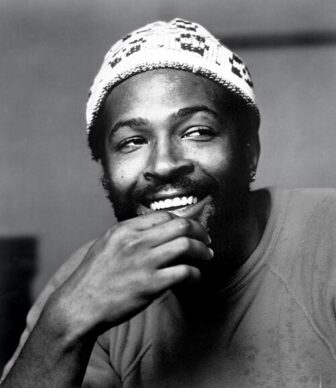
Marvin Gaye publicity photo from 1973 [public domain]
Marvin Gaye demonstrated over three albums how to engage an audience through the seriousness of environmental and cultural awareness, with 1971’s What’s Going On, with the ultimate album about the power of sexual healing, 1973’s Let’s Get It On, and the joy of sex for its own sake in his 1976 masterpiece, I Want You.
As a musical year we blossomed not just sexually, but in our willingness to be open and blunt about our needs as a growing country. Although disco as a form and a movement had been around since the 1960s, its musical influence in the 1970s can be best remembered by the two years following the bicentennial with Saturday Night Fever (1977) and Thank God, It’s Friday (1978). The former had the distinction of having nearly half of its 17 tracks from the movie become memorable classics, including “How Deep Is Your Love“, “More Than a Woman“(Bee Gees), “Stayin’ Alive“, “If I Can’t Have You“, “Night Fever“, “Boogie Shoes“, the second version of “More Than a Woman” (Tavares) and the instrumental background music of “Manhattan Skyline.”
In many ways it was the start of a flower that remained slow to blossom, yet never died. The United States of America is only human. Gil Scott-Heron’s classic “The Revolution Will Not Be Televised” remains relevant 56 years after its original debut in 1970.
I agree with Scott-Heron: we first must change within our minds, then demonstrate the change through our active interactions with others, and finally avoid watering down our choices to fit the “safe” or acceptable venues as given by corporate America.
In that sense, regardless of one’s political affiliation, if we are learning and growing, then we are in motion. We are the revolution we seek. The cacophony of discord in the national psyche has a playlist. We just have to listen to the lyrics. We have to see the meaning beneath the finger-snapping catchy tune. The darkness beckons when we attempt to avoid the maw of the pit we do not realize is beneath us.
We create the playlists that provide the background for our lives. We must remember that ethics are not a culture of erasure, even it feels like it now.
The Wild Hunt is not responsible for links to external content.
To join a conversation on this post:
Visit our The Wild Hunt subreddit! Point your favorite browser to https://www.reddit.com/r/The_Wild_Hunt_News/, then click “JOIN”. Make sure to click the bell, too, to be notified of new articles posted to our subreddit.