

Thorn Season, by Kiera Azar, arrived in bookstores packaged as romantasy. “Shadow and Bone meets The Selection,” the marketing promises, banking on glittering courts and will-they-won’t-they tension. What the book actually delivers is something else entirely—the first chapters of a feminist high fantasy saga with a queer and Pagan reading.
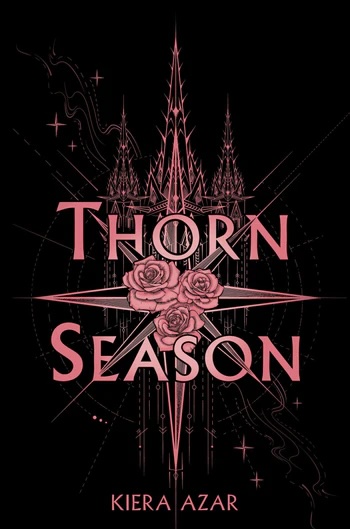
Cover to Thorn Season by Kiera Azar [HarperCollins]
Thorn Season makes good use of the court glitter as surface for a far denser investigation into repressed power, caste systems, witch hunts, and the generational cost of silence. Its primary currency is political intrigue and high stakes, not romantic ones. That is not a critique of the romantasy subgenre, per se. The problem lies in the reductive function of market labels — ones that erase what a book is actually doing. And Thorn Season is doing quite a lot.
In Thorn Season, witches are not burned. They are caged and dissected.
The Apparatus of Persecution
The Kingdom of Daradon operates on a simple and brutal logic. Wielders — those born with a Spectre, a living, sentient force that moves through and beyond the body’s visible limits, so deeply woven into the self that to suppress it is to suppress the person entirely — are hunted, imprisoned, and eliminated by Wholeborns, those without magic who control the state apparatus, wherein the persecution is institutional; the Hunters are a professional class, the executions are public spectacles, and the court is where the firing squad learns to smile. It’s more Bridgerton meets Game of Thrones than Shadow and Bone meets The Selection, with the glamour of the first and the high stakes of the latter.
What Thorn Season refuses to do is present all of this as mere worldbuilding backdrop. This is a narrative wherein the system is the story and the logic of which is not one of fear alone — it is the logic of extraction. Those in power don’t merely want to eliminate the Wielders. They want their power and they want it legible, containable, and ultimately usable. The basic law of colonialism. As Alissa herself observes: “After all, power was only deemed dangerous when it couldn’t be commandeered by those in authority.”
This is precisely the argument Silvia Federici makes in Caliban and the Witch1: that the early modern persecution of women accused of witchcraft centered on the violent reorganization of bodies, labor, and autonomous knowledge under emerging capitalist and patriarchal structures. The witch hunt was an instrument of enclosure of both land and powers that existed outside institutional control. Azar does not need to have read Federici to have arrived at the same structural insight. The resonance is in the bones of the world she built.
The Wielders who disappear in Daradon vanish into something worse than death. What the novel gradually reveals is that the machinery of persecution is also one of study. This is not fantasy cruelty for atmosphere, but an argument about what states do to bodies whose power they cannot own.
The Armor of Silence
Alissa Paine is the daughter of a Hunter family and she is secretly a Wielder. Her position is one of constitutive, exhausting duplicity — not the exciting kind, but the kind that grinds. She has survived through suppression. Her Spectre, described by Keil — the Ansoran ambassador and himself a Wielder — as something as natural as breathing, a gift that should not hurt, hurts her constantly. However, what hurts her is not the Spectre per se, but a lifetime forcing it down. The pain she carries is not the cost of magic, but the cost of its suppression.
This is the central metaphor of the book, and it is a queer one—not in the sense that Alissa’s desires are necessarily queer, but in the structural sense that her situation replicates, with remarkable precision, the logic of the closet: identity as crime, suppression as survival, the armor that protects and mutilates from the same point of contact. Audre Lorde wrote that caring for oneself is not self-indulgence, it is self-preservation, and that is an act of political warfare. Alissa has never been permitted that. Every act of self-preservation available to her requires the denial of what she is, because in Daradon, the self is a capital offense.
What compounds this is that the suppression was taught, not chosen. Alissa’s father, who loved her genuinely and protected her fiercely, was also the figure who trained her to hide, making his love inseparable from the lesson that survival depended on disappearing. This is the precise dynamic Murdock identifies as central to the heroine’s journey: the father’s daughter, the young woman who has internalised the values of the dominant culture—embodied here in the literal figure of a beloved Hunter father—at the cost of everything she actually is. The protection and the wound come from the same source.
Drawing on bell hooks’ discussions of domination and internalized oppression, one could argue that oppressive systems function not only through external violence, but by teaching the oppressed to fear their own nature. Alissa has absorbed this lesson so completely that her Spectre, her most intimate self, registers to her as something to be ashamed of, managed, and concealed. The system has done its work before the novel even begins.
Complicity and the Cost of the Surname
What makes Thorn Season even more sophisticated than its marketing suggests is that Alissa’s crisis is not simply one of secrecy but of complicity since she has benefited—often at the expense of her friends, as she later comes to realize—from the system that persecutes her own kind. Her surname, her father’s protection, her position at court, all of it is built on a structure that hurts people like her. The novel, however, does not let her off the hook for this. When the Ansoran Wielders ask her to act, she hesitates, calculates, and delays. The dam of silence holds through fear and through the privilege that silence has purchased.
This is the specific terrain that neither the hero’s journey nor the standard romantasy arc is equipped to map. The heroine’s journey, as theorised by Maureen Murdock, moves through stages in the first half of her journey: separation from prescribed identity, identification with patriarchal values as a survival strategy, the illusory success that identification brings, and then the collapse—the moment when the achievement reveals itself as the betrayal. Alissa’s arc in Thorn Season unfolds through this contradiction: her greatest tactical successes at court coincide with the gradual erasure of the self they demand from her. Every step deeper into the system requires another concession, another suppression, until advancement itself becomes inseparable from self-annihilation.
Carmen, the princess whose position sits at the very apex of that system, functions as a crucial mirror here. She has every privilege the structure can confer—and she uses it covertly, at considerable personal risk, to subvert the apparatus from within. The contrast is not flattering to Alissa, nor is the narrative interested in softening it. Carmen acts. Alissa watches and waits and performs. The question the book is really asking is not whether Alissa will be discovered, but whether she will finally choose her kin’s side, namely, the Wielders, and what it will cost her either way.
Princess Carmen is also a figure worth dwelling on in the context of female solidarity. In a court designed to pit women against each other through the Rose Season’s logic of competition for the king’s favor, through the surveillance of feminine propriety, through the weaponization of reputation and desirability, and the constant performance of harmlessness, the alliances that form between women are acts of structural defiance. Tari’s loyalty to Alissa despite disagreeing with her choices, Carmen’s covert subversion of her family’s apparatus, and even Perla’s unexpected intervention at a critical moment: these are not incidental to the plot. They are the plot’s moral architecture.
The Weight Is the Story
There is a particular kind of weight that does not require catastrophe to make itself felt, and Thorn Season operates in that register. The prose is gorgeous—deliberately, almost painfully so—and yet reading it is not easy. The court glitters; the oppression hums beneath every exchange, every murmur, every glance, every silence, and every carefully performed smile. Nothing needs to reach the level of catastrophe for us to almost physically feel the cost of existing in Daradon.
This is no structural flaw, though, but a structural choice, one that owes less to the Western three-act tradition of tension and release than to narrative sensibilities shaped by other inheritances. Azar, who is half-Lebanese and half-Indian, builds a world where suffering is not an event to be resolved but a condition to be endured. The pain seeps from the effort of not being.
Readers familiar with the narrative structure of K-dramas, and particularly with the Korean concept of han—a deep, embodied form of grief and resentment accumulated across generations of structural violence, carried in both body and memory—will recognize the texture. Thorn Season breathes in that same rhythm. The weight is the story.
One could argue that this formal choice is itself a feminist one. The Western narrative tradition, rooted in Aristotelian dramatic structure, privileges resolution: the tension that builds must be released, the wound must be healed, the hero must return transformed. Murdock’s critique of the hero’s journey is precisely that the hero’s arc does not describe the experience of women under patriarchy, where suffering is not a temporary state between departure and return but a persistent condition of existence. Thorn Season refuses the promise of catharsis, offering instead something harder and more honest: the felt reality of living inside a system that was built to contain you, rendered in prose so precise it becomes almost unbearable to read.
That unbearability is the point. It is also, finally, what the book’s Pagan and queer readings converge on. Contemporary Pagan traditions — particularly feminist Witchcraft and earth-based spiritualities — understand power as something inherent to the body and the self, something that precedes and exceeds institutional sanction. The Spectre in Thorn Season is exactly this: power that does not require permission, that exists before laws, that the body produces as naturally as it breathes, and that the state must suppress in order to maintain its monopoly on force. The resonance with queer experience is built into the text. For many queer people, the first communities that offered language for existing outside compulsory normativity were precisely these Pagan circles, feminist covens, spaces where the body’s knowledge was treated as legitimate rather than pathological.
Azar is writing a YA fantasy saga. She is also, whether intended on every layer of it or not, writing about what it costs to be something the world has decided is dangerous, and what it might finally mean to stop pretending otherwise.
If you have been following my columns here on The Wild Hunt, you might have already noticed how many times I mention Caliban and the Witch. This is essential reading for anyone who wants to understand the architecture of the systems that made witch hunts possible, and that have never, in any meaningful sense, stopped. Federici’s dissection of early capitalism’s war on women’s bodies and autonomous knowledge is the kind of book that changes the shape of everything you read and watch after that. Once you see the patterns, you cannot unsee them. I could not recommend this book more highly.↩
The Wild Hunt is not responsible for links to external content.
To join a conversation on this post:
Visit our The Wild Hunt subreddit! Point your favorite browser to https://www.reddit.com/r/The_Wild_Hunt_News/, then click “JOIN”. Make sure to click the bell, too, to be notified of new articles posted to our subreddit.