

Jeffrey E. Anderson’s Voodoo: An African American Religion is an extremely readable scholarly investigation into the evidence available to us about what the Voodoo of the Mississippi River Valley region looked like in the period from its initial development in the 18th century, its heights in the 19th, and its fading from prominence in the 20th. Anderson examines the documentary history of how this uniquely American religion was portrayed, mostly by a hostile or sensationalist white press or by folklorists and anthropologists, and reconstructs a portrait of a tradition that has remained a huge part of the American popular imagination even as the details of its practice have slipped from popular consciousness.
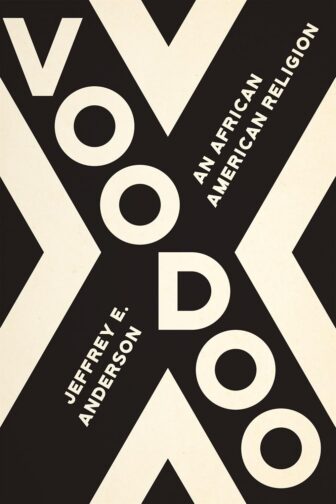
Voodoo: An African American Religion by Jeffrey E. Anderson [LSU Press]
Anderson begins by assessing the name “Voodoo” itself for this project. The names Vodun, Vodu, Vodoun, Vodou, and Voudou are all brought up as possible candidates, among others, that might escape some of the stigma associated with Voodoo, but Anderson settles on the latter due to the simple fact of its widespread popularity among both scholars and the public. (The book settles on Vodou to discuss Voodoo’s Haitian cousin and generally uses Vodun to describe the related religions of Benin and other West African nations.)
Anderson also breaks down the comparison between “Voodoo” and “hoodoo,” noting that while today most scholars and practitioners alike regard “Voodoo” as referring to a religion with a specific theology and “hoodoo” as referring to a set of magical practices, historically these phrases were often used interchangeably, and in any case lacked the rigid definitions that appear today. While Anderson settles on using “Voodoo” to discuss the religion and “hoodoo” to describe magical practice, he acknowledges this is primarily for ease of discussion; throughout the book, he frequently describes how historical usage diverges from this schema.
From there, the book goes into five chapters. The first deals with the peoples of the Mississippi River Valley region. While most of Anderson’s material deals with New Orleans, he draws on evidence far beyond Louisiana, stretching up through Memphis, St. Louis, and, surprisingly, St. Joseph, Missouri, a town about 30 miles north of Kansas City. While the primary focus is on enslaved Africans and their descendants, Anderson also discusses how Indigenous peoples and white populations, especially the French and Spanish Catholic plantation class, influenced Voodoo’s development. Finally he discusses how the arrival of settlers from the United States and Haiti after 1800 contributed to Voodoo.
The second chapter, “African Spirits in the Mississippi River Valley,” is of special interest. Anderson examines the available evidence to reconstruct a list of deities or spirits that appear to have been honored in historical Voodoo. The chapter reveals a set of entities that diverges significantly from the lwa of Haitian Vodou (and notably, the terms “lwa” or “loa” are not documented in historical Mississippi River Valley Voodoo.) Some of these spirits are easily recognizable as cognates of Haitian lwa or West African deities, such as Papa Lébat, whom Voodoo adherents called upon in ritual to “open the door” in much the same manner as Haitian Vodou calls upon Legba.
Others still seem to be connected to other African Diasporic Religious traditions, but the connection is more tenuous. Anderson describes, for example, a deity called “Monsieur Danny,” also called “Blanc Dani.” Anderson argues that this spirit is the Mississippi River Valley reflex of the Fon and Ewe serpent deity Dan, known in Haiti as Danbala Wédo. Anderson also argues that a spirit called “Grandfather Rattlesnake,” attested in the practices of Voodoo in St. Joseph, Missouri, is also a cognate of Dan. What is strange, however, is that Monsieur Danny has a clear linguistic connection to Dan, but lacks any direct serpent imagery, while Grandfather Rattlesnake obviously has snake iconography but lacks the name. Although Anderson makes a convincing argument that Dan, Danbala Wédo, Monsieur Danny, and Grandfather Rattlesnake are all ultimately derived from the same entity, the lack of direct evidence for some connections is apparent.
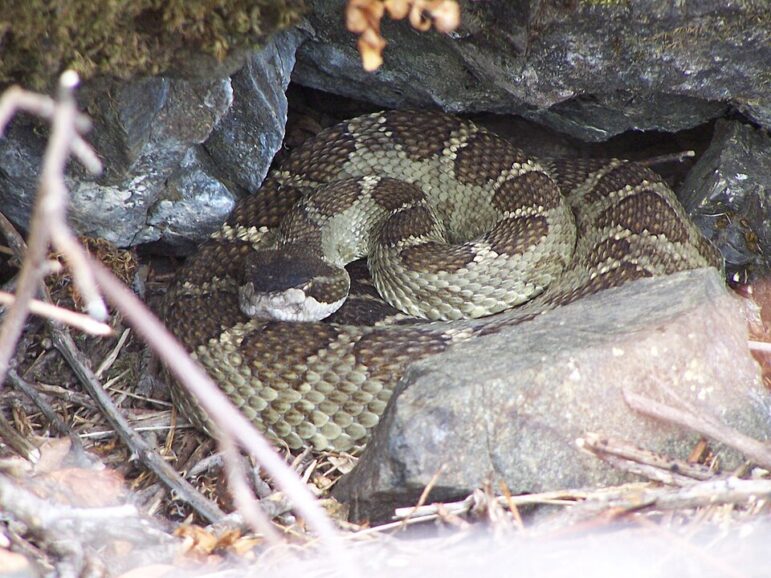
Timber rattlesnake [TJ Green, Wikimedia Commons, CC 3.0]
Still more entities in Mississippi River Valley Voodoo have no obvious relationships to West African or Haitian spirits. Anderson catalogues divinities like Samunga, Grand Zombi, Héron, and Mama You who are documented but may or may not reflect other known deities. Conversely, he points out that numerous divinities popular in other branches of the Voodoo family tree did not seem to appear in the Mississippi River Valley, such as the lwa Agwé, Ezili Freda, and Bawon Samdi – a key piece of evidence that Mississippi River Valley Voodoo developed independently of Haitian Vodou, and was not simply imported in from Haiti after the Haitian Revolution.
The third chapter, “The Voodoos and Their Work,” looks at how authority was structured within Voodoo, especially at the kinds of titles and duties that were associated with the Voodoo priesthood. The title of “queen,” most famously associated with Marie Laveau, is discussed in detail. Voodoo leadership was primarily, though not exclusively, female, and these leaders had roles both as servants of divinities and as providers of magical services.
This chapter contains a startling anecdote for a modern Pagan reader. King Alexander, a practitioner in St. Joseph, Missouri, is recorded as creating magical amulets known as “luck balls.” The source for this is the work of the folklorist Mary Alicia Owen, to whom we owe most of our information on the Voodoo practices of St. Joseph. Owen commissioned King Alexander to create a luck ball for her colleague and benefactor – none other than Charles Godfrey Leland, who only a few years later would publish Aradia, or the Gospel of the Witches, soon to be one of the formative texts of the modern Pagan movement.
The fourth chapter, “Working with the Spirits,” reviews what is known about Voodoo ritual. Unfortunately, there is no direct documentation from the practitioners themselves, and what is recorded, as mentioned above, is often from a sensational or outright antagonistic perspective. Still, there is valuable insight into initiation practices recorded, as well as documentation of the most visible public Voodoo ceremony in New Orleans, the annual ritual on St. John’s Eve.
The final chapter is one that advances a contentious, but probable, argument: namely, the Voodoo of the Mississippi River Valley region likely died out by about the 1940s after a decline in which events like the St. John’s Eve ceremonies had long ceased to occur. Anderson weighs other arguments, such as Kodi Roberts’s claim that Mississippi River Valley Voodoo had essentially been continued as the New Orleans Spiritual Church tradition, and also examines modern day New Orleans Voodoo practices. He argues that although there is certainly influence from the historical Voodoo tradition on these modern practices, there is a break in continuity. Modern New Orleans Voodoo, in particular, owes much of its character to Haiti, where many of its most prominent leaders were initiated. Notably, Anderson does not denigrate modern Voodoo for this lack of continuity – he portrays it as a sincere and meaningful religious community that is attempting to reconstruct the historical Voodoo with the materials it has at hand. For any Pagan who practices a reconstructionist path, this section offers much to consider.
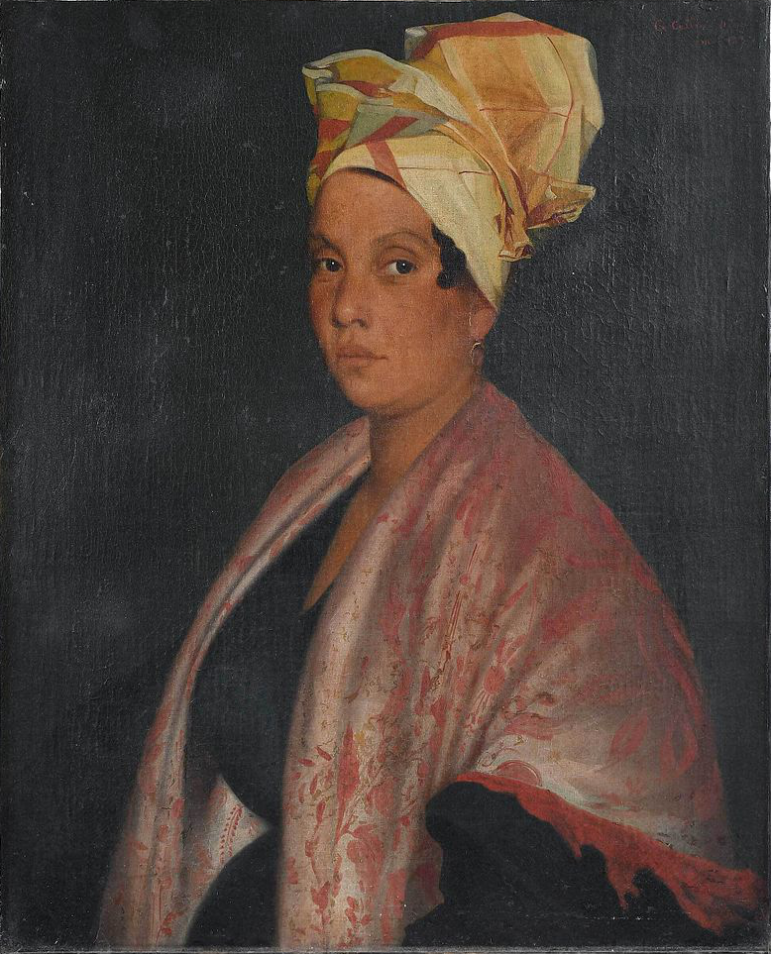
Charles Jean-Baptiste Colson, Portrait of a Creole Woman with Madras Tignon, 1837, oil on canvas. The painting has often been claimed to portray Marie Laveau. [public domain]
Anderson ends with a consideration of what Voodoo was and how we should interpret it today. “Any serious scholar of Louisiana Voodoo – or Vodun or Vodou for that matter – must take into account the divergent understandings of what it is,” he writes. He goes onto note that there is an urge to interpret Voodoo as a liberatory practice, a force for racial equality and empowerment – an urge he himself feels.
But this urge can cloud our ability to reckon honestly with Voodoo as a real historical practice in favor of our romanticized desires for what it could have been. Anderson notes that Marie Laveau, the Voodoo Queen herself, enslaved other Black people and was noted in an obituary to have been a loyal supporter of the Confederacy. Some documented Voodoo ceremonies were supposedly held to bolster the South in the Civil War with the aim of preventing the liberation of enslaved Black people, in order to maintain the relative privilege of free Black practitioners. That is not to discount that Voodoo and hoodoo were also frequently used toward the ends of freedom and equality, of course – just to note that the picture was complicated. “In sum,” he writes, “Voodoo was a religion that is too big to confine to a narrow interpretation, no matter how well meaning its formulation.”
In an appendix, Anderson catalogues the known chants, songs, and prayers of Mississippi River Valley Voodoo. Much of this is fragmentary at best, but for the curious, it is a valuable resource.
For those who are interested in the history of Voodoo, this is an invaluable book, one that significantly expands the range of knowledge on what this religion looked like in the Mississippi River Valley. As a life-long inhabitant of that region, I found myself learning much about the history of my homeland on every page. Voodoo: An African American Religion comes highly recommended for anyone who wants to learn more about the development of this African Diasporic Religion, a tradition that, even accepting Anderson’s thesis that it effectively died out in the early 20th century, continues to have an impact on modern Voodoo, American popular culture, and, in obvious and not so obvious ways, the modern Pagan movement.
Voodoo: An African American Religion by Jeffrey E. Anderson is available from LSU Press.
The Wild Hunt is not responsible for links to external content.
To join a conversation on this post:
Visit our The Wild Hunt subreddit! Point your favorite browser to https://www.reddit.com/r/The_Wild_Hunt_News/, then click “JOIN”. Make sure to click the bell, too, to be notified of new articles posted to our subreddit.