

This article comes to us from High Priestex Mortellus.
In January of 2026, Pope Leo XIV, speaking at the World Day of Social Communications, issued a warning that AI risks damaging human relationships and eroding the depth of human communication. He framed AI as an anthropological problem, one that simulates presence, voice, and intimacy while hollowing out the conditions that make them meaningful. It was a sober and, in many respects, welcome intervention—I don’t disagree with him that AI is a risk to some of the most critical aspects of our humanity—yet the conversation surrounding his remarks quickly revealed a familiar pattern.
While the Pope himself avoided sensationalism, related Catholic discourse—particularly from the 15th International Conference of Exorcists—raised alarms about AI creating “new forms of necromancy.” Once again, Pagan practice lingers in the background of this anxiety as an implied cautionary tale, an example of spiritual danger, boundary violation, or moral corruption. A framing that I believe deserves closer scrutiny. Not because AI is harmless, but because the way we talk about these and other issues matters, and treating Paganism as shorthand for spiritual excess while ignoring Christianity’s own long and intimate relationship with the dead does nothing to clarify the ethical stakes of AI—it simply obscures them.

A candle for the dead [Pixabay
When societies encounter forms of change they cannot easily regulate, Paganism is often invoked as a proxy threat. For example, early modern witch trials were fueled less by theology than by economic instability and disease. The Satanic Panic transformed anxieties about daycare, feminism, and mass media into accusations of occult abuse. Even today, works such as Pagan Threat: Confronting America’s Godless Uprising, frame Paganism not as a religious minority, but as an organized menace—a stand-in for fears about declining Christian dominance, shifting moral authority, and cultural pluralism. Time and again, we locate danger in imagined Pagan conspiracies rather than in structural change; each time, the charge of occult danger does nothing more than displace society’s anxieties onto a group that history has already deemed an acceptable container for all that we fear.
Paganism is positioned as the spiritual category into which things go when they feel transgressive or morally suspect, and the result is not serious ethical analysis but a familiar moral reflex—one that reassures insiders while quietly reinforcing suspicion of minority religions. So, when warnings of “digital necromancy” are used to describe the dangers of AI, once again using Pagan traditions as the unspoken reference point for potential harm, the implication is not subtle.
An Inconvenient Fact: Catholicism Already Practices Necromancy
The fear being articulated here is not new. Concerns about impersonation, false voices, and the misuse of the dead has existed for as long as humans have told stories, preserved relics, or spoken prayers. What’s new is the technology—not the anxiety. But if necromancy is understood as ritualized interaction with the dead, we must take time to clarify that Catholicism is not an outsider to necromantic practice—it’s one of its most enduring custodians.
Catholic devotional life is saturated with the presence of the dead. Saints aren’t merely remembered—they’re addressed, petitioned, and relied upon. Their bones, hair, blood, and clothing are preserved as relics, displayed in reliquaries, kissed, carried in procession, and placed beneath altars. Feast days are structured around their deaths. Their voices—recorded in writings, visions, and hagiographies—continue to shape doctrine and devotion long after their bodies have ceased breathing. The Communion of Saints isn’t metaphorical, it’s a theological assertion that the dead remain active participants in the life of the Church. That they are present.
And none of this is sinister. It’s meaningful, relational, and deeply embedded in Christian history. But it does make one thing clear: alarmist claims that AI introduces “necromancy” into an otherwise “pure” spiritual landscape rely on selective memory because the issue at hand isn’t communication with the dead—it’s who is authorized to do it, and under what institutional terms.
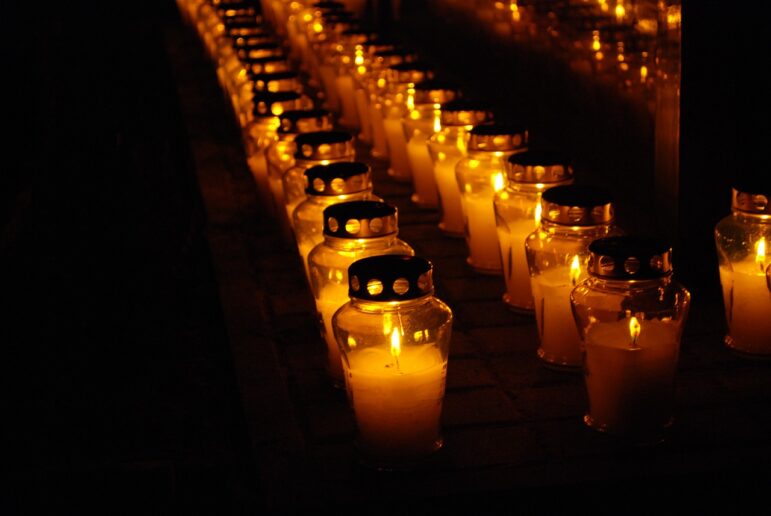
Rows of candles [kropekk_pl, Pixabay
The Real Ethical Line Is Not Necromancy
If AI poses a spiritual and ethical threat, it won’t be because it resembles ancestor veneration; it will be because it simulates relationships without reciprocity. Memory without responsibility. Voice without consent. Because AI systems are built by scraping vast archives of human expression without permission or meaningful accountability. The dead can’t consent to having their speech recombined into synthetic outputs and the living are rarely given a choice either.
AI asks nothing of those who use it and offers nothing in return but a plausible illusion, producing voices without bodies and responses without accountability. It isn’t necromancy in any meaningful religious sense—it’s ventriloquism at an industrial scale. What results isn’t communion; it’s extraction. A statistical imitation of presence stripped of obligation.
This is where many Pagan practices diverge sharply not only from AI, but from Catholicism as well, a practice that relies on bodies and relics taken without consent. On posthumous authority conferred through canonization. On hagiographies that place words, intentions, and moral presumptions into the mouths of the dead as spoken by the living. Whatever their devotional meaning, these practices hinge not on the consent of the deceased, but on posthumous institutional authorization.
Pagan practice, by contrast, treats the dead as agents whose participation is negotiated, conditional, and never assumed. Bounded by ethical reciprocity, relationships with the dead carry expectations—care, offerings, limits, and consequences—and may be withdrawn if those obligations are violated. Pagan traditions don’t presume access to the dead, but risk refusal, silence, or reprisal as part of responsible practice, a difference that matters when discussing ethics.
Why Pagan Communities Bear the Cost of Misplaced Panic
When religious authorities invoke “necromancy” as a catch-all warning about AI, the collateral damage is predictable. Pagan and occult practitioners—already accustomed to moral suspicion—find themselves once again positioned as symbols of danger rather than as participants in ethical conversation, and this vague spiritual panic has real consequences. It fuels censorship, justifies surveillance, normalizes the idea that certain forms of religious expression are inherently risky or corrupting, and runs the risk of distracting from the actual harms of AI, such as labor exploitation, cultural theft, environmental cost, and the erosion of human creativity.
Pagan traditions aren’t asking to be exempt from ethical scrutiny—they’re asking not to be used as a convenient metaphor for fears that institutions are unwilling to examine in themselves.
Pope Leo XIV is right to insist that the debate over AI is fundamentally human, and when he warns against simulated relationships replacing embodied ones, he’s naming a genuine danger. But it’s not a danger that should be understood through the language of occult corruption—it’s one we should understand through the language of consent and responsibility. AI threatens human connection by encouraging passivity and offering unearned and frictionless intimacy in place of relationships that require effort.
The danger is not that machines will summon ghosts—it is that they will teach us to accept imitation instead of encounter. And until we acknowledge the difference, warnings about “necromancy” will continue to reveal less about the dangers of AI than it does about the discomfort of institutions avoiding their own reflections.
The Wild Hunt is not responsible for links to external content.
To join a conversation on this post:
Visit our The Wild Hunt subreddit! Point your favorite browser to https://www.reddit.com/r/The_Wild_Hunt_News/, then click “JOIN”. Make sure to click the bell, too, to be notified of new articles posted to our subreddit.