
WASHINGTON — A national survey released October 20, 2026 finds a substantial divide, placing competing understandings of morality alongside the political disagreements shaping the approaching midterm elections.
The findings echo debates within Pagan communities. In his March 2025 opinion essay “Elon Musk and the Theology of Empathy,” for example, The Wild Hunt columnist Karl E. H. Seigfried examined Musk’s warnings about “suicidal empathy” and argued for empathy as a central value in Heathen theology and practice.

The 17th annual American Values Survey, released by the Public Religion Research Institute (PRRI) in partnership with the Brookings Institution, found that 68% of Americans favor the statement that “empathy is a foundational moral value that helps build a healthy society.” Another 27% favor the competing statement that “empathy can become dangerous when it leads people away from building a society guided by God’s truth.”
The first statement drew support from 84% of Democrats, 70% of independents, and 54% of Republicans, a 30-percentage-point partisan gap. Among white evangelical Protestants, 42% selected empathy as foundational, while 54% selected the statement warning of its potential danger. The full report gives the 42% figure; the press release lists 48%.
The question measures preferences between two statements about empathy’s social role and religious limits, rather than respondents’ capacity for empathy or behavior toward others. PRRI asked a similar question in 2025 but changed the wording, limiting direct comparisons.
The findings also reflect a particular political moment. Interviews occurred August 20, 2026–September 7, 2026, amid debate about President Donald Trump’s administration and the congressional elections.
PRRI surveyed 5,200 adults from Ipsos’s KnowledgePanel, plus 339 recruited through opt-in panels to increase sample sizes in smaller states. The reported national margin of error is plus or minus 1.6 percentage points at the 95% confidence level; subgroup margins may be larger.
It is important to note that the published findings provide no separate estimate of Pagan attitudes. Neither religiously unaffiliated respondents nor combined non-Christian groups can stand in for Pagans. But the findings still speak to common values and conversations within many modern Paganisms.
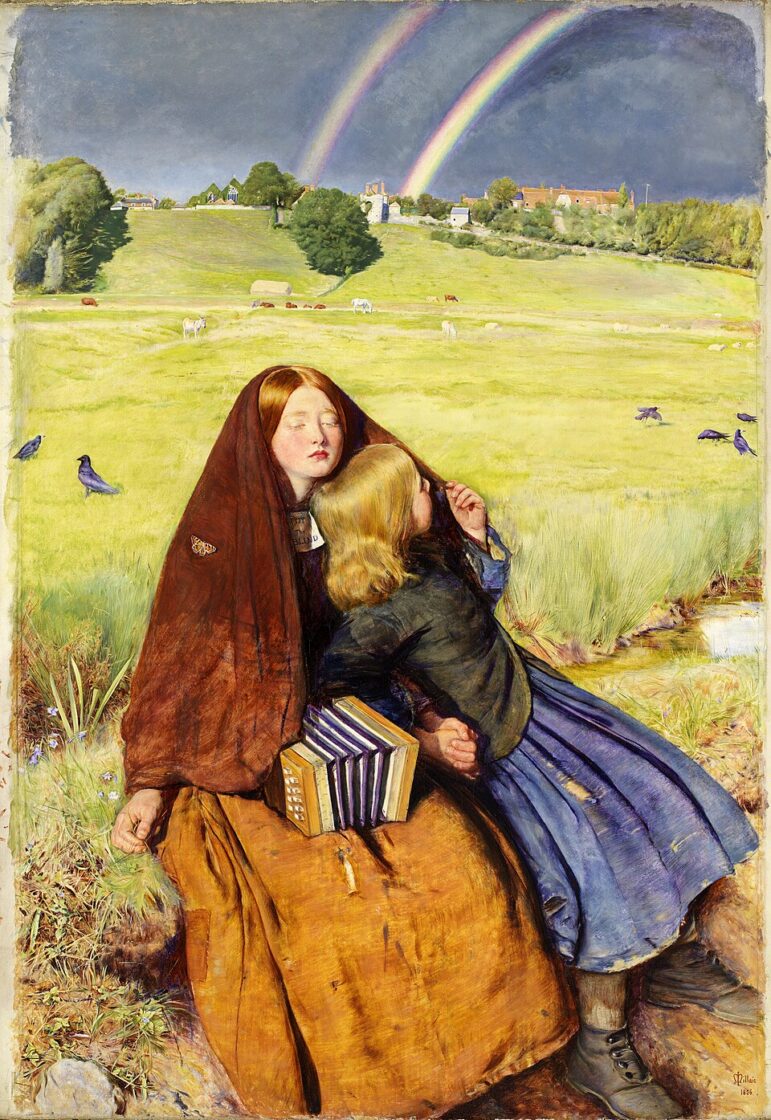
John Everett Millais: The Blind Girl, 1856 [Public Domain
PRRI President and Founder Robert P. Jones interpreted the results as evidence of a troubling division.
“As Christian nationalist leaders attack the sentiment of empathy, a disturbing ‘empathy gap’ has opened, separating Republicans and white evangelicals from most other Americans,” Jones said in the organization’s announcement.
“Such orchestrated attacks are typical of violent authoritarian movements and should be disturbing to all who care about the moral foundations of our pluralistic democracy.”
The report also finds that 59% of respondents classified as Christian nationalism adherents selected the statement that empathy can become dangerous. These associations do not establish what caused respondents’ answers or how much religious affiliation accounts for the partisan gap.
Religious and partisan differences also appear in immigration policy. Nationally, 59% support allowing undocumented immigrants to become citizens if they meet certain requirements. Since 2013, Republican support for a citizenship pathway has declined from 53% to 37%, while support for identifying and deporting all undocumented immigrants has risen from 32% to 50%.
Among white evangelical Protestants, support for citizenship fell from 56% to 44%, while support for deportation rose from 30% to 47%.
Meanwhile, 62% of Republicans and 53% of white evangelical Protestants support detaining undocumented immigrants in what the survey describes as internment camps until deportation. These answers do not establish that attitudes toward empathy cause support for particular immigration policies.
On election administration, 35% of Americans agreed that “if there are serious concerns about voter fraud in a local voting location, the president should order federal agents to seize the ballots and take over the vote counting.” Support reached 58% among Republicans and 65% among Republicans who view Trump favorably.
Most Republicans, 82%, identified ineligible people casting votes as the bigger election problem, while 80% of Democrats identified eligible voters being denied the vote. Those responses measure perceptions, rather than documented frequency.
Nevertheless, large majorities oppose officials enriching themselves through public office, drawing voting maps for partisan advantage, or trading individual stocks while serving.
Social trust offers another counterpoint. Some 77% somewhat or completely trust their neighbors, 74% trust people of another religion, and 72% trust people born outside the United States. A smaller majority, 61%, trust supporters of another political party.
The findings reveal a country sharply divided over empathy, religious authority, and the exercise of political power, yet one in which majorities still express trust across religious, national, and partisan differences. Jones’s warning also raises a broader question about the moral and spiritual foundations that allow people from different backgrounds to share a democracy and support common values within it.
The Wild Hunt is not responsible for links to external content.
To join a conversation on this post:
Visit our The Wild Hunt subreddit! Point your favorite browser to https://www.reddit.com/r/The_Wild_Hunt_News/, then click “JOIN”. Make sure to click the bell, too, to be notified of new articles posted to our subreddit.