

Equinox Blessings!
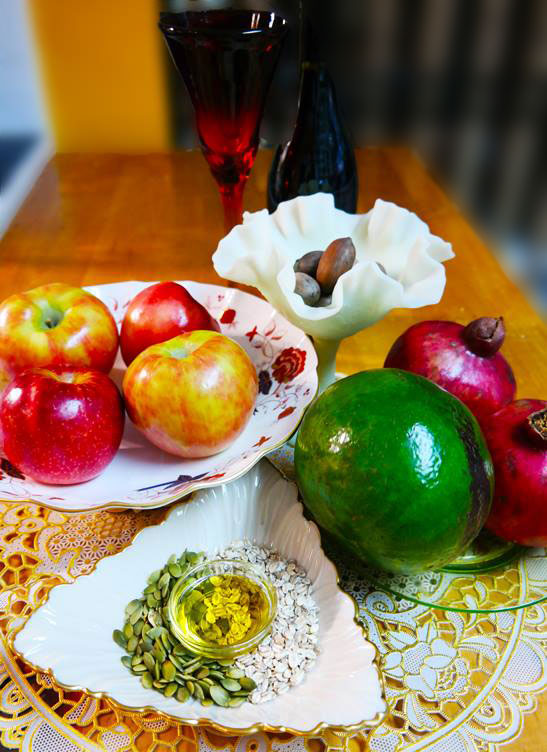
Photo Credit: M. Tejeda-Moreno
Pretty Much Everywhere on this Planet (You know, the one there’s no substitute for) — Meteorological autumn began on September 1, covering September, October, and November—or, as we call them in South Florida: Heatember, Hotober, and BelieveItsFall. For most, though, the new season truly begins with the equinox.
The September equinox in 2026 occurs on Tuesday, September 22, at 8:05 p.m. EDT (00:05 UTC on September 23). At that moment, astronomical autumn begins in the Northern Hemisphere and astronomical spring in the Southern Hemisphere. Around the world, day and night are roughly equal in length, though not perfectly so.
Equinoxes occur when Earth’s axis tilts neither toward nor away from the Sun, placing the Sun directly above the equator. Because Earth’s axis is tilted about 23.44 degrees, the equinox marks a moment of balance before the hemispheres diverge once again: toward longer nights in the north and lengthening days in the south.
These moments are thresholds, signaling the close of one season more than the full arrival of the next. In the north, days will shorten, the air will cool, and colors will deepen. As an Irish proverb says: “Autumn days come quickly, like the running of a hound on the moor.” In the south, light and warmth surge back, with blossoms and longer days heralding the approach of summer.
Astrologically, the Sun enters Libra, the scales of balance traditionally associated with Themis, Titaness of divine justice and cosmic order. Libra is the only sign of the zodiac represented not by a living creature or figure, but by an object—and, symbolically, an ideal.
In Japan, the autumn equinox falls within Higan, the Buddhist observance of the “other shore,” held around both the spring and autumn equinoxes. Families traditionally visit and tend ancestral graves, make offerings, and remember the dead. The setting sun in the west is associated in Pure Land Buddhism with the direction of Amida Buddha’s Pure Land.
In Poland, Dożynki, the traditional harvest festival, celebrates the completion of the harvest and has long been associated with the approach of autumn. Celebrations traditionally include the making of an elaborate harvest wreath from grain, flowers, fruit and ribbons, carried in a ceremonial procession before the festivities begin. The solemnity is followed, as you’d expect, by plenty of music, dancing, feasting and other revelry. Some traditions have connected Dożynki with the autumn equinox, although its documented history is more complicated, and today celebrations generally follow the local harvest rather than a fixed astronomical date.
In Latvia, Miķeļdiena, or Michael’s Day, traditionally marks the end of the harvest season and the completion of major autumn farm work. Although its name comes from the Christian feast of the Archangel Michael, older Latvian harvest traditions remain intertwined with the celebration. Among them is Jumis, a figure associated with fertility and the abundance of the fields, often symbolized by a double stalk or ear of grain. Customs surrounding the final grain of the harvest sought to preserve that fertility and ensure its return the following year. Traditional dainas—short Latvian folk songs and verses—preserve many of these older agricultural beliefs. Modern Miķeļdiena fairs continue the autumn celebration with traditional foods, crafts, music and activities recalling Latvia’s rural customs.
In many modern Pagan traditions, the equinox is observed as the second of three harvest festivals, framed by Lughnasadh and Samhain. Wiccans may call it Harvest Home or Mabon; some Druids use Alban Elfed; some Heathens observe traditions associated with Winter Finding; and others simply call the season Mid-Harvest or the autumn equinox. In modern Greek, the autumnal equinox is Phthinoporiní Isimería; in Old English, efnniht, literally “equal night.”
In much of the north, pumpkin spice has already swept in, as certain a sign of autumn as falling leaves. Albert Camus wrote: “Autumn is a second spring when every leaf is a flower.”
In Early Modern English, the season was sometimes called backend, the “back end” of the year. The term appears in northern English, Scots, and Irish dialects, was used by writers including Robert Burns in the 18th century, and persisted regionally well into the 20th. Today, of course, “backend” usually belongs to business and technology, but once it meant autumn.
Whatever name it carries—Fall, Harvest Home, Mabon, Alban Elfed, Mid-Harvest, or Spring for our southern kin—may this September equinox bring balance, gratitude, and renewal.

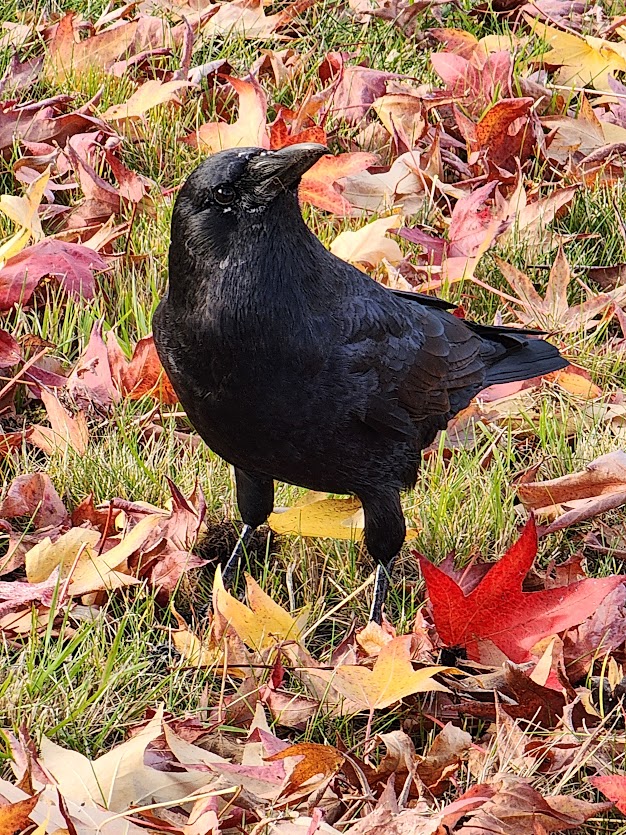
Raven Judging Manny [Photo Credit: S. Ciotti
Fall migration can begin as early as summer and continue into December, although September and October bring some of the heaviest movements. Songbirds, waterfowl, shorebirds, and raptors are among those traveling toward wintering grounds in Mexico, Central and South America, and the Caribbean. Fall numbers are generally greater than spring migration because the population now includes young birds produced during the breeding season.
And the numbers can be astonishing. BirdCast, a project led by the Cornell Lab of Ornithology and partner universities, uses the same weather-radar network employed to track storms to detect and estimate birds moving through the atmosphere. On September 12, roughly 321 million birds were forecast to migrate across the continental United States. In King County, Washington, nearly 1.4 million birds crossed overhead during a single night earlier this month.
Most of this great passage happens in darkness. More than 80% of migratory bird species in the United States migrate at night, often hundreds of meters above the ground. Weather plays an important role in determining when they depart: favorable winds, temperature, precipitation and cloud cover can turn an otherwise ordinary evening into a major migration night.
But the darkness birds depend upon is increasingly interrupted by artificial light. Migrating birds can be attracted to and disoriented by illuminated buildings, leaving them vulnerable to exhaustion and collisions with windows. With nearly half a billion birds expected to cross the United States during a two-week period this month, conservationists are again urging residents and building managers to participate in “Lights Out” efforts by turning off unnecessary lighting at night.
BirdCast recommends extinguishing nonessential lights from dusk until dawn during migration season, particularly on nights when large movements are forecast.
Birds are not alone in their autumn journeys. Monarch butterflies travel toward wintering grounds in Mexico, caribou undertake migrations spanning thousands of miles, and humpback whales leave Alaskan waters for warmer breeding grounds near Mexico and Hawaii.
So, as the equinox approaches and the nights lengthen, look up—or perhaps simply turn out the lights. Above us, one of the largest movements of life on Earth is already underway.
Community Announcement
8:00 PM Eastern Time
7:00 PM Central Time /
6:00 PM Mountain Time /
5:00 PM Pacific,
and last 30 minutes.

“Bring us Witches with agency. Bring us transformation. Bring us rot and bloom.”
 California — Coreopsis Journal has announced an international call for submissions for Spellbound, the first volume of a planned three-book fantasy anthology inspired by The Coven, a series of paintings by Ukrainian fantasy artist Inna Vjuzhanina.
Vjuzhanina, who lives and continues to work in Zaporizhzhia, Ukraine, created The Coven as part of what organizers describe as her personal spiritual and artistic journey. She is collaborating on the anthology with the team behind Coreopsis Journal. The project is being published by an independent Canadian publisher, with the first volume planned for 2027.
Each of the three proposed volumes will feature nine of Vjuzhanina’s paintings accompanied by original fiction and poetry inspired by the artwork. For Spellbound, writers select one of nine paintings and create a work in which the depicted Witch is essential to the story. The figure may be interpreted broadly—as protagonist, antagonist, deity, familiar, machine, memory, place or something else entirely—but editors emphasize that the work should not function without the Witch at its center.
Submissions are open to writers worldwide. Fiction of up to 15,000 words and poetry of up to 50 lines will be considered, along with shorter and flash fiction when appropriate to the selected artwork. The project offers a token payment with organizers hoping to increase compensation through fundraising.
An optional priority-reading process is available for Ukrainian and Ukrainian-diaspora writers and writers currently living in or displaced from war zones.
Editors say they are particularly interested in imaginative, emotionally engaging work featuring Witches with agency and transformation. They will not consider work relying on ethnic stereotypes, pseudo-Slavic caricatures, stock portrayals of Witches as evil hags or seductive villains, graphic sexual content, sexual violence, or gratuitous violence. Writers drawing upon living cultures or traditions outside their own are asked to approach the material with research and care.
Submissions for Spellbound close December 1 at 11:59 p.m. Eastern Time.
More information, the nine paintings, and submission instructions are available from the Spellbound project at Worldsmyths. Questions may be directed to publishing@worldsmyths.com.
And they shared some Magical Music to write by …
EarthSpirit Announces Fall schedule
 WESTERN MASSACHUSETTS — The EarthSpirit Community has shared its calendar of rituals and gatherings for the remainder of 2026, beginning with an Autumnal Equinox Ritual and Sacred Land Walk near EarthSpirit’s home in western Massachusetts.
Twilight Covening, EarthSpirit’s annual intensive spiritual retreat, will take place October 9–12 in the Berkshires. The community will return to Glenwood on October 25 for an Ancestor Ritual and Sacred Land Walk from 1 to 5 p.m., including a ritual walk at 1 p.m. and an Ancestor Ritual at 3 p.m.
EarthSpirit’s Samhain Ritual is scheduled for Friday, October 30, from 7:30 to 9 p.m. at the Williamsburg Grange in Williamsburg, Massachusetts. The community will close its 2026 seasonal ritual calendar with its Yule celebration. Specific details below:
Autumnal Equinox Ritual and Sacred Land Walk
September 13, 2026 1 – 5 pm
at Glenwood, EarthSpirit’s home in western MA
Ritual Walk at 1 pm, Harvest Celebration at 3 pm
Twilight Covening
October 9-12, 2026
in the Berkshires of western MA.
Ancestor Ritual and Sacred Land Walk
October 25, 2026, 1 – 5 pm
at Glenwood, EarthSpirit’s home in western MA
Ritual Walk at 1 pm, Ancestor Ritual at 3 pm
EarthSpirit Samhain Ritual
Friday, October 30, 2026 7:30-9pm
Williamsburg Grange, Main St, Williamsburg, MA
EarthSpirit Seasonal Rituals in Williamsburg:
Yule – December 19
Events and Announcements
More Events at our new Events Calendar
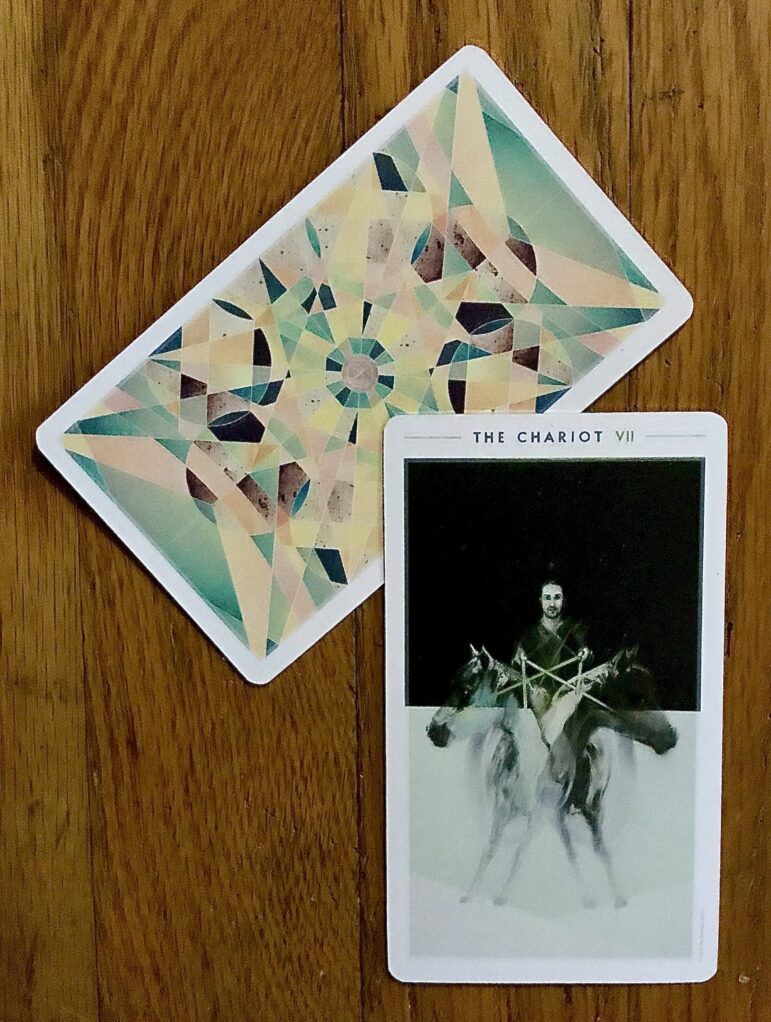 Deck: The Fountain Tarot, created by Jonathan Saiz, written by Jason Gruhl, designed by Andi Todaro, and published by Roost Books, an imprint of Shambhala Publications, Inc.
The Wild Hunt is not responsible for links to external content.
To join a conversation on this post:
Visit our The Wild Hunt subreddit! Point your favorite browser to https://www.reddit.com/r/The_Wild_Hunt_News/, then click “JOIN”. Make sure to click the bell, too, to be notified of new articles posted to our subreddit.