

When I was a kid, I read a book that taught me the beauty of ritual, the necessity of ritual vestments, the nature of offerings for sacrifice, and the sacred role of oracle to the community. It wasn’t for Pagans, but it helped to make one of me.
Zilpha Keatley Snyder’s The Egypt Game was published in 1967. It won the Newbery honors for its distinguished contribution to American literature for children. It tells the story of a new kid in town meeting some locals and developing a game of imagination they can play together. The game transforms a vacant lot in Berkeley into ancient Egypt, lonesome afternoons into friendship, and a secret message box into an oracle of Thoth.
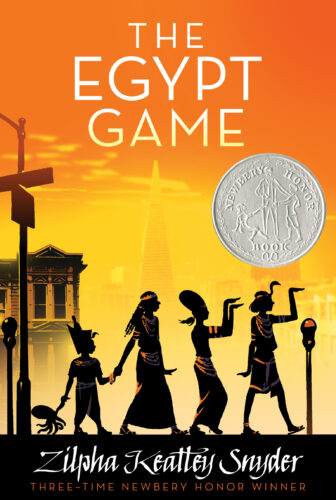
Cover to The Egypt Game by Zilpha Keatley Snyder [Atheneum Books for Young Readers]
As a military brat, I was always the new kid in town. Some places I’d make friends and some I would not, but the result was always the same. Eighteen to 36 months after arriving, I would leave, a little sadder and a little wiser, courtesy of another base town. I carried books like this one from state to state, hoping they’d take the place of the friends I couldn’t keep.
The Egypt Game was a reliable read, even after I was too old for it. The story contains a murder mystery in cut-down form to make it palatable to children, but the scare in it isn’t about the presence of a dead body. Instead, the children work hard building elaborate headdresses to look like Nefertiti, braiding beards of yarn to become pharaohs. They leave offerings for the gods and are startled to experience the presence, the favor, the existence of the gods in ways they didn’t expect.
Unlike our esteemed weekend editor, I was not raised by witches. Itinerant and passed between houses and families, I can claim having been raised Catholic at times and Baptist at others, with a finishing school in the house of Jehovah’s Witnesses followed by 15 years of Mormon in-laws. When it came to ritual, I saw many versions of the same thing. Staid communion lines in high-ceilinged cathedrals, bitter wine and wafers given while censers swung, as well as Wonderbread and Kool-Aid administered from the bed of a pickup truck and the ceremonial feast passed in a Kingdom Hall that none but the elect (you know who you are!) are permitted to touch.
Christian ritual always seemed to me like it was trying to keep people out. When I read about these kids making up their own forms of worship and ecstatic dance, without a book or a system of rules to follow, it touched something inside of me, something that I recognized later as the Black Heart of Innocence, as described by Victor Anderson and venerated in the Feri tradition.
A group of children playing baloons, Ismailia, Egypt [Husseingallery, Wikimedia Commons, CC 4.0]
In my teens, I remember reading about the folk beliefs and practices that were documented among homeless children, seemingly put together out of snatches of myth, local geographic and architectural features, Disney movies, and urban myths. Reading it revealed something to me that I already knew: children make up rituals. They make up stories. Like the kids in The Egypt Game, they make up religion, even if their parents assure them that they have religion at home. Homeless children have no lack of religious influence; indeed churches are often the only spaces where they are welcomed and fed. But even these well-churched kids have Pagan tendencies, seeking to commune with the spirits of the sidewalk and propitiate the forces of luck, good weather, and favorable outcomes.
Characters in The Egypt Game do a lot of things that Pagans will recognize. They choose Egyptian names (Aida, Bastet, Ramose) to call one another when they’re in their temple. They make themselves ritual garb of tunics and sandals, capes and crowns, putting it all on with great ceremony before approaching the gods they call the “Mighty Ones.” Their rituals allow them to express their emotions and needs from their real lives, lending meaning to their own cycles of life and death. When Neferbeth’s treasured pet parakeet Petey dies, the kids devise an elaborate funeral, preparing Petey with grave goods, seed and his favorite bell, to take with him to the bird underworld. They express grief there, but also frustration, joy, abandonment and enchantment, because together they’ve built a circle that can preserve and contain all of it.
It’s important to note that this enthusiasm for ancient Egypt is constructed on very little information. None of the children are Egyptian, though the friend group is diverse and includes Black and Asian-American children. Having been written in the mid-1960s, Snyder was likely drawing on an American cultural fascination that followed the touring exhibit of objects from the tomb of Tutankhamun, the Egyptian pharaoh from 1300 BCE. People in major US cities had recently had firsthand experience with Egyptian treasures, the exhibit was photographed in major magazines, and Snyder must have had her share of Tut-mania. However, she was not (and her child characters certainly were not) at all versed in Egyptian language, culture, or religion. The kids are really making their own magic with a glaze of a known culture over the top. In the final passage of the book, the kids discuss a new game while using a slur typically applied to the Romani people of Europe.
My own earliest efforts at constructing a religious schema were made up of uninformed ideas and borrowed parts, as well. Out of zealous ignorance, I collected symbols from all over the world. One of my earliest religious experiences took place after my first reading of The Rubaiyat of Omar Khayyam, itself a colonialist project in warped translation of an 11th century Persian poet by a 19th century British romantic. I picked up a cheap silver ring inscribed with a Sanskrit mantra and stapled up Tibetan prayer flags like many a seeker before me. I hung glass eggs in pine branches at Ostara and put a pentacle on top of my first Yule tree after moving out on my own for the first time. I was groping in the perceived grab-bag of spirituality, grasping at pieces that felt meaningful whether I had the first clue what they meant to the people who made them or not. I had a lot reading to do before any of it would come together.
I don’t think I was alone in this.
Neither do I think I was alone among kids who read The Egypt Game and felt a hunger, not just for a group of weirdo friends, but for the creation of ritual. I wanted to make, with my hands and my community, a sense of connection to the divine that I could understand and share and change when it needed changing. It’s a trail of breadcrumbs I followed through hundreds of books, not all of them intended for the Witchlings of the world.
Now, when I lay offerings on my own altar stone, it’s in the names of gods with whom I am acquainted rather than merely imagining in a vague associative way. It’s a whole loaf, not the crumbs. And it’s partly thanks to silly books for silly children about silly rituals that were all made up, and still worked every single time.
The Wild Hunt is not responsible for links to external content.
To join a conversation on this post:
Visit our The Wild Hunt subreddit! Point your favorite browser to https://www.reddit.com/r/The_Wild_Hunt_News/, then click “JOIN”. Make sure to click the bell, too, to be notified of new articles posted to our subreddit.