

For the last three columns I have been walking around the same building and entering through different doors—and if you have been tracking them, you have stumbled into this building with me. Whether you’re just reading this text here and now, or you have read the three essays before this one, I hereby invite you to follow my lead.
I did not plan it that way, though. At least, not at first. I wrote about Witch Hat Atelier because Kamome Shirahama draws as though the line itself were the spell. I wrote about The Witch Boy because Lee Knox Ostertag trusts a middle-grade reader to feel an argument he never states out loud. I wrote about Thorn Season because the marketing lied — or at least diminished the impact and reduced the scope — about what Kiera Azar had actually written. Well, and I was annoyed enough to say so in public, and then decided to digress and delve deep into the world she created.
Three different books (set apart by years), three reasons, and, as far as I was concerned, three separate columns. Yet I could already see the threads connecting while I was writing the second one. And then, the third. Boom! The same thing kept surfacing under my hands, and it had nothing to do with genre or age bracket or how the magic was drawn but with what nobody in those worlds is actually told in the first place: the damning secrets.
So this is the fourth column, and this is where I stop pretending they were separate—they have been entangled all the time. Keep on reading to understand why.
Three doors, one architecture
One thing is true: almost every magical system in fiction has a rule about who is allowed to learn, whether implicitly or explicitly. What has been remarkable about fantasy over the past few decades is how many of those systems have stopped pretending this rule is natural, and how books written by authors with so many different backgrounds and life histories have been playing on the same stuck key.
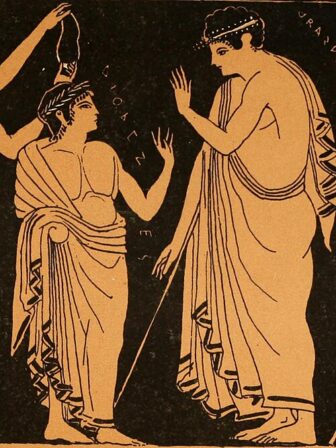
The initiated and the hierophant, from an amphora of Vulci in the British Museum. Source: History of Rome and the Roman people, from its origin to the establishment of the Christian empire, Duruy, Victor, 1811-1894. [public domain]
I have spent three columns inside three of them. Kamome Shirahama’s Witch Hat Atelier, where magic is a craft that anyone with a steady hand could learn, and where that fact was deliberately erased from the collective memory of humankind. Then came Lee Knox Ostertag’s The Witch Boy, where a family distributes power by gender and never once explains why. Kiera Azar’s Thorn Season, where the state hunts, cages, and dissects the people whose power it cannot own. Different genres, different age brackets, different continents of influence; still, one shared architecture.
In all three, the violence that matters most is not the spectacular kind: it is the information that never arrives—until it does and everything crashes and burns.
The three shapes of silence
Shirahama gives us silence as erasure. The Day of the Pact removed magical knowledge from the world so thoroughly that the absence of knowledge became indistinguishable from the absence of capacity. People did not grow up knowing they had been shut out of something. They grew up believing they were simply the wrong kind of person for a thing that existed elsewhere. The official term for that condition in the world of Witch Hat Atelier, “Unknowing,” does the ideological work in a single word: a political fact is converted into a personal characteristic. Just. Like. That.
Ostertag gives us silence as inheritance. The Vanissen rule is transmitted without justification, generation to generation, and the family’s cautionary tale about Mikasi is designed to close the conversation. The boy who was denied witchcraft became a monster—that meant the refusal was justified, right? Well, not exactly. Aster’s grandmother enters the scene and finally names the inversion near the end of the first volume: what deformed Mikasi was what the family withheld. Knowledge was never the danger—refusal was.
Azar gives us silence as armor. Alissa Paine hides her Spectre because in Daradon the self is a capital offense, and she was taught this suppression by her father, who loved her. The pain she carries comes from the effort of not being. While her silence protects her, purchasing her position at court, it also mutilates her from the same point of contact.
Erasure, inheritance, armor. Three mechanisms, one function, which is to make an arrangement of power feel like the weather.
The archive as weapon
Two more books, briefly, because both deserve articles on their own.
Rebecca Yarros’s Fourth Wing has been read, mostly, as a romance with dragons. Romantasy. The romance is what most readers carry away, and it tends to overshadow the harder material the book is built on. Underneath the leathers, it is a story about a scribe’s daughter discovering that the archive she was raised to revere has been curated. The records were edited, so the stories that reach the cadets of Basgiath are meant to produce a specific kind of soldier, one who fights the enemy the state names and never asks any questions about the enemy the state buried. Violet’s real weapon is her training in reading, and what it lets her notice is an absence.
M.L. Wang’s Blood Over Bright Haven takes the same premise into an academy. A woman fights her way into a magical institution that never wanted her, wins on the institution’s own terms, and then finds the thing the institution was built to keep unspoken. I am keeping this deliberately vague, for what matters here is the structural rhyme: she is admitted to the knowledge and, in being admitted, is held responsible for what the knowledge contains.
That is the move all five books make, each in its own register. The protagonist of each of them crosses from outside the silence to inside it, and discovers that inside is not safe. Inside means complicity, or the choice to refuse it.
Why this keeps happening now
It would be easy to call this a trend and leave it there; however, I think something more specific is going on.
Silvia Federici’s Caliban and the Witch argues that the early modern witch hunts were an instrument of enclosure. Land was fenced, and so was knowledge: the herbal practice, the midwifery, the reproductive autonomy, the accumulated folk medicine held largely by women outside any institution. The persecution either transferred that knowledge into licensed hands or destroyed it. What survived did so in fragments.
This history is not a metaphor for Pagan readers. It is our lineage’s rupture. The reason contemporary Paganism is so heavily reconstructionist, so full of scholarship and inference and honest gaps, is that the chain of transmission was broken on purpose. We are the descendants of an erasure. When Shirahama writes a world where the knowledge was taken and the taking was forgotten, she is describing something with a documented historical shape.
So of course these books land differently in our communities: we recognize the machinery, for we have spent decades reassembling what it destroyed.
The uncomfortable part
Our traditions also run on withheld knowledge. Oathbound material. Degree systems. Coven structures where the teaching arrives in a sequence controlled by someone else. Initiatory lineages that decide who is ready. The phrase you have to be initiated to understand, which is sometimes true and sometimes a door closing on a person who had every right to walk through it.
Every one of those practices has a defense, and the defenses are sincere. Some knowledge does require preparation. Some practices are dangerous to the unprepared. Some traditions were built in secrecy because secrecy was survival, and the habit outlived the emergency. This sincerity is precisely what makes an institution durable. The most effective form of control asks no cynicism of its enforcers.
The test Shirahama hands us is simple and merciless: look at where the prohibition lands. In her world, healing a sick body is a crime, and erasing a person’s memory to protect the secret of the powerful is institutional duty. Every rule in that system answers one question consistently: who does this serve? Body magic that serves the individual is outlawed. Body magic that serves the order is given a name that sounds like governance and so gets legitimated.
Apply it to us. When a piece of knowledge is withheld in a Pagan context, who is being protected? Sometimes it really is the student. Sometimes it is the teacher’s position, the lineage’s prestige, the gatekeeper’s ability to remain the one who decides. Those are different things wearing the same robe.
And then apply Tartah’s test, which is even sharper. Tartah belongs to a witch lineage and is excluded anyway, because the magic system was calibrated for a body that can distinguish colors and his cannot. Nobody declared that prerequisite. Nobody had to. Our rituals carry the same unmarked assumptions: full mobility, full vision, full hearing, neurotypical processing, the ability to stand in a circle, chant in a register, read a script, hold a visualization. A wall with no sign on it looks like open air from one side.
What the books are actually asking
None of these five stories resolves into a slogan. Shirahama refuses to make the Brimmed Caps right just because the Pointed Caps are wrong. Ostertag lets the grandmother keep her own hidden power, and the reveal passes almost without comment: she survived by being illegible to a system that assumed it already knew what she was. Azar will not let Alissa off the hook for the years she spent benefiting from the machinery that hunts her and hurts her peers.
What they share is an insistence that the question be asked out loud. What rules do we keep because they serve us? Who wrote them? Who has always moved through them without friction, and who has been paying the toll?
For Pagan parents, teachers, coven leaders, and solitaries building something new, that is the whole assignment. Transmit generously. Notice when a boundary is protecting a person and when it is protecting a position or institution. Ask whose body your ritual was designed around. And remember Mikasi, who wanted to learn, and was told no, and was told it was love.
Magic has always been possible. Withheld was the knowledge that it existed.
The Wild Hunt is not responsible for links to external content.
To join a conversation on this post:
Visit our The Wild Hunt subreddit! Point your favorite browser to https://www.reddit.com/r/The_Wild_Hunt_News/, then click “JOIN”. Make sure to click the bell, too, to be notified of new articles posted to our subreddit.