

Uncovering the Past
VILNIUS, Lithuania — Long remembered as Europe’s last officially pagan kingdom, medieval Lithuania may have been more religiously diverse than once believed. New archaeological research has identified a young Christian migrant who traveled hundreds of kilometers to Vilnius decades before the Grand Duchy officially adopted Catholicism, offering fresh evidence that Orthodox Christian communities had already become part of the city’s earliest development.
Editorial Note: In historical contexts, pagan is used in lowercase to refer to pre-Christian religions or peoples. The Wild Hunt reserves the capitalized term Pagan for contemporary Pagan religions and communities.
The study, published in the journal Antiquity, examined human remains from a large medieval cemetery excavated on Bokšto Street in Vilnius’ Old Town. Archaeologists uncovered 532 intact graves during eight years of excavations, revealing a Christian burial ground that remained in use from the late thirteenth through the fourteenth century, well before Lithuania’s official conversion in 1387.
Unlike the cremation practices then common among Lithuania’s pagan majority, those buried at Bokšto were laid on their backs in east-west aligned graves. Only about ten percent of the burials contained grave goods, while cross necklaces and Orthodox enkolpions identified the community as Christian.
The cemetery lay within the Civitas Ruthenica, or Ruthenian Quarter, an Orthodox Christian district of medieval Vilnius that documentary sources first mention in 1383. The cemetery demonstrates that the community had already existed for decades before appearing in the historical record.
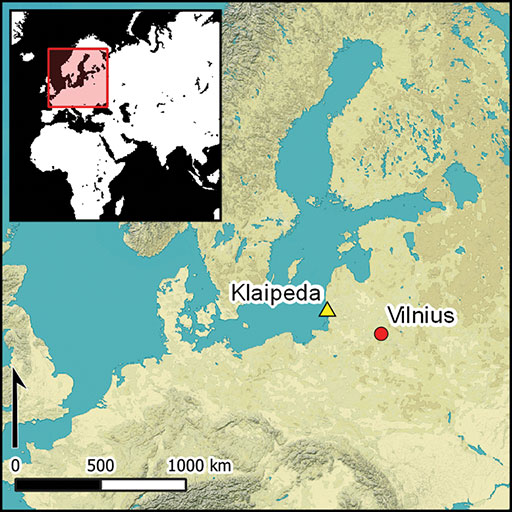
Location of the Bokšto (Civitas Ruthenica) cemetery in medieval Vilnius. Illustration by Rūta Karaliūtė, courtesy of the authors and Antiquity (CC BY 4.0).
“Archaeologists have long suspected that the Civitas Ruthenica community included migrants from the Ruthenian lands,” said Dr. Rytis Jonaitis of the Lithuanian Institute of History, who co-led the excavations. “The isotope data now provide direct evidence that at least some individuals buried at Bokšto came from far beyond Lithuania.”
To investigate where the community originated, researchers performed multiple isotope analyses on the remains of 15 individuals. Tooth enamel and dentine preserve evidence of childhood diet and local water sources, while bone collagen reflects the foods a person consumed during the final years of life.
One individual, buried in grave 311, stood apart from every other person examined.
The individual died at approximately 18 years of age, but chemical signatures preserved in the teeth revealed a childhood unlike that of the rest of the cemetery population. The isotope evidence indicates a diet that included millet. That grain was already disappearing from Lithuania as colder conditions associated with the Little Ice Age favored rye and buckwheat, as well as comparatively high levels of meat, dairy, or fish.
The same isotopic signatures point to a childhood spent well south of Vilnius, most likely somewhere in present-day Ukraine or southern Poland, possibly within the medieval region of Halych-Volhynia. By adulthood, however, the individual’s bone chemistry matched that of other people buried at Bokšto, suggesting that they had adopted local dietary habits after migrating to Lithuania during adolescence.
The grave itself contained no objects and otherwise followed Orthodox Christian burial customs.
Researchers identified several other possible migrants as well. One man may also have originated farther south, while two others display isotope signatures more consistent with the region surrounding Kernavė, Lithuania’s first medieval capital. One of those men was buried with crossed legs inside a stone-framed grave, a practice associated with parts of southern Lithuania, although the authors caution that the evidence is insufficient to determine his precise origins.
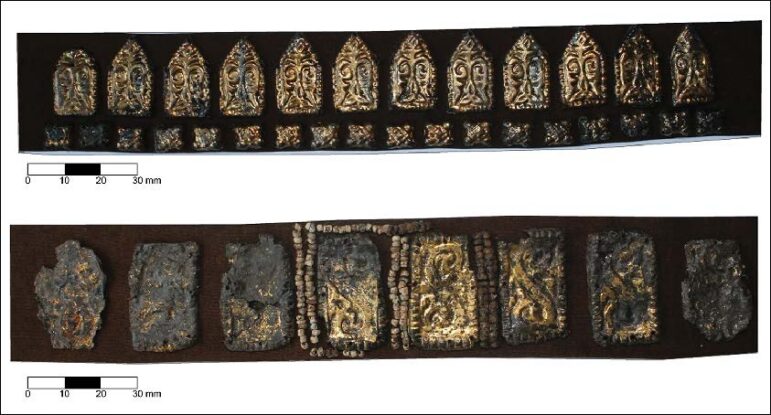
Head ornaments (chaplets) recovered from the Bokšto cemetery. Photograph courtesy of the authors, published in Antiquity under a Creative Commons Attribution 4.0 license.
The isotope evidence also revealed an intriguing contrast between men and women buried at Bokšto. All five adult women analyzed appear to have grown up locally around Vilnius, while most evidence for long-distance migration came from male burials.
Some of the women were interred with objects more commonly associated with pagan traditions, leading the researchers to suggest that local women may have converted to Orthodox Christianity after marrying migrant men. The authors stress that this remains a hypothesis requiring additional research, including ancient DNA analysis.
One woman buried in the same grave as the young migrant also displayed evidence of millet consumption throughout her life, raising the possibility that the pair may have been related.
The cemetery’s artifacts further illustrate the community’s international connections. Archaeologists recovered cowrie shells, glass beads, earrings, rings, and decorative chaplets whose styles appear to reflect influences from Halych-Volhynia and the wider Byzantine world.
The findings also fit with what is known about medieval Vilnius. In letters issued in 1323, Grand Duke Gediminas invited merchants, artisans, and settlers from across Europe to establish themselves in the growing city. At the same time, the expanding Grand Duchy of Lithuania maintained close political ties with neighboring Ruthenian territories inhabited by Orthodox Christians, creating opportunities for migration through diplomacy, trade, and commerce.
“Human remains preserve remarkable information about mobility, diet and social interaction that cannot be detected through archaeology alone,” said lead author Giedrė Motuzaitė Matuzevičiūtė of Vilnius University and the Lithuanian Institute of History. “By combining archaeological and historical investigations with multi-tissue isotope analysis of human osteological remains, we can, for the first time, directly identify individuals who migrated into medieval Vilnius during the city’s earliest formation. This research shows that Vilnius was already a highly diverse and internationally connected city from the very beginning of its history.”
For generations, Lithuania has been remembered as Europe’s last officially pagan kingdom. The new research does not challenge that history. Instead, it paints a more nuanced picture of religious change. Long before Grand Duke Jogaila accepted Catholic baptism in 1387, Vilnius had already become home to Orthodox Christian immigrants and local converts living alongside a predominantly pagan population, suggesting that the transition from pagan kingdom to Christian state unfolded gradually through migration, diplomacy, trade, and everyday human relationships.
The Wild Hunt is not responsible for links to external content.
To join a conversation on this post:
Visit our The Wild Hunt subreddit! Point your favorite browser to https://www.reddit.com/r/The_Wild_Hunt_News/, then click “JOIN”. Make sure to click the bell, too, to be notified of new articles posted to our subreddit.