
WASHINGTON — Earlier this year, The Wild Hunt reported that federal protections for the sacred landscape surrounding Chaco Culture National Historical Park faced renewed uncertainty after the U.S. Department of the Interior (DOI) proposed reversing a 2023 Public Land Order that withdrew approximately 336,400 acres of federal lands and minerals within a 10-mile buffer around the park from new oil and gas leasing for 20 years.
The proposal drew widespread opposition from Tribal nations, elected officials, archaeologists, conservation organizations, and preservation advocates, who argued that Chaco Canyon represents far more than an archaeological site. The Wild Hunt also reported on a sharply criticized seven-day public scoping period that coincided with Easter, Passover, and traditional Pueblo observances, prompting more than 100,000 public comments opposing the proposal.
On July 15, 2026, the Department of the Interior opened a 14-day public comment period on its Draft Environmental Assessment, giving the public another opportunity to weigh in before the agency decides whether to revoke or reduce the protections surrounding one of North America’s most significant Indigenous cultural landscapes. The clock is ticking for additional public comments on the matter.
Located in northwestern New Mexico, Chaco Canyon served as the ceremonial and cultural center of the ancestral Pueblo world between approximately 850 and 1250 C.E. Monumental architecture, extensive road systems, astronomical alignments, and thousands of associated archaeological sites reflect its importance as both an engineering achievement and a sacred ceremonial landscape. Today, Chaco remains a living ancestral homeland for the Hopi Tribe, the Navajo Nation, the Zuni Tribe, and the 20 sovereign Pueblo nations whose histories, spiritual traditions, and cultural identities remain deeply connected to the region.
The current proposal follows tribal consultation initiated by the Trump administration in October 2025 to reverse Public Land Order 7923. If finalized, new federal oil and gas leasing could once again occur within 10 miles of the park’s boundaries, including lands immediately adjacent to the national historical park. DOI is also considering a second alternative that would reduce the protective buffer from 10 miles to five miles.
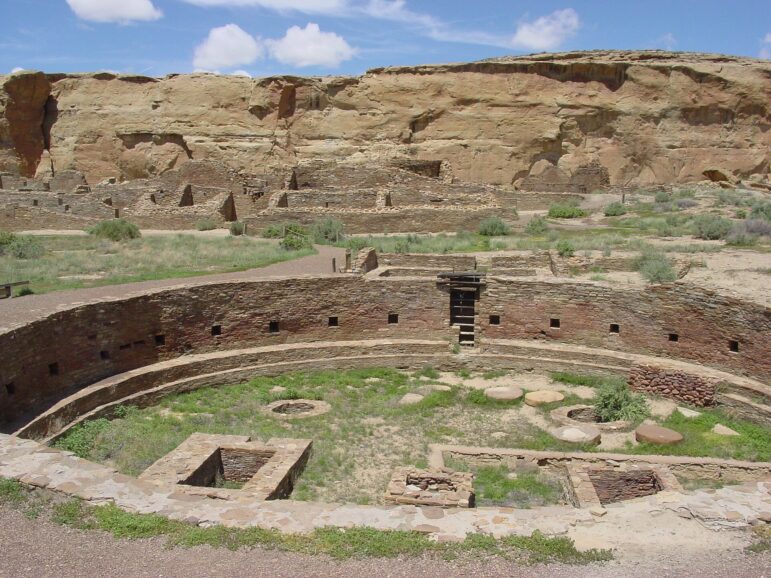
An image of the ruins of Chetro Ketl in Chaco Canyon (New Mexico, United States); shown is the complex’s great kiva. [Public Domain: National Park Service]
Critics argue that neither proposal adequately protects the broader cultural landscape. Archaeologists estimate that although only 15 to 20 percent of the area has been formally surveyed, as many as 12,000 archaeological sites and traditional cultural places may lie within the five- to ten-mile zone that would become vulnerable to future energy development under the reduced-buffer alternative.
Opponents have long argued that focusing solely on known archaeological sites overlooks the significance of the landscape itself. Sacred places, ancient road networks, shrines, pilgrimage routes, and viewsheds extend well beyond the park’s boundaries, and industrial development, including drilling infrastructure, traffic, noise, light pollution, and habitat fragmentation, could permanently alter the cultural integrity of the region even if individual ruins remain undisturbed.
The National Parks Conservation Association (NPCA) criticized both the proposal and the abbreviated review process. The organization noted that the current process provides the public only 21 non-consecutive days of comment across both review periods and includes no public meetings, in contrast to the process that established the withdrawal, which included 150 days of public comment, eight public meetings, and approximately eighteen months of review.
“This decision sends a dangerous message that no place, not even one that holds a thousand years of history, is too important to sacrifice for oil and gas drilling,” said Maude Dinan, the NPCA’s New Mexico Program Manager. “Chaco Canyon is one of the most extraordinary cultural landscapes in our National Park System and continues to hold profound meaning for Tribes today.”
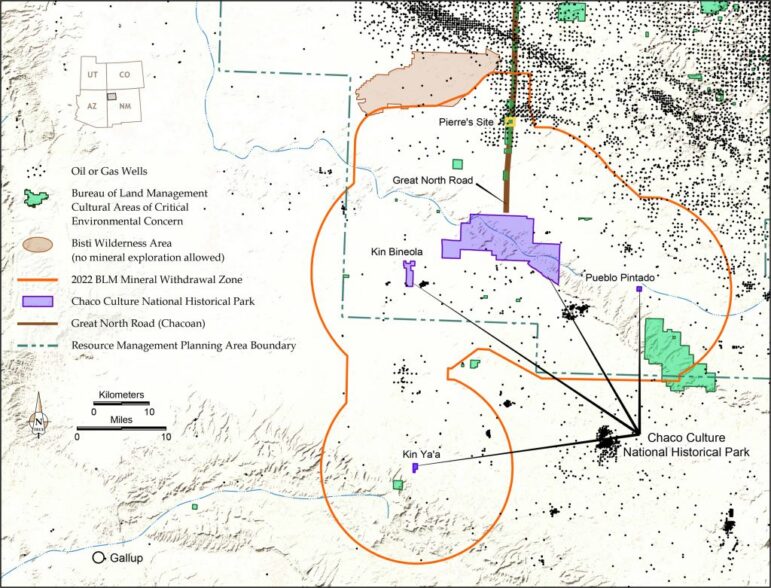
Chaco Canyon and the Greater Chaco Region face growing threats from oil, gas, and mineral extraction, with about 90% of surrounding federal lands already leased for development. (Map by Archaeology Southwest)
“Now, the Trump administration is auctioning it off to the oil and gas industry, trading sacred and scenic vistas for pumpjacks and the drum of drilling. This is not about energy strategy. It’s an attack on cultural heritage, community health, and all that our national parks were created to protect,” Dinan added.
The proposed reversal also comes amid broader federal efforts to expand oil and gas development on public lands. The July 2026 federal budget reconciliation law requires the Bureau of Land Management to offer approximately 87 percent of New Mexico’s eligible federal lands with federally managed subsurface minerals for oil and gas leasing multiple times each year, a policy critics say places increased pressure on culturally and environmentally sensitive landscapes.
Supporters of maintaining the withdrawal also point to public opinion. According to a 2026 Colorado College Conservation in the West Poll, 71 percent of New Mexico voters oppose allowing new energy development on public lands near Chaco Culture National Historical Park.
The Bureau of Land Management is accepting public comments on the Draft Environmental Assessment through the close of the current 14-day comment period. Information on submitting comments is available on the agency’s website.
The Wild Hunt is not responsible for links to external content.
To join a conversation on this post:
Visit our The Wild Hunt subreddit! Point your favorite browser to https://www.reddit.com/r/The_Wild_Hunt_News/, then click “JOIN”. Make sure to click the bell, too, to be notified of new articles posted to our subreddit.