
WASHINGTON — In mid-February, the Public Religion Research Institute (PRRI) released a report titled Mapping Christian Nationalism Across the 50 States. The study examines support for Christian nationalism in all 50 states using data collected throughout 2025 as part of PRRI’s American Values Atlas. Based on interviews with more than 22,000 adults, the report explores the relationship between Christian nationalism and political affiliation, religion, media consumption, education, immigration attitudes, and views of President Donald Trump.
PRRI is a nonprofit, nonpartisan organization founded in 2009 that conducts research and polling at the intersection of religion, culture, and politics. The organization states that its mission is to inform journalists, scholars, clergy, and the public about the cultural and religious dynamics shaping American society.
The survey was supported by the Wilbur & Hilda Glenn Family Foundation, the William and Flora Hewlett Foundation, and the Unitarian Universalist Veatch Program at Shelter Rock. According to the report, the survey sampled 22,111 adults aged 18 and older across all 50 states. Of those participants, 20,771 were recruited through Ipsos’s KnowledgePanel, while an additional 1,340 respondents were recruited through opt-in panels to increase representation in smaller states. Interviews were conducted online between February 28 and December 8, 2025. PRRI reports a national margin of error of plus or minus 0.87 percentage points at the 95% confidence level, including a design effect of 1.7.
The report does not mention Pagans, nor does it address Pagan movements that may align with nationalist or ethnocultural tendencies. Some of the dynamics described in the report are not unfamiliar in discussions of other religious nationalist movements. The overlap is not theological, but structural.
In both cases, religion can become fused with ethnic or cultural identity, claims of historical ownership, anxieties about demographic change, and narratives about restoring a “true” national culture. Unlike smaller religious nationalist movements, however, Christian nationalism is embedded within major political movements, state legislatures, media ecosystems, and segments of mainstream American Christianity.
Nevertheless, Christian nationalism can pose challenges to Pagan communities because the ideology often frames the United States as fundamentally and institutionally Christian in its identity, culture, law, and public life. One of the central concerns raised by critics is that Christian nationalism can blur the line between religious freedom for Christians and governmental preference for Christianity. When public institutions adopt explicitly Christian symbols, prayers, or legal rationales, minority-faith practitioners may find themselves treated as outsiders to the national identity or as less legitimate participants in civic life.
To measure Christian nationalism, PRRI used five survey questions examining beliefs about the relationship between Christianity, American identity, and the federal government. Respondents were categorized into four groups: Christian nationalism Adherents, Sympathizers, Skeptics, and Rejecters.
Nationally, 11% of Americans qualified as Adherents, 21% as Sympathizers, 37% as Skeptics, and 27% as Rejecters.
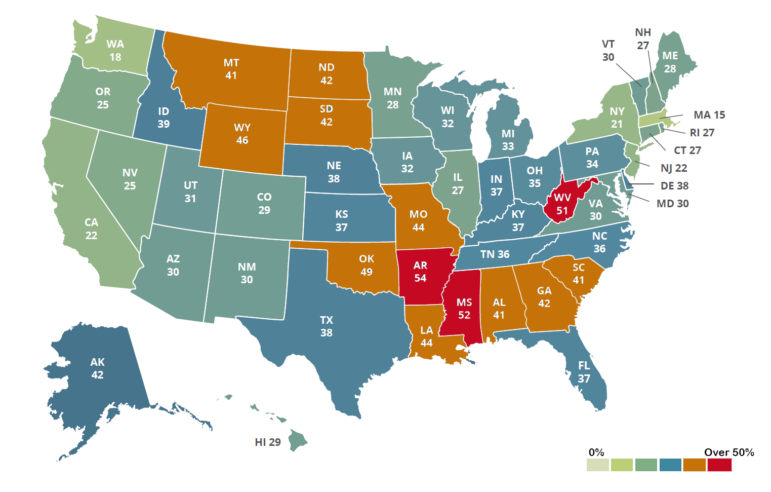
Source: PRRI American Values Atlas / Mapping Christian Nationalism Across the 50 States Report
The report found that approximately one-third of Americans qualify as either Christian nationalism Adherents or Sympathizers, while roughly two-thirds qualify as Skeptics or Rejecters. Support varied significantly by state, ranging from a low of 15% in Massachusetts to a high of 54% in Arkansas. PRRI also noted that these percentages have remained relatively stable since it first began measuring Christian nationalism in late 2022, although the percentage of Rejecters declined slightly after peaking at 32% in mid-2023.
The report found significant differences among religious and demographic groups. White Christians (46%) were more likely than Christians of color (39%), non-Christians (13%), and religiously unaffiliated Americans (10%) to qualify as Adherents or Sympathizers. White evangelical Protestants (67%) and Hispanic Protestants (54%) were the only major religious groups in which a majority supported Christian nationalist views.
Religious practice was also strongly correlated with support for Christian nationalism. Among Americans who attend religious services weekly or more often, 54% qualified as Adherents or Sympathizers, compared with 39% of those attending only a few times a year and 20% of those who seldom or never attend religious services. Similar patterns appeared among respondents who frequently pray or regularly read religious texts.
PRRI also found correlations between Christian nationalism, education, and age. Americans with a high school education or less (37%) or some college education (35%) were more likely to qualify as Adherents or Sympathizers than Americans with a college degree (27%) or postgraduate degree (21%). Adults age 50 and older were more likely than younger Americans to express Christian nationalist views.
The report identified significant racial differences within religious practice. White Americans who frequently attend religious services, pray, or read religious texts were more likely than Black or Hispanic Americans with similar religious practices to qualify as Christian nationalism Adherents or Sympathizers.
Political affiliation and media consumption also showed strong correlations. A majority of Republicans qualified as either Adherents (21%) or Sympathizers (35%), compared with 25% of independents and fewer than one in five Democrats. PRRI further reported that two-thirds of Americans who primarily trust far-right news sources qualified as Adherents or Sympathizers, as did a majority of those who identified Fox News as their most trusted source.
Geographically, support for Christian nationalism was concentrated most heavily in the South and parts of the Midwest. The states with the highest levels of support were Arkansas (54%), Mississippi (52%), West Virginia (51%), Oklahoma (49%), and Wyoming (46%). Among white non-Hispanic residents specifically, Arkansas (59%), Mississippi (54%), and West Virginia (53%) had majority support for Christian nationalist views.
PRRI reported strong state-level correlations between Christian nationalism and favorable views of President Trump, as well as with Republican representation in state legislatures. States with higher average Christian nationalism scores also tended to report higher favorability ratings toward Trump.
The report also connected Christian nationalism with higher levels of support for political violence and authoritarian attitudes. Thirty percent of Adherents and 23% of Sympathizers agreed that “because things have gotten so far off track, true American patriots may have to resort to violence to save the country,” compared with 14% of Skeptics and 11% of Rejecters. PRRI noted that support for political violence among Adherents was higher during President Joe Biden’s administration and declined somewhat following Trump’s reelection.
Adherents and Sympathizers also scored highest on PRRI’s Right-Wing Authoritarianism Scale. The report found that Christian nationalism Adherents overwhelmingly viewed Trump as a strong leader rather than a dangerous dictator. Seventy-three percent of Adherents described Trump as a strong leader, while only 25% viewed him as a dangerous dictator. By contrast, majorities of Skeptics (55%) and Rejecters (85%) described Trump as a dangerous dictator rather than a strong leader.
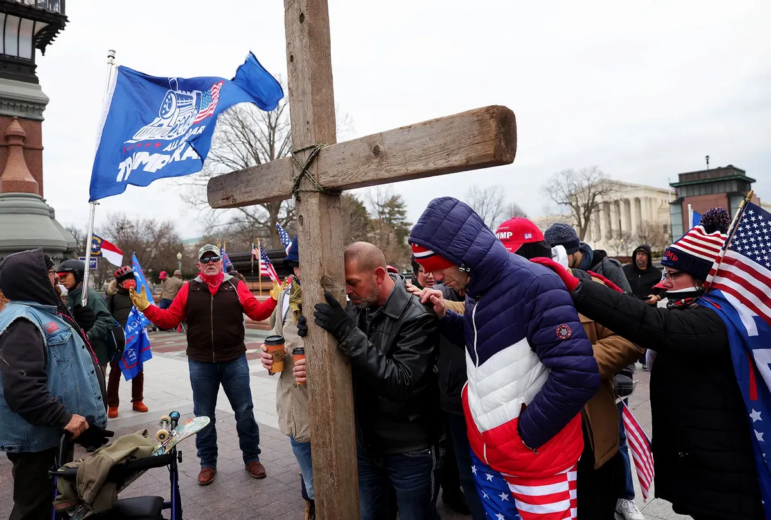
Religious nationalism. Image Credit: Wolfman5678. Creative Commons Zero, Public Domain Dedication
The report further found that Christian nationalism Adherents and Sympathizers expressed significantly stronger anti-immigration views than other Americans. Majorities agreed with statements asserting that immigrants are “invading” the country and replacing American cultural and ethnic identity. Majorities also supported deporting undocumented immigrants to foreign prisons without due process and favored stripping citizenship from individuals considered threats to the country.
Pagan traditions have historically struggled for recognition in the United States. Critics of Christian nationalism argue that rhetoric portraying America as inherently or exclusively Christian can reinforce the perception that minority-faith traditions are less authentically American. Historically, periods of intense Christian cultural nationalism have often coincided with suspicion toward minority spiritualities, raising concerns among Pagans and other minority-faith practitioners about exclusion from civic discourse, public institutions, and policy debates.
At the same time, many Christian leaders, denominations, and interfaith advocates remain active voices opposing Christian nationalism in public life. It is important to underscore that the report distinguishes Christian nationalism from Christianity broadly, and many Christian denominations and religious leaders have publicly criticized Christian nationalism as incompatible with religious pluralism and democratic norms.
The Wild Hunt is not responsible for links to external content.
To join a conversation on this post:
Visit our The Wild Hunt subreddit! Point your favorite browser to https://www.reddit.com/r/The_Wild_Hunt_News/, then click “JOIN”. Make sure to click the bell, too, to be notified of new articles posted to our subreddit.