

Sing, Muses, of grey-eyed Athena, goddess of wisdom, and of her friend far-traveled Odysseus. Sing of the clever king of Ithaca and his journey home.
I have spent most of my life not reading the Odyssey. I missed it in high school, and by the time I got to college it was an assumed pre-requisite. There was never a moment I decided not to read it, or to focus on Hesiod and the various Hymns – Homeric, Orphic, etc. – as source materials for my religious work. It’s just that I never got around to it.
Part of that was a lack of focus. I was primarily Heathen for a long time. All of the energy I had available for comparing translations and diving into source texts for my own spiritual journey was spent elsewhere. Part of it was the far-more-damning truth that I have never particularly enjoyed source texts. Sitting down with Homer, in the evening, felt like assigning myself more work after a long day. I knew that I should read it, in the same way I knew that I should go running or work on my resume. I knew that someday I would do it – but today was never, quite, the right day.
Even once I got my hands on a copy of Emily Wilson’s translation, it sat on a pile in a corner of my room, waiting. I would definitely read it, I told myself as the books around it changed. It was just taking me a while.
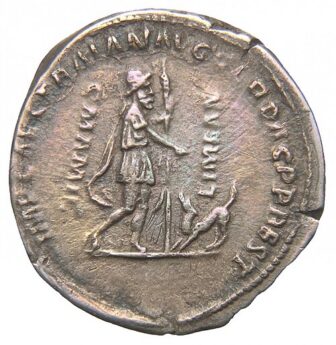
Reverse of a Roman coin depicting Odysseus and his dog Argos, 112-114 CE. [public domain]
Sing, Muses, of Telemachus and the stories he gathered in search of his father. Sing of the ways a story changes in the mouths of gods and heroes, in the throat of the blind poet, in my throat.
In another version of the story, I have spent most of my life reading the Odyssey. It happened in fits and starts, across television and movies and songs and games. I learned the bones of it as told by a Jack Russell Terrier in armor, fleshed them out in a book of mythology, skinned them over in references and retellings and deliberate reinterpretations. Odysseus was so present, so well known, that authors could stretch and shape him to fit their tales and still leave him recogniseable. I watched Ulysses Everett McGill plot to win his wife back and knew that he was grown from a kernel of a much older hero. I caught the references to the lotus eaters that peppered through other books, and I knew about the escape from the cyclops, Polyphemus. I added details to my understanding of the Odyssey every time I saw it refracted in another text, building back towards an original.
It felt comfortable and companionable, a familiarity entirely unearned. I knew Odysseus – at least, well enough to nod to him at a party. I knew his progeny, the clever thieves and beleaguered travelers that together sketch the shape of a specific sort of hero. I thought about him in the same breath as Danny Ocean and Butch Cassidy, but bigger, more important. I even thought I could recognize the different facets that his storytellers focused on – the war hero, the tragic leader of men, the devoted husband. I hung part of my theology using him as a peg. Odysseus made hero worship make sense to me. What would apotheosis be, if not becoming a story so vast that it rivaled the size of the gods?
Of course a spirit like that would be real, even if he was not flesh and blood to begin with. I decided that I liked him, in the same sort of way I like a lot of spirits that I don’t know well. Seemed like an interesting guy, but not anyone I had the opportunity or reason to build a relationship with. Maybe, someday, I’d read the Odyssey and reassess – but not right now. Not yet.
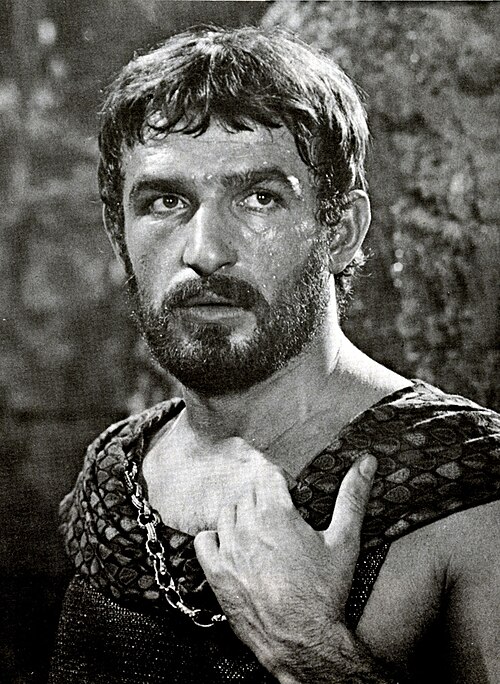
Photo from the Italian magazine Dadaumpa (1967); Bekim Fehmiu plays Ulisse in the Italian TV-Series L’Odissea [public domain]
Sing, Muses, of the husband of Penelope and of the ships he lost. Sing of the gods he angered and the men he killed, the ways the journey changed him.
Here is a third version: I am reading the Odyssey and I do not want it to be over.
I started a couple of years ago, taking one section at a time as the spirit moved me. I was not surprised that it was more complicated and odder than the versions I knew, but the specifics of the differences came as shocks. It is, in large part, a story about storytelling. The adventures I knew were told around dinner tables and over drinks, friends and gods and strangers recounting things that they knew, or had heard, or had experienced themselves. It talks at length about familiarity and the ways it can be strained – gods who wear the shapes of servants, family acquaintances who welcome in the sons of their friends, homes that are unwelcoming and unsafe to those who live there. It talks, a lot, about Odysseus bursting into tears.
I know what happens, at the end of it. I know that he goes home and finds the wife who waited, finds the son who went looking for him, reclaims the kingdom and treasure that he has been kept from for so long. I know he is the only one, of all of his men, to see his home again, and that both his trials and his successes are due to the personal interest the gods have in his life.
I don’t know if going home makes him happy, if he feels at ease there with a strange man who is his son and a wife who does not know him anymore. I do not know if I can handle the answer, whatever it is.
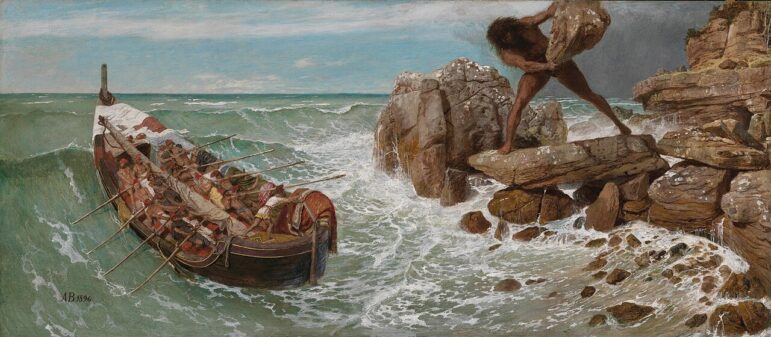
Arnold Böcklin (1827–1901), Odysseus and Polyphemus, 1896, Oil and tempera on panel, 66 cm × 150 cm (26 in × 59 in). Museum of Fine Arts, Boston, Massachusetts. [public domain]
Sing, Muses, of the wisdom of the road, of the highway and the late night diner, of the land that does not want you back. Sing about returning and staying away, of setting your sails against the wind, of a healthy crew and the warmth of strange waters.
Going home does me no good. The last trip – two days there, two days back – left me worn thin, strained around all of the places that I do not fit anymore. There is a reason I have been away so long.
We tell the myths out of context, reinterpret the events through the lenses of our time, reinterpret the people to be the kinds of heroes we want. I have heard the story of Odysseus as a man losing his humanity, of a perfect 1950s husband coming home from the war to his wife, of a sneak and a thief cheating his way through the consequences of his actions.
I am telling the story of a man who, whatever he might want, cannot go home. I am telling a story of the people who tell that story, who talk about the ways they are stranded, the false loves that have ensnared them, the traps they have fallen into. I am telling about all of the people they have lost and the strange family that they dream might be waiting, if they keep going, if the grey-eyed goddess turns her face towards them again.
Some days, when it seems like the road goes on forever, I am exhausted. Some days, when the sun rises on the bright gift of a never ending journey, I am delighted. On both, I think of Odysseus.
The Wild Hunt is not responsible for links to external content.
To join a conversation on this post:
Visit our The Wild Hunt subreddit! Point your favorite browser to https://www.reddit.com/r/The_Wild_Hunt_News/, then click “JOIN”. Make sure to click the bell, too, to be notified of new articles posted to our subreddit.