

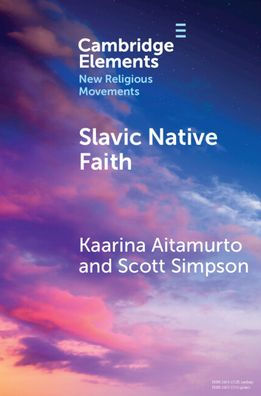
Kaarina Aitamurto and Scott Simpson’s Slavic Native Faith offers a detailed examination of one of the most dynamic contemporary Pagan revivals in Europe, situating it within both the broader landscape of new religious movements and the specific historical context of post-communist societies. At its core, the work explores how modern practitioners reconstruct, reinterpret, and live out pre-Christian Slavic religious traditions in ways that are both rooted in the past and responsive to present realities.
The researchers’ expert analysis makes clear that Slavic Native Faith — often referred to in Roman script by terms such as Ridnovirstvo from Ukrainian or with the Russian loan word of Rodnovery — is not a single unified religion, but a constellation of related movements. These traditions share a central commitment to “nativeness,” understood as a sacred connection to Slavic land, ancestry, and cultural identity. This emphasis on indigeneity distinguishes Slavic Native Faiths from more universalist spiritual frameworks, positioning them as both a religious and cultural project. For many adherents, reclaiming ancestral traditions is inseparable from reclaiming historical agency after centuries of Christianization and, more recently, political suppression under communist regimes.

Statue of Svetovid in Kyiv. [Nick Grapsy, Wikimedia Commons, CC 4.0]
From a Pagan studies perspective, one of the most significant contributions of Aitamurto and Simpson’s work is its framing of reconstruction as an inherently creative and negotiated process. Practitioners draw heavily on academic sources, archaeology, ethnography, and historical texts, but they do so selectively, often privileging interpretations that affirm the possibility of recovering ancient Slavic religion.
At the same time, the movement explicitly rejects the idea that it must replicate the past exactly. Instead, it embraces its identity as a “living religion,” one that develops new rituals, artistic expressions, and relationships with deities, ancestors, and the natural world.
This dynamic between reconstruction and innovation will be familiar to many in contemporary Pagan and polytheistic communities globally.
Indeed, the scholars highlight how practitioners consciously navigate the tension between authenticity and adaptation. Rather than viewing anachronism as a failure, many Slavic Pagans accept it as a necessary feature of religious revival in the modern world. Their goal is not historical reenactment, but continuity: to extend an ancient religious worldview into the present and future.
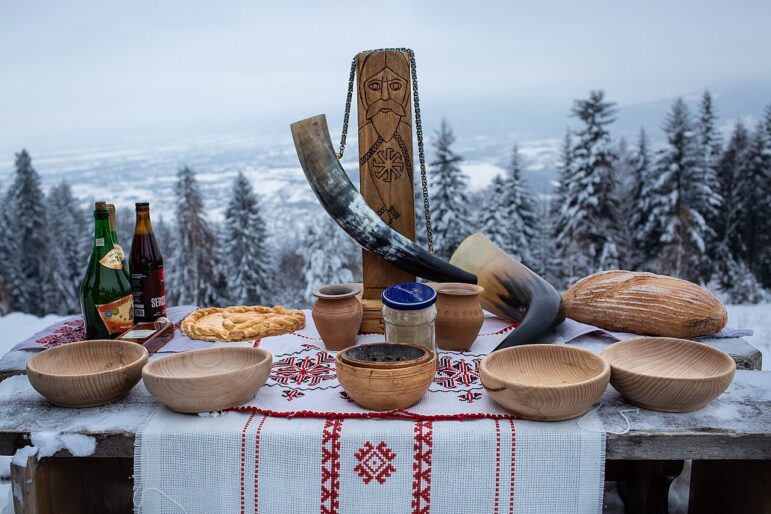
Polish Rodnover outdoor altar [Pola lilla, Wikimedia Commons, CC 4.0]
Another key theme in Slavic Native Faith is the relational cosmology at the heart of these traditions. The religions emphasize interconnectedness between humans and “other-than-human beings,” including deities, ancestors, and the natural environment. This worldview aligns closely with broader Pagan ecological ethics, where land is not merely symbolic but sacred, and where ritual practice often centers on seasonal cycles and place-based spirituality. In this sense, Slavic Native Faith contributes to global Pagan discourse by offering a distinctly regional expression of animistic and polytheistic thought.
Aitamurto and Simpson also explore the movement’s openness, albeit sometimes cautiously, to external influences. While rooted in Slavic tradition, some communities engage with ideas and practices from other Indigenous or Pagan traditions, as well as from contemporary spiritual movements such as shamanism or New Age currents. These borrowings are typically reframed through a process of “indigenization,” ensuring they align with the movement’s core emphasis on Slavic identity. This reflects a broader pattern in modern Paganism, where traditions are both locally grounded and globally interconnected.
Importantly, Slavic Native Faith situates the spiritual practice within its social and political contexts.
Since the late 20th century, these movements have grown in visibility and complexity, becoming part of wider cultural conversations in Central and Eastern Europe. While still relatively small, they increasingly influence art, national identity debates, and public discourse around heritage and spirituality. This visibility, however, also brings challenges, including internal diversity, differing interpretations of tradition, and occasional entanglements with nationalist ideologies.
For Pagan readers, this extensive scholarly work underscores a familiar but vital insight: modern Paganisms are not simply revivals of the past, but creative, evolving traditions shaped by contemporary needs and realities. Slavic Native Faith exemplifies how communities can honor ancestral roots while forging new spiritual paths, negotiating authenticity, identity, and meaning in a rapidly changing world. It is a must-read for those interested in the Slavic faith traditions.
Slavic Native Faith is available from Cambridge University Press as a free download until April 14, 2026.
The Wild Hunt is not responsible for links to external content.
To join a conversation on this post:
Visit our The Wild Hunt subreddit! Point your favorite browser to https://www.reddit.com/r/The_Wild_Hunt_News/, then click “JOIN”. Make sure to click the bell, too, to be notified of new articles posted to our subreddit.