

When I was just a young Warlock, I was enamored with the idea that Witchcraft could be viewed through the lens of science. Here it is explained that the processes of a magical working adhere to the laws of physics but lie just outside the edges of what our current technology can detect and record.
Popular books at the time, such as Laurie Cabot’s groundbreaking Power of the Witch furthered this idea, introducing me to several concepts that framed the supposed “supernatural” aspects of the Craft as merely natural processes that had yet to be observed using the scientific method. For some practitioners, the occult may be best approached with such an understanding: a system of correspondences, formulas, techniques, and protocols that when followed, should lead us to obtain the desired result.
This is a sound approach that allows us to include the rational in our spiritual work. The downside, however, is that this can actually prevent us from going deeper.
Approaching magic as science assumes that everything in the universe can be rationally explained. In a wholly rational worldview, we might see the universe as an intricate mechanism with nature being the result of that mechanism in constant action.

That’s some technoshamanism badassery, right there. (Image credit Deposit Photos)
It is no surprise that we might arrive at this conclusion. After all, we know many intricacies of the earth’s environments and how entire ecosystems are comprised of many different biological life forms and processes that interact benefiting the whole. It is when we mistake this approach for the heart of magic, rather than just a lens through which we may view it, that we lose something essential, vital, and wild. We lose something unpredictable. Something alive.
We feel that loss because magic is not a mere machine. Magic is an art.
Art is not primarily concerned with being right so much as it is with being true. When we approach occult magic as art, we accept from the outset that subjectivity is not a flaw to be corrected or a puzzle to be solved, but an inherent quality to cultivated and grown. We understand that the magician is not an observer separate from their rites but an active participant whose history, emotions, body, culture, sexuality, trauma, and imagination all guide and shape the outcome. The spell does not exist outside of the caster. The artist is the medium.
This can be deeply uncomfortable for anyone who has been taught to believe that legitimacy requires objectivity. However, magic has never been concerned with one’s comfort.
When we approach magic as art, we open up the doors of our imagination which can lead us to greater insights than rationality alone can provide. The scientist asks, “Does this work the same way for everyone?” while the artist asks, “What does this awaken in me?”
Consider music. We can analyze it, learning about theory, scales, temp, and frequency. We can learn about point and counterpoint and how certain instruments produce their unique sounds. But none of these sheds any light on why a particular song seems to reach inside and open our hearts, or how a melody heard once in childhood, has the power to transport us back in time, bringing tears to our eye’s decades later. The meaning of music is not to be found in its mathematics but in the relationship between sound and the human soul.
Magic, I believe, functions in much the same way.
A ritual working can be impeccably constructed and performed, using painstaking details and following established tradition and still feel lifeless, while a messy, intuitive working improvised on the spot using little to no tools and relying on nothing more than breath, concentration, and a deep longing, can provide earth shattering results. This is not because one is “correct” and the other not. It is because magic responds to engagement over compliance.
When we approach magic as simply a science, we are in danger of forcing it into a muted predictability, closing our eyes and ears to what it may have to teach us, looking only for what we expect to see. When we treat magic is an art, we allow it to speak; we learn to listen, to discover its moods and rhythms. We learn when we can move forward and when we should pull back.
This should not be taken to mean that study and discipline have no place in our study. On the contrary. Artists train, honing their talents into skills through practice. They learn technique, so thoroughly that it seems to disappear into instinct. The difference is that technique serves expression, not the other way around.
Yet in occult communities, we often see those who cling to traditional teachings until they become dogma, propping up correspondences as if they were the laws of physics, rather than the symbolic languages they are. Symbols are not equations. They are metaphors that live and breathe. When we forget this, magic becomes brittle, dogmatic, and fragile. It becomes reduced to mental exercises instead of avenues toward wonder and discovery.
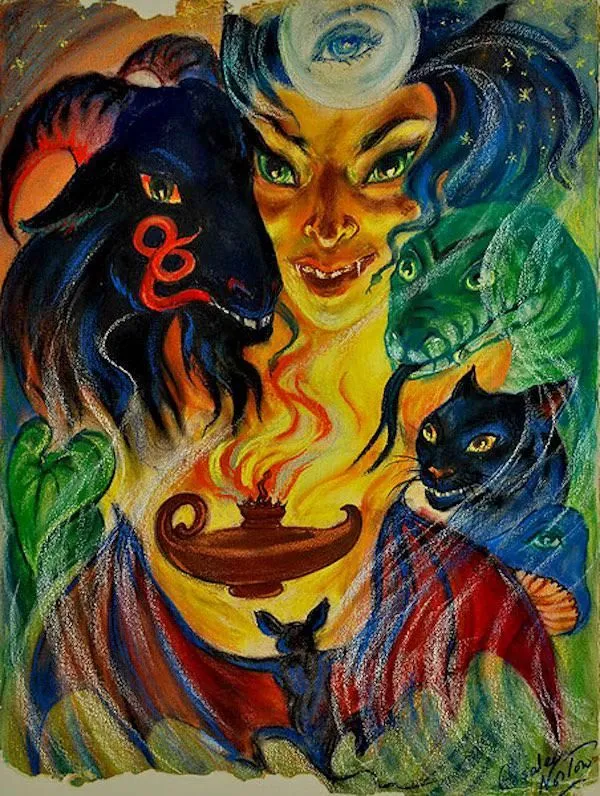
“Self Portrait with Accomplices of Evil,” Rosaleen Norton (1917–1979). An incredible documentary of her life, “The Witch of King’s Cross”, is highly recommended. [Fair Use]
In the Faery tradition, it is often said that magic arises out of paradox. Art thrives in paradox and contradiction. But science, by its very nature, must struggle with them, seeking out definite answers rather than embracing comfort in the unknown.
Two Witches can perform radically different workings focused on the same goal, using entirely different methods and both can succeed. Is the “true magic,” then, found in only a particular set of correspondences, of gods, of spirits, of cosmologies? The diversity of magic alone should tell us something of its nature; that it is not concerned with repeatability in sterile laboratory conditions, but in engagement. It functions less like a recipe and more like a conversation where context, mood, tone, and language all matter.
Approaching magic as art centers responsibility in the practitioner. In a purely scientific framework, failure is often externalized: the formula was wrong, the variables incorrect and uncontrolled. From the standpoint of art, failure is just more information, a stepping stone toward a deeper understanding of the medium, the technique, and even of ourselves.
When magic is practices as an art, it intersects with that which makes us human. Art asks us who we are, not in theory, but in a visceral, embodied way. It reveals to us the stories that we tell ourselves about ourselves, stories about power, agency, worth, and connection. It exposes to us where we create and where we just imitate. It can show us where we might be hiding behind tradition rather than engaging it.
This is why lineages that treat magic as art tend to value myth, poetry, dance, trance and personal gnosis. Not because they are nebulous or unserious, but because they are the native language of the unconscious. Magic does not negotiate primarily with the rational mind but rather with the imagination, where symbols are not abstractions, but living forces to be engaged and embodied. One cannot command the realm of the imaginal by issuing commands or instructions. One enters it by abandoning the ego’s death grip and surrendering into a type of dialogue, a conversation with the conscious universe.
In the end, approaching magic as art is an act of humility. It says that we are not technicians, lording over every life form and particle as if we were their superiors, but instead as equal participants, entering into relationships with a universe populated with different types of conscious awareness in a vast and often unruly web of meaning and connection. As artists, we are willing to be transformed by what we dare to create. And, to me, that is the very point of magic. We engage, we create, we transform, ourselves and the world around us. There is no “one right way,” to magic any more than there is a style of art that is superior to all others. Art meets the needs of the moment. It lifts us up and gives our lives meaning. It reminds us that all we really have is this moment right now and that a moment spent creating, or engaging that creation, is time well spent.
The Wild Hunt is not responsible for links to external content.
To join a conversation on this post:
Visit our The Wild Hunt subreddit! Point your favorite browser to https://www.reddit.com/r/The_Wild_Hunt_News/, then click “JOIN”. Make sure to click the bell, too, to be notified of new articles posted to our subreddit.