

WASHINGTON — Many spiritual traditions note that life has an electric field, and plants often seem to manifest it, at least in the way they respond to light, touch, and weather. In recent decades, a few studies (often reputable in method but sometimes stretched into “life force” claims) have fueled that intuition. New research published in Geophysical Research Letters from February 2026 is not quite about a vital energy, but it is shocking nonetheless: scientists have now directly observed a near-invisible electrical glow flickering on tree leaves during thunderstorms.
The phenomenon is called a corona discharge, a weak electrical discharge that forms when a strong electric field concentrates around sharp points. People sometimes encounter a related effect like the famous St. Elmo’s Fire, the eerie blue-violet light at the tips of ship masts, church spires, or other pointed structures during stormy weather. For almost a century, researchers have suspected something similar could happen on trees under thunderstorms, but until now it had never been directly documented in the wild.
That changed with the new observations. Researchers describe what they argue are the first direct measurements of coronae on trees during real storms, recorded not in the visible spectrum (where ambient storm light overwhelms the effect), but in ultraviolet.
“For the first time, researchers have observed and measured weak electrical discharges, known as coronae, on trees during thunderstorms,” the authors wrote in a press release. The measurements suggest the effect is not a rare curiosity happening on an occasional leaf tip, but something that may ripple across entire canopies as storms pass overhead.
The scientific backdrop is surprisingly rich. Lightning is the dramatic headline, splintering trunks and igniting fires. It usually gets all the attention but coronae are a subtler cousin. Unlike lightning, which heats air to extreme temperatures, coronae are “cold” discharges only slightly warmer than the surrounding air.
Yet they still matter. The paper notes that coronae can produce ultraviolet radiation and generate large amounts of hydroxyl radicals (-OH), a key atmospheric oxidizer that influences air chemistry. Past work also links electrical stress to subtle leaf damage, and there is a long-standing interest in whether coronae contribute charged particles to storm electrification.
The coronae are also hard to capture. They are faint, weaker than moonlight in visible emissions, and transient sparking in irregular bursts. The researchers solved this by developing a “solar-blind” ultraviolet observing system: a telescope coupled to a UV-sensitive camera tuned to wavelengths that don’t normally reach the ground from sunlight because Earth’s ozone blocks them. At ground level, that particular UV band is typically produced only by a short list of sources: electrical discharges, certain lamps, or fires. During the storm observations, fires and lamps weren’t present, leaving coronae as the best explanation for the measured UV signals.
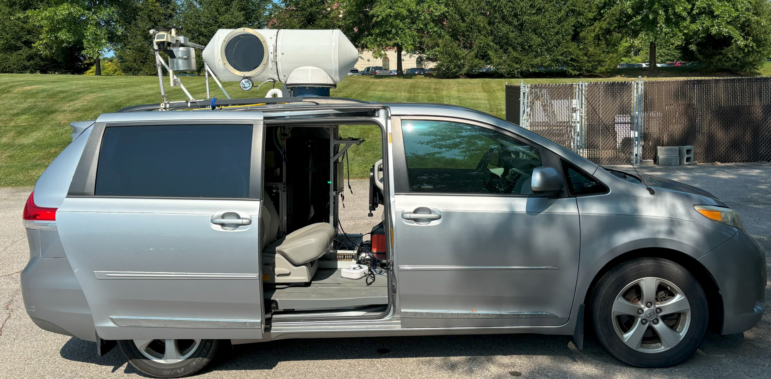
The modified Toyota Sienna the team used to observe coronae on trees under thunderstorms in the field. The roof-mounted periscope directs light to an ultraviolet-sensitive camera to detect coronae outdoors, where ambient light renders them invisible to human eyes. Via AGU – Credit: Patrick McFarland
The AGU press release tells the story with a storm-chasing twist:
Documenting coronae under real thunderstorms…would require a different approach,” they wrote, specifically, a 2013 Toyota Sienna kitted out with a weather station, electric field detector, laser rangefinder, and roof-mounted periscope directing light to an ultraviolet camera. Field science is sometimes glamorous; this was more like determined improvisation.
“The most fun part was taking a jigsaw and cutting a twelve-inch hole in the roof,” lead author Patrick McFarland said. “Totally killed the resale value, but that’s fine.”
The team trained the instrument on treetops during thunderstorms along the U.S. East Coast in summer 2024. In one detailed case, they watched a sweetgum tree in Pembroke, North Carolina for about 90 minutes and later analyzed the video. They detected dozens of corona “clusters,” each lasting fractions of a second up to a few seconds. The discharges behaved like skittish sparks. They appeared, faded, then reappeared elsewhere, often tracking with leaves and branches as the wind shifted the canopy. They then moved to a nearby loblolly pine and saw similar behavior, despite the different leaf structure.
The study goes further than simply saying “we saw it.” Using careful calibration, the researchers estimated how many UV photons the coronae emitted and translated those observations into approximate electrical currents on the order of microamps in the observed branches. In lab work with small trees under high-voltage plates, they also established a strong relationship between UV intensity and electrical current, suggesting that UV measurements could become a practical proxy for gauging electrical activity in trees during storms.
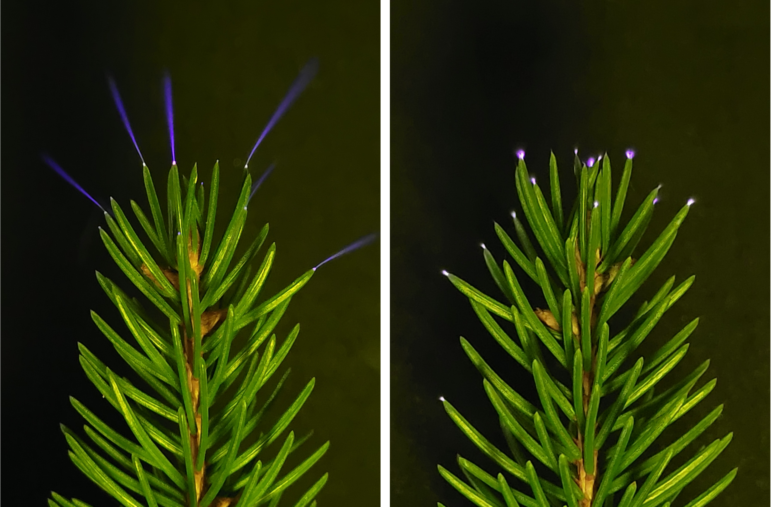
Coronae glow on the tips of spruce needles, induced by charged metal plates in a laboratory. These weak electric discharges subtly singe the tips of leaves and needles, and new observations indicate they may occur ubiquitously across treetops under thunderstorms. via AGU – Credit: William Brune
All of this adds up to a vivid implication: forests may shimmer with a hidden electrical light show whenever thunderstorms pass overhead,” thunderstorms may paint entire canopies with a scintillating blue glow, albeit too faintly for human eyes to see.” McFarland puts it even more playfully: “If you had superhuman vision, ‘I believe you’d see this swath of glow on the top of every tree under the thunderstorm…as if thousands of UV-flashing fireflies descended on the treetops.’”
The findings also raise ecological questions. Coronae form at sharp tips, the same delicate leaf edges that can burn or degrade under electrical stress. The authors note that leaf tips can show visible damage in seconds under certain conditions, and they speculate that repeated exposure across many storms might subtly shape canopy health, and perhaps even long-term evolutionary pressures on leaf form and protective coatings.
The study shows that storms do not merely pass over forests; they may briefly electrify them, making treetops glow in ultraviolet pulses that human eyes will never see. It may not be a mystical force, but it is magical nonetheless.
The Wild Hunt is not responsible for links to external content.
To join a conversation on this post:
Visit our The Wild Hunt subreddit! Point your favorite browser to https://www.reddit.com/r/The_Wild_Hunt_News/, then click “JOIN”. Make sure to click the bell, too, to be notified of new articles posted to our subreddit.