
TWH – Today marks International Women’s Day, a holiday commemorating the long struggle for women’s equality and liberation. UN Women, the United Nations secretariat for the UN Commission on the Status of Women, has declared the theme for this year’s IWD to be “Rights. Justice. Action. For ALL Women and Girls.”
“International Women’s Day 2026 comes at a defining moment,” UN Women declares. “Women and girls have never been closer to equality, and never closer to losing it. Legal protection against domestic violence has expanded in many countries. Yet, the rights of women and girls are being rolled back in plain sight, and across the world, women still do not enjoy the same legal rights as men.”
International Women’s Day begins the 70th session of the Commission on the Status of Women, which will continue through March 19th. The Commission is the UN’s largest forum for the discussion of gender rights and equality.
Ahead of the forum, the United Nations Secretary-General has issued a new report, “Ensuring and Strengthening Access to Justice for All Women and Girls”, which examines the legal rights of women around the world. The report claims that women hold just 64% of the legal rights afforded to men globally, leading to increased exploitation and violence.
UN Women summarizes the global legal situation for women and girls:
As backlash against longstanding commitments on gender equality intensifies, violations of the rights of women and girls are accelerating, fueled by a global culture of impunity, spanning from courts to online spaces to conflict. Laws are being rewritten to restrict the freedoms of women and girls, silence their voices, and enable abuse without consequence. As technology outpaces regulation, women and girls face growing digital violence in a climate of impunity where perpetrators are rarely held accountable. In conflicts, rape continues to be used as a weapon of war, with reported cases of sexual violence rising by 87 per cent in just two years.
The UN Secretary General’s report also shows that progress is possible: 87 per cent of countries have enacted domestic violence legislation, and more than 40 countries have strengthened constitutional protections for women and girls over the past decade. But laws alone are not enough. Discriminatory social norms – stigma, victim-blaming, fear, and community pressure – continue to silence survivors and obstruct justice, allowing even the most extreme forms of violence, including femicide, to go unpunished. Women’s access to justice is also prevented by everyday realities such as cost, time, language, and a deep lack of trust in the very institutions meant to protect them.
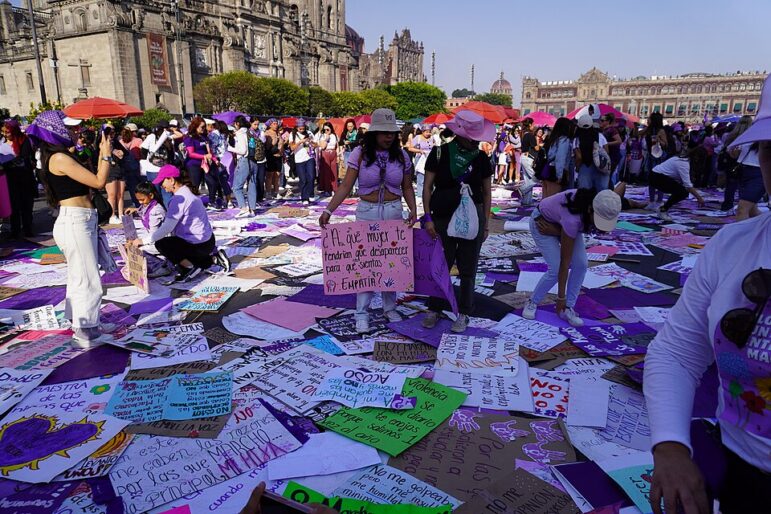
Marchers at a Women’s Day demonstration in Mexico City, 2025 [TSolange, Wikimedia Commons, CC 4.0]
International Women’s Day has a long history, originating in the United States in the early 20th century and then becoming widely celebrated internationally. As TWH’s Star Bustamonte wrote in 2024:
March in the U.S. is designated as Women’s History Month. What began as a week-long celebration of women’s history in Santa Rosa, California in 1978, timed to coincide with International Women’s Day, first became nationally recognized by President Jimmy Carter in 1980. And then in 1987, Congress designated the entire month of March as a way to celebrate the achievements and contributions of women throughout history.
International Women’s Day (IWD) has a much longer history. While the United Nations officially recognized IWD in 1977, the very first observance was on February 28, 1909 in the U.S. That first event was organized by the Socialist Party of America in support of garment industry workers who were on strike in protest of the often deplorable and extremely unsafe working conditions. The Triangle Shirtwaist Company Fire two years later in which 146 workers died, would shine a national and international spotlight on exactly how unsafe the working conditions truly were.
Throughout the early 20th century IWD was often a rallying point for a variety of issues that overly impacted the lives of women—discrimination, working rights, the women’s suffrage movement, and even WWI.

2011 International Women’s Day Altar – courtesy – Selena Fox
Women’s rights, equality, and empowerment have been a central tenet of the modern Pagan movement, especially modern religious Witchcraft. For many practitioners, Witchcraft and Paganism afford women a way to reclaim their personal power from the patriarchal structures that would otherwise seek to subordinate women to men. Although these values have not always been universally or perfectly upheld – and have sometimes led to backlash in the form of reactionary forms of Paganism that seek to uphold “traditional gender roles” – for most Pagans, a commitment to building a world where women and girls can fully thrive is a central part of their ethics.
There is still much work to be done, particularly in a moment when efforts to roll back women’s rights have intensified in many parts of the world, including the USA and the “West”. Campaigns targeting women’s voting access, economic independence, and reproductive health often signal broader attempts to reinforce rigid social hierarchies. Measures framed as protecting women are also increasingly used to justify restrictions affecting other marginalized communities as well, particularly LGBTQIA+ people and transgender people in particular. Yet within a religious movement shaped by goddesses and Witches, priestesses and prophetesses, many Pagans see both the responsibility and the capacity to help build a world in which women and girls can fully thrive.
The Wild Hunt is not responsible for links to external content.
To join a conversation on this post:
Visit our The Wild Hunt subreddit! Point your favorite browser to https://www.reddit.com/r/The_Wild_Hunt_News/, then click “JOIN”. Make sure to click the bell, too, to be notified of new articles posted to our subreddit.