

Uncovering the Past
ISTANBUL – Medusa appears to be making the rounds these days. Long before Gianni Versace adopted her face as the emblem of his fashion empire, or Caravaggio fixed her severed head in a moment of visceral horror and pity, Medusa was already an ancient and complicated figure, one whose meaning has shifted repeatedly across centuries. In recent months, archaeological sites seem to be her next haunt. All the while, making clear that she has never truly loosened her grip on our imagination.
Medusa really needs little introduction. She is one of the three Gorgons, daughters of the primordial sea deities Phorcys and Ceto. Unlike her immortal sisters, Stheno and Euryale, Medusa was mortal. She is best known for her lethal gaze, which could turn any living being to stone. Over time, her story evolved from that of a monstrous guardian at the edge of the world into a cautionary tale shaped by power, punishment, and transformation. By the Roman period, Medusa’s image, especially her head, known as the gorgoneion, was widely used as a protective symbol, meant to repel harm and misfortune.
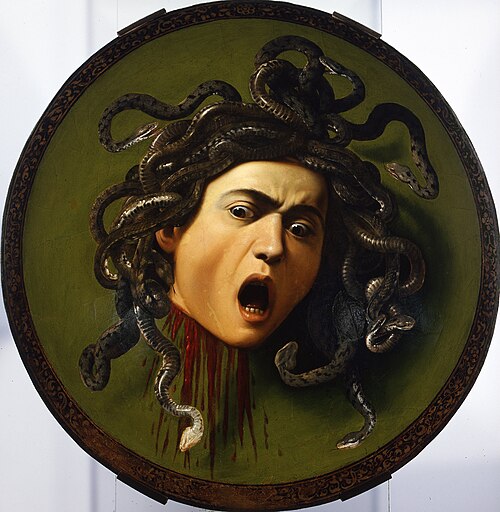
Medusa (Testa di Medusa) by Caravaggio. (1597, oil on canvas ) in Uffizi, Florence – public domain
That apotropaic function has come sharply into focus again through recent archaeological discoveries. In Türkiye last month, excavations in the ancient city of Amastris, now modern Amasra on the Black Sea coast, have revealed an unexpected depiction of Medusa that challenges familiar assumptions.
Archaeologists working in the ancient city of Amastris in the district of Amasra in Bartin have brought to light a rare smiling depiction of Medusa on the ceiling blocks of a monumental Roman stoa, a columned gallery.https://t.co/OzRSjDOKKf
— TurkishArchaeoNews (@turarchaeonews) December 9, 2025
Rescue excavations at the ancient city of Amastris, underway for more than three years across two primary areas, the enomous columnedstructure (stoa) and the Roman bath complex known as the Bedesten, have uncovered a remarkable range of finds, including statues of Alexander the Great, nymphs and household deities, talismanic amulets, more than 1,000 coins from multiple periods, seven marble columns each measuring approximately six meters in length, and numerous fragments of inscribed stone.
Archaeologists working in the area reported an amazing find. They uncovered a Medusa carving on the ceiling coffers of a monumental stoa. This columned public gallery once formed part of the city’s civic heart. Rather than the grimacing, snake-haired terror so common in ancient art, this Medusa smiles.
The carving was found during a long-running excavation overseen by Bartın University’s Archaeology Application and Research Center and supported by Türkiye’s Ministry of Culture and Tourism. The stoa itself is an imposing structure, with marble columns rising almost 30 feet (9 meters); it is described by researchers as the most monumental marble building in the Black Sea region. The smiling Medusa appears on the ceiling panels above those columns, positioned to look down on the public space below.
Professor Fatma Bağdatlı Çam, who leads the excavation, has emphasized how unusual this image is. Instead of projecting fear, the Medusa resembles Eros, rendered with the soft features of a small child and an almost playful expression.
The research team interprets this gentler portrayal as a reflection of Amastris’s prosperity and stability during the Roman period. In a space dedicated to trade, social interaction, and civic life, Medusa still served a protective role, but one adapted to a peaceful and flourishing city rather than a defensive frontier.
In the past months and several hundred miles to the northwest, another Medusa has emerged from the ground in a very different context.
In Austria, a tiny gemstone carving known as the Hallstatt Medusa has quickly become one of the most important Roman-era finds ever recorded in Upper Austria. Discovered in June 2025 during construction work for a new funicular railway, the cameo was unearthed near Lake Hallstatt in what was once a Roman lakeside settlement.
Only about 1.5 centimeters high, the cameo depicts Medusa’s head carved in relief from black-and-white banded agate, also known as onyx. Snakes frame her face, and small wings emerge from her hair. Despite its size, the craftsmanship is exceptionally refined. Archaeologists date the piece to the second century CE, around 1,800 years ago, and stylistic analysis points to Aquileia—a major Adriatic port—as its likely place of manufacture. From there, the cameo would have traveled along Roman trade networks into the Alpine province of Noricum.
The Hallstatt Medusa was almost certainly worn as jewelry, possibly as a necklace rather than a ring, given its thickness. Like the smiling Medusa of Amastris, it functioned as a gorgoneion: a portable symbol of protection. At the same time, it signaled wealth, status, and connection to the wider Roman world. Found amid the remains of houses and everyday activity, the cameo offers a rare, intimate glimpse into personal belief and adornment in a community shaped by salt production and imperial trade.
Medusa continues to resonate today as a protector who affirms personal power. In some traditions, she has been reclaimed as a figure who transforms trauma into strength, whose power lies in both destruction and survival, warding off harm while confronting it directly. She may be reminding us that we have that power still.
The Wild Hunt is not responsible for links to external content.
To join a conversation on this post:
Visit our The Wild Hunt subreddit! Point your favorite browser to https://www.reddit.com/r/The_Wild_Hunt_News/, then click “JOIN”. Make sure to click the bell, too, to be notified of new articles posted to our subreddit.