

NEW YORK – Let me be upfront – this is news, but also a please-indulge-me article. I have been fascinated by the Voynich Manuscript for decades and have been mildly following developments on its decryption. Looking at the Manuscript Witch’s eyes, it hints at something deeply esoteric, equally familiar, possibly important, and very unreadable. Now, there might be a connection to the Tarot.
The Voynich Manuscript is widely regarded as one of the most enigmatic documents in the history of books. Named after rare-book dealer Wilfrid Voynich, who acquired it in 1912, the manuscript is a richly illustrated codex written in an unknown script that has resisted decipherment for over a century. After Voynich’s death, it passed to his wife, Ethel Voynich, and later to Anne Nill. It was eventually acquired by rare-book dealer Hans P. Kraus, who unsuccessfully attempted to sell it before donating it to Yale University in 1969. Today, it is housed at the Beinecke Rare Book & Manuscript Library and has been fully digitized for public study.

A page from the Voynich Manuscript, Beinecke Rare Book & Manuscript Library, Yale University [Public Domain
Scientific investigations using carbon dating place the parchment between 1404 and 1438, situating its creation firmly in the early 15th century, likely in Europe. The manuscript consists of roughly 240 pages (though there are some missing), filled with looping, consistent characters arranged in word-like clusters, suggesting a structured writing system rather than random symbols or markings.
The illustrations divide the manuscript into several thematic sections. One appears botanical, depicting unfamiliar plants with roots, leaves, and flowers that do not clearly correspond to known species. Another section shows astronomical or astrological diagrams, including circular charts and zodiac figures. A third image features nude female figures bathing in interconnected pools and tubes, often interpreted as symbolic representations of medicine, alchemy, or cosmology. There are also pharmaceutical-style drawings of jars and a section thought to contain recipes or instructions.
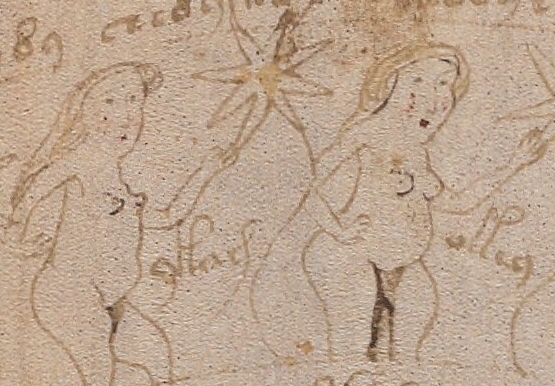
Retouching of drawing in Voynich Manuscript [Public Domain
Despite sustained and intense study by linguists, cryptographers, historians, and computer scientists, the manuscript has defied deciphering. There is still no agreed-upon translation of the Voynich Manuscript.
In late November, a new study in the journal Cryptologia, by independent researcher and science journalist Michael Greshko, appears to bring the deciphering of the Voynich slightly closer. Greshko looked at whether a historically plausible encryption method could produce text exhibiting the same unusual statistical patterns found in the Voynich Manuscript. Greshko does not claim a solution to the Voynich Manuscript (VMS), but instead rigorously demonstrates that a historically plausible substitution cipher can reproduce many of the manuscript’s statistical properties simultaneously, a bar that few prior models meet.
In other words, what Greshko finds is that at complex Voynich-like lettering behavior can arise from historically realistic mechanisms. The process would be taking ordinary Latin or Italian text and transforming it into sequences of glyphs that closely resemble Voynichese. This is achieved by dividing continuous text into short letter groupings and then substituting them using structured tables, with controlled randomness introduced through tools such as dice and playing cards, that is to say, from objects readily available in 15th-century Europe.
“Playing cards are also historically plausible, having been introduced to Europe in the late fourteenth century via trade with the Mamluk Sultanate, “ Gresho writes. “I have designed two variants of the Naibbe cipher. One uses the 78-card tarocchi (tarot) deck, which was created in 15th-century Italy to play trick-taking card games.”
Greshko is repeatedly clear that his proposal is not a solution to the Voynich cipher. “I do not assert that the Naibbe cipher precisely reflects how the [Manuscript] was created,” he adds, “nor do I assert that the [Manuscript] even is a ciphertext.”

The Extensible Voynich Alphabet used throughout Greshko’s paper to transliterate Voynichese using the Latin alphabet . Credit: Michael A. Greshko, Cryptologia (2025)
The Naibbe Cipher offers a plausible way to reconcile competing interpretations of the Voynich Manuscript by showing how it could simultaneously exhibit properties of ciphertext, language, and apparent gibberish. In this model, the Manuscript would be a ciphertext that encodes relatively little plaintext, on average, only one to two letters per written token, while preserving the original letter order in very short n-grams. Its distinctive “word grammar” would function not as a language in itself, but as a system for generating many reusable word forms and affixes that encrypt single letters and short letter groups.
If the Voynich Manuscript is indeed a ciphertext, Greshko suggests it would likely lack any one-to-one correspondence between letters and glyphs. Instead, plaintext would be heavily respaced into short sequences, with each letter mapped to multiple possible glyph strings depending on its position within a group. Selection among these options would follow a structured, non-cyclic procedure. In other words, whatever the manuscript is about, it is not random and likely still concealing its meaning.
The Voynich Manuscript is possibly closer to being deciphered, but still teaching us about resistance.
The Wild Hunt is not responsible for links to external content.
To join a conversation on this post:
Visit our The Wild Hunt subreddit! Point your favorite browser to https://www.reddit.com/r/The_Wild_Hunt_News/, then click “JOIN”. Make sure to click the bell, too, to be notified of new articles posted to our subreddit.